

Saudi aviation sector records 11% growth in flight numbers in Q2

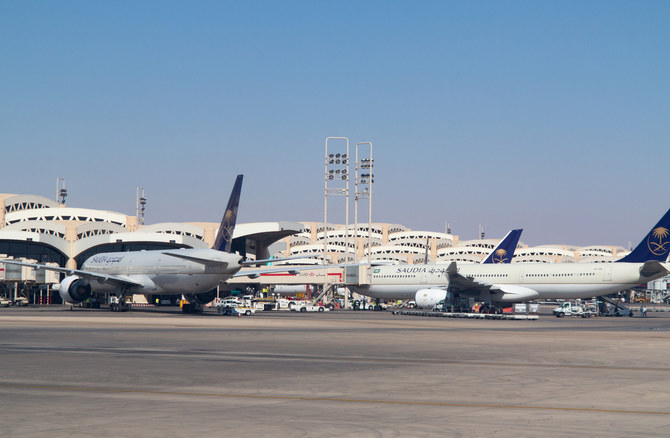
According to a report by Cluster 2, flights in the second quarter of the year increased from 30,898 to 34,326 on an annual basis with passengers rising from 3.16 million to 3.7 million, a 17 percent year-on-year growth. (Shutterstock)
Short Url
Updated 12 July 2023
Follow

Saudi aviation sector records 11% growth in flight numbers in Q2

RIYADH: With the introduction of several new routes, Saudi Arabia’s aviation sector witnessed an 11 percent growth in the number of flights in the second quarter of 2023 compared to the same period last year, according to a report by Cluster 2, a Riyadh-based firm that manages and operates 22 airports around the Kingdom.  

The report indicated that flights in the second quarter of the year increased from 30,898 to 34,326 on an annual basis with passengers rising from 3.16 million to 3.7 million, a 17 percent year-on-year growth.  

The report stated that the average daily flights for the second quarter were 377, with an average daily passenger count of 40,759.  

This is also marks an increase from the figures of 2022 which recorded 340 daily flights with 34,789 passengers, a 7 and 13 percent growth, respectively.  

New routes have been established in the second quarter of the year, with operations being started on Jazan-Cairo, Al Jowf-Tbilisi, Jazan-Dubai and Al Qassim-Istanbul routes as well as Al Qassim-Trabzon and Al Qassim-Tbilisi sectors.   

According to the latest report released by the General Authority of Civil Aviation in May, the number of passengers jumped to 35.8 million in the first four months of 2023, up from 25.3 million during the same period last year.  

The Kingdom’s airports also witnessed a marked increase in air traffic during 2023 compared to pre-pandemic levels, growing at a rate of 6.2 percent compared to the same period in 2019.  

On the domestic front, the number of passengers increased by 6.7 percent in the first four months of 2023, reaching 16.3 million, up from 15.3 million during the same period last year, the GACA report stated.  

The number of passengers on international flights showed a remarkable jump, surging by 95.5 percent to 19.5 million, up from 10 million passengers in the same period last year.  

Established in 2013, Cluster 2 is a subsidiary of Matarat Holding which manages 27 airports around the Kingdom.  

Matarat aims to develop the Kingdom’s aviation sector and improve the performance of its airports through its subsidiaries.  

Riyadh Airports Co., Jeddah Airports Co. and Dammam Airports Co. are also under Matarat’s umbrella. 


Boeing has 400 defense partners in Saudi Arabia 

Updated 5 sec ago
Follow

Boeing has 400 defense partners in Saudi Arabia 

RIYADH: Boeing Saudi Arabia President Asaad Al-Jomai said the company has more than 400 defense partners in Saudi Arabia and works closely with local manufacturers such as Saudi Arabian Military Industries, or SAMI, which is leading the Kingdom’s defense localization mission. 

He added: “The partnership is also active through academic and technical cooperation as Boeing is a founding partner of Al-Faisal University and has partnerships with King Abdullah University of Science and Technology, or KAUST, and King Abdulaziz City for Science and Technology.” 

Localization of industry is a key objective for companies operating in Saudi Arabia, Al-Jomai said, adding that partnerships with firms such as SAMI support the Kingdom’s goal of localizing more than 50 percent of military spending by 2030. Boeing considers itself a central partner in localization and technology transfer. 

According to Al-Jomai, Boeing’s relationship with Saudi Arabia spans more than 81 years. The company currently employs more than 90 people at its Saudi headquarters and has delivered more than 170 commercial aircraft in recent years. 

Defense contracts dominate operations 

Boeing’s existing contracts include maintenance and technical support for advanced defense systems, most notably F-15 fighter jets, with Saudi Arabia the largest operator of the aircraft outside the US. 

He added that these contracts also cover Apache attack helicopters and AH-6i aircraft, known as the “Little Bird.” 

Al-Jomai said that although support agreements cover both commercial and defense sectors, defense operations currently dominate in Saudi Arabia due to the expansion in military spending. He added that long global delivery cycles for commercial aircraft have shifted technical support efforts toward servicing defense fleets already operating in the Kingdom. 

According to Boeing’s website, Boeing Defense, Space & Security’s relationship with the Royal Saudi Air Force began in 1978 when Saudi Arabia selected its first fleet of F-15C/D aircraft, forming the backbone of the Kingdom’s air defense. 

The fleet expanded significantly in December 2011 when Saudi Arabia and the US signed a military sales agreement — the largest in US history at the time — covering F-15SA fighter jets, AH-64E Apache attack helicopters and AH-6 light armed reconnaissance helicopters.