

Factories increase in Saudi Arabia thanks to investment boom

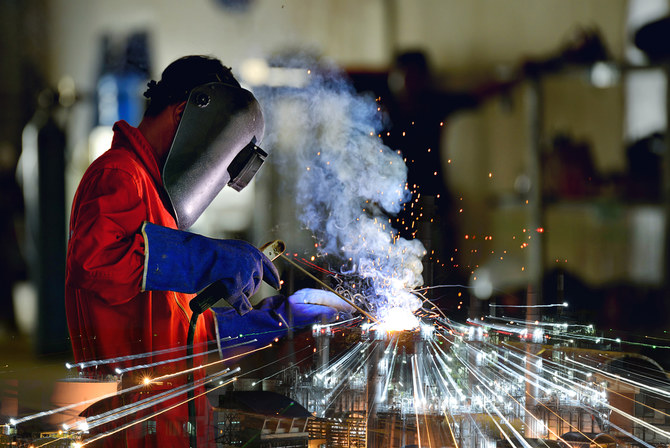
Figures released by the Ministry of Industry and Mineral Resources show the total number of industrial facilities hit 10,819 by the end of March — up from 10,518 factories at the end of 2022 — with the estimated capital of these factories amounting to over SR1.43 trillion. (Shutterstock)
Short Url
Updated 12 July 2023
Follow

Factories increase in Saudi Arabia thanks to investment boom

RIYADH: Investment in chemical product manufacturing helped drive up the number of factories in Saudi Arabia by 2.86 percent in the first quarter of 2023, according to the government. 

Figures released by the Ministry of Industry and Mineral Resources show the total number of industrial facilities hit 10,819 by the end of March — up from 10,518 factories at the end of 2022 — with the estimated capital of these factories amounting to over SR1.43 trillion ($381 billion).  

The bulletin revealed that chemical product manufacturing plants attracted the most investment, followed by producers of other non-metallic mineral products and basic metal factories. 

As part of its goal to diversify its economy away from oil under the Vision 2030 initiative, Saudi Arabia has made more than 700 regulatory changes in a bid to attract foreign investments to its industrial sector.

The bulletin showed that national factories lead by type of investment, pulling 83.5 percent of all funds, followed by foreign-owned factories with 8.5 percent, then factories with joint ownership by 8 percent.  

The Riyadh region recorded the largest percentage of the total number of factories with about 4,194, followed by the Eastern province with 2,476, then the Makkah region with 2,068.  

The bulletin also indicates that small factories represent the largest percentage of the total, reaching 5,654, followed by medium-sized facilities, which made 4,341, and then large plants, which recorded 824 of the total.  

There are some 725,563 workers in these factories, with Riyadh topping the regions with nearly 268,000 employees, followed by the Eastern province where 183,193 laborers are working. 
The Al-Baha region registered the least number of workers, with 1,605.  

The Eastern region led the size of investment in the factories with SR603 million, and with a change rate of 0.3 percent compared to the fourth quarter of 2022. 

Earlier this week, the Ministry of Industry and Mineral Resources announced it has begun evaluating the second tranche of facilities as part of its “Future Factories Program” to modernize the sector.

The initiative seeks to establish a strong technological ecosystem and transform the manufacturing sector in alignment with modern practices and principles.

The program will evaluate 260 licensed factories operating at different levels of technical development. 

Each factory will hold an authorized capital of over SR200 million.


Arab Energy Fund approved for Panda bonds, first MENA multilateral issuer in China

Updated 5 sec ago
Follow

Arab Energy Fund approved for Panda bonds, first MENA multilateral issuer in China

RIYADH: The Arab Energy Fund has received regulatory approval to issue Panda bonds in China, marking a significant step in linking Middle Eastern and Chinese capital markets.

This decision makes the Riyadh-based institution the first multilateral financial institution from the Middle East and North Africa region to secure such approval, granting it direct access to China’s domestic bond market.

According to a press release, the approval was granted by the Asian country’s National Association of Financial Market Institutional Investors, the regulator overseeing the interbank bond market.

This milestone reflects rapidly deepening ties between the Gulf Cooperation Council, especially Saudi Arabia, and China.

Recent high-level engagements have prioritized strategic investment and technology transfer in Vision 2030 sectors, resulting in dozens of agreements, and in December Foreign Minister Wang Yi described the China-GCC partnership as vital for safeguarding common interests and strengthening Global South resilience.

Under the program, TAEF is authorized to issue up to 10 billion Chinese yuan ($1.4 billion) in Renminbi-denominated bonds. The fund can issue these Panda bonds in multiple tranches over a two-year period, providing flexible, long-term capital for its strategic investments.

Vicky Bhatia, chief financial officer of the Arab Energy Fund, said: “This milestone allows us to further diversify our funding sources by tapping into a deep pool of Chinese investors, while laying a strong foundation for closer collaboration between a highly rated multilateral financial institution from the MENA region and China’s capital markets.”

This access represents a major diversification of TAEF’s funding strategy. Panda bonds provide a stable and direct source of Renminbi financing, strengthening the Fund’s capital planning capabilities as it supports projects across the energy spectrum. 

With a 50-year history, strong governance, and a high international credit rating, TAEF invests in conventional energy, energy infrastructure, and broader energy transition solutions.

By entering the onshore Panda bond market, the Arab Energy Fund reinforces its position as a trusted multilateral partner and an active, innovative participant in global capital markets. 

The move signals China’s growing role as a pivotal source of capital for international energy projects and highlights the increasing financial interconnectivity between the MENA region and Asia.