

IMF’s $3 billion bailout program reignites funding hopes for Pakistani startups following 90 percent decline

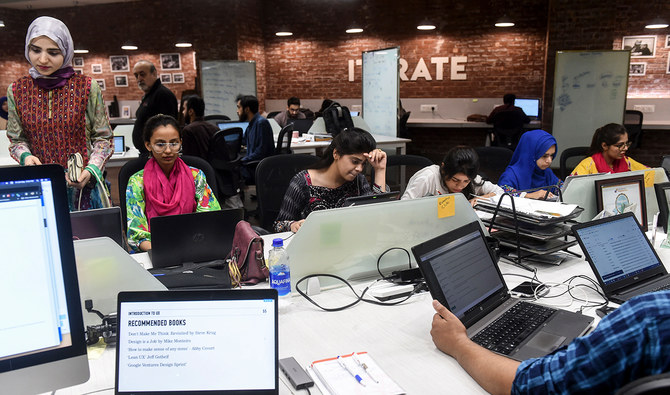
In this photograph taken on May 24, 2019, Pakistani youngsters work at their desks at the National Incubation Centre (NIC), in Lahore, Pakistan. (AFP/File)
Short Url
Updated 12 July 2023
Follow

IMF’s $3 billion bailout program reignites funding hopes for Pakistani startups following 90 percent decline

  • Pakistani startups received about $28 million in the first half of the year as compared to $277 million in 2022
  • Startup monitors say the funding decline was in keeping with global slowdown and macroeconomic crisis at home

KARACHI: After suffering almost 90 percent funding drop in the first half of the current year, Pakistani startups are hoping for the revival of funding rush after the country got positive signals from the International Monetary Fund (IMF) in recent weeks, said startup monitors and advisers on Tuesday.

Pakistani startups raised about $375 million of global funding in 2021 which exceeded the overall financing received by them in the previous six years.

However, they only received around $28 million in the first half of 2023, including $5 million received in the second quarter, depicting a 90 percent decline in their funding, as compared to $277 million raised in the first half of 2022, according to Alpha Beta Core (ABC), a startup funding advisory firm, and Data Darbar, a startup and market tracking firm.

“This funding decline was aligned with the global slowdown coupled with macroeconomic crisis at home,” Khurram Schehzad, ABC’s chief executive officer, told Arab News. “The rupee-dollar parity issue, slow industrial activities, and high inflations created a context where investors chose to remain on the sidelines instead of putting their money in risky startup businesses.”

The number of funding breakthroughs has largely remained stagnant during the second quarter of the 2023. Major deals in this quarter include Fintech startups such as GoldFin securing $2 million and Neem raising $1 million.

In addition, smaller pre-seed and accelerator level deals were struck by Apollo Group, Qist Bazaar, OkayKer, and Pattern App, according to ABC.

Pakistan, which has been grappling with deteriorating economic conditions, finally reached a staff-level agreement (SLA) with the IMF last month over a $3 billion bailout program which rekindled startup funding hopes.

“The recent news of the IMF bailout is a welcome respite though, at least in the short term, in stemming some of the uncertainty,” Kalsoom Lakhani, co-founder and general partner at i2i Ventures, a funding company, said in a statement.

“I also think more startups will raise toward the end of this year (provided our relative respite holds and elections go as planned as well),” she continued, adding: “We definitely won’t reach our 2022 numbers, but here’s hoping 2H2023 finishes out better than the first half of this year.”

Schehzad agreed with Lakhani, saying the recovery would be gradual since “the IMF deal would improve investors’ confidence and help improve liquidity situation in the market.”

However, he noted the investors would adopt “pick and choose” strategy, instead of funding across the board.

“Now the investors are betting on smart startups or entrepreneurs – they will now pick and choose only smart startups which have shown resilience.”

Pakistani startup experts said the startup operating in ecommerce, fintech healthtech, agritech and education have substantial potential to attract funding from investors in the future.

However, Pakistani startups will have to go the extra mile, as a global slowdown combined with a tough national macroeconomic situation is definitely an uphill climb, according to i2i Insight, the research arm of i2i Venture.

Pakistani startups have raised approximately $953 million through 329 deals since 2015, according to i2i Insight.


Pakistan, global crypto exchange discuss modernizing digital payments, creating job prospects 

Updated 05 December 2025
Follow

Pakistan, global crypto exchange discuss modernizing digital payments, creating job prospects 

  • Pakistani officials, Binance team discuss coordination between Islamabad, local banks and global exchanges
  • Pakistan has attempted to tap into growing crypto market to curb illicit transactions, improve oversight

ISLAMABAD: Pakistan’s finance officials and the team of a global cryptocurrency exchange on Friday held discussions aimed at modernizing the country’s digital payments system and building local talent pipelines to meet rising demand for blockchain and Web3 skills, the finance ministry said.

The development took place during a high-level meeting between Finance Minister Muhammad Aurangzeb, Pakistan Virtual Assets Regulatory Authority (PVARA) Chairman Bilal bin Saqib, domestic bank presidents and a Binance team led by Global CEO Richard Teng. The meeting was held to advance work on Pakistan’s National Digital Asset Framework, a regulatory setup to govern Pakistan’s digital assets.

Pakistan has been moving to regulate its fast-growing crypto and digital assets market by bringing virtual asset service providers (VASPs) under a formal licensing regime. Officials say the push is aimed at curbing illicit transactions, improving oversight, and encouraging innovation in blockchain-based financial services.

“Participants reviewed opportunities to modernize Pakistan’s digital payments landscape, noting that blockchain-based systems could significantly reduce costs from the country’s $38 billion annual remittance flows,” the finance ministry said in a statement. 

“Discussions also emphasized building local talent pipelines to meet rising global demand for blockchain and Web3 skills, creating high-value employment prospects for Pakistani youth.”

Blockchain is a type of digital database that is shared, transparent and tamper-resistant. Instead of being stored on one computer, the data is kept on a distributed network of computers, making it very hard to alter or hack.

Web3 refers to the next generation of the Internet built using blockchain, focusing on giving users more control over their data, identity and digital assets rather than big tech companies controlling it.

Participants of the meeting also discussed sovereign debt tokenization, which is the process of converting a country’s debt such as government bonds, into digital tokens on a blockchain, the ministry said. 

Aurangzeb called for close coordination between the government, domestic banks and global exchanges to modernize Pakistan’s payment landscape.

Participants of the meeting also discussed considering a “time-bound amnesty” to encourage users to move assets onto regulated platforms, stressing the need for stronger verifications and a risk-mitigation system.

Pakistan has attempted in recent months to tap into the country’s growing crypto market, crack down on money laundering and terror financing, and promote responsible innovation — a move analysts say could bring an estimated $25 billion in virtual assets into the tax net.

In September, Islamabad invited international crypto exchanges and other VASPs to apply for licenses to operate in the country, a step aimed at formalizing and regulating its fast-growing digital market.