Rights group urges probe into Darfur atrocities by Sudanese paramilitary forces battling the army

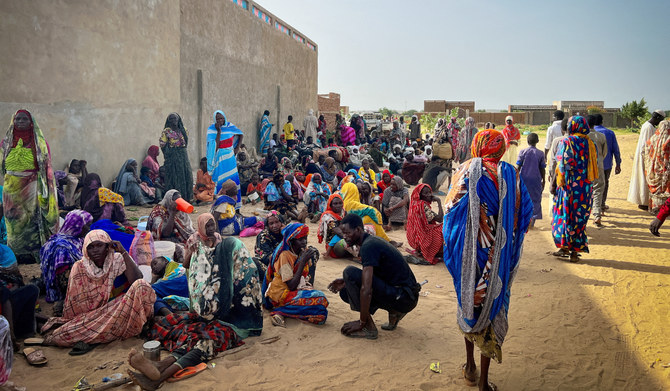
Sudanese refugees gather as Doctors Without Borders (MSF) teams assist the war-wounded from West Darfur, Sudan, in Adre hospital, Chad June 16, 2023. (REUTERS)
Short Url
Updated 12 July 2023
Follow

Rights group urges probe into Darfur atrocities by Sudanese paramilitary forces battling the army

  • The Darfur conflict began when African tribes that had long complained of discrimination rebelled against the Khartoum government, which responded with a military campaign that the ICC later said amounted to genocide

CAIRO: A prominent rights group on Tuesday called for the International Criminal Court to investigate atrocities in Sudan’s volatile Darfur region, including what it says were “summary executions” of 28 non-Arab tribesmen by a Sudanese paramilitary force and allied Arab militias in May.
Human Rights Watch said several thousand members of the paramilitary Rapid Support Forces and their allies rampaged through the Darfur town of Misterei, home to the non-Arab Massalit tribe, on May 28.
The assailants killed the tribesmen and also left dozens of civilians dead or wounded, the New York-based watchdog said. The attack came as the paramilitary and Sudan’s army have been engaged in monthslong fighting that the United Nations says has brought Sudan to the brink of a full-scale civil war.
“The mass killings of civilians and total destruction of the town of Misterei demonstrates the need for a stronger international response to the widening conflict,” said Jean Baptiste Gallopin, senior crisis and conflict researcher at Human Rights Watch.
Human Rights Watch said the paramilitary force would not immediately comment on the group’s findings. HRW urged the ICC to investigate the attack on Misterei and others elsewhere in Darfur as part of its investigation into the region’s genocidal war in the early 2000s.
The Darfur conflict began when African tribes that had long complained of discrimination rebelled against the Khartoum government, which responded with a military campaign that the ICC later said amounted to genocide. State-backed Arab militias known as the Janjaweed were accused of widespread killings, rapes and other atrocities. The Janjaweed later evolved into the paramilitary Rapid Support Forces.
The fighting between the paramilitary and Sudan’s army erupted in mid-April, at first centered in the capital, Khartoum. Later, the clashes spread across Sudan, including in Darfur, which saw some of the fiercest battles.
According to Human Rights Watch, the paramilitary and allied Arab militias on motorcycles, pick-up trucks and horses surrounded Misterei and clashed with Massalit fighters. The assailants, armed with assault rifles, rocket-propelled grenades and vehicle-mounted machine guns, killed men in their homes, on the streets or in hiding.
HRW said they also looted property, stole livestock and valuables before burning the town to the ground. Thousands of residents, including women and children, fled as assailants fired on them, killing many more, the group said.
It quoted an unidentified 76-year-old man as saying the attackers fired on the fleeing people. “I saw three people running, being shot at, and falling to the ground near a grocery store,” he said.
The group said the attackers also went after those who were hiding in schools and a local mosque.
The rights groups said it documented the killing of at least 40 civilians. Local officials said 97 people were killed in the May 28 attack. At least 59 were buried in mass graves, HRW said.
Along with Misterei, six other West Darfur towns and villages were also burned down over a period of several weeks, according to satellite imagery and fire detection data analyzes. Geneina, the local capital in West Darfur, also suffered widespread and apparently deliberate fire damage, HRW said.
Also Tuesday, the UN food agency said residents were still fleeing the violence in Darfur and crossing into Chad, including more than 20,000 refugees who crossed into the Chadian border town of Adre in the last week alone.
That brought the number of people who fled the fighting to Chad to more than 230,000 refugees and 38,000 returnees since since mid-April, the World Food Program said in a statement. In total, the conflict displaced about 3 million people, including over 700,000 who crossed into Sudan’s neighboring countries, according to the UN figures.
The agency said many of the arrivals to Chad were seriously wounded amid reports that fleeing civilians are being deliberately targeted “with an increasing ethnic dimension to the violence.”
“People are running across the border, wounded, scared, with only their children in their hands and the clothes on their backs. They need safety, security, and humanitarian assistance,” said Pierre Honnorat, WFP’s country director in Chad.
Many of the arrivals have lost family members, and “we don’t even dare ask them, ‘Where are the men?’ The answer from the mothers is often that they were killed,” Honnorat said later during an online briefing.
Speaking from the Zabout refugee camp in the Chadian border town of Goz Beida, Honnorat said financial support is urgently required to meet the growing needs of the refugees including dangerously malnourished children. At least one in 10 displaced youngsters from Sudan is malnourished, according to the WFP.
“Every week children are dying at the nutrition centers, this is a reality,” Mr. Honnorat said, adding that the UN food agency needs at least $13 million every month to help those on the Chad-Sudan borders.


Sudan defense minister dismisses ‘intelligence document’ as fabrication after convoy strike

Updated 6 sec ago
Follow

Sudan defense minister dismisses ‘intelligence document’ as fabrication after convoy strike

  • Gen. Hassan Kabroun tells Arab News claims that army hid weapons in aid convoy are “completely false”

RIYADH: Sudan’s defense minister has firmly denied reports attributed to Sudanese intelligence alleging that a convoy targeted in North Kordofan was secretly transporting weapons under the cover of humanitarian aid.

Gen. Hassan Kabroun described the claims as “false” and an attempt to distract from what he called a militia crime.

The controversy erupted after news reports emerged that a document attributed to Sudan’s General Intelligence Service claimed the convoy struck in Al-Rahad on Friday was not a purely humanitarian mission, but was instead carrying “high-quality weapons and ammunition” destined for Sudanese Armed Forces units operating in the state.

The report further alleged that the convoy had been outwardly classified as humanitarian in order to secure safe passage through conflict zones, and that the Rapid Support Forces had destroyed it after gathering intelligence on its route and cargo.

Kabroun categorically rejected the narrative.

“First of all, we would like to stress the fact that this news is false,” he told Arab News. “Even the headline that talks about the security of the regions, such as Al-Dabbah, is not a headline the army would use.”

He described the document as fabricated and politically motivated, saying it was designed to “cover up the heinous crime they committed.”

The minister affirmed that the area targeted by drones is under full control of the Sudanese Armed Forces and does not require any covert military transport.

“Second, we confirm that the region that was targeted by drones is controlled by the army and very safe,” Kabroun said. “It does not require transporting any military equipment using aid convoys as decoys because it is a safe area controlled by the army, which has significant capabilities to transport humanitarian aid.”

According to the minister, the Sudanese military has both the logistical capacity and secure routes necessary to move equipment openly when needed.

“The army is professional and does not need to deliver anything to Kadugli or Dalang on board aid convoys,” he said. “The road between Dalang and Kadugli is open. The Sudanese forces used that road to enter and take control of the region. The road is open and whenever military trucks need to deliver anything, they can do so without resorting to any form of camouflage.”

Kabroun further rejected any suggestion that the military uses humanitarian operations as cover.

“Aid is transported by dedicated relief vehicles to the areas in need of this assistance,” he said. “Aid is not transported by the army. The army and security apparatus do not interfere with relief efforts at all, and do not even accompany the convoys.”

He stressed that the Sudanese Armed Forces maintains a clear institutional separation between military operations and humanitarian work, particularly amid the country’s crisis.

“These are false claims,” he said. “This fake news wanted to cover up the heinous crime they committed.”

Sudan has been gripped by conflict since April 2023, when fighting broke out between the Sudanese Armed Forces and the Rapid Support Forces, plunging the country into what the United Nations has described as one of the world’s worst humanitarian disasters.

The latest dispute over the convoy comes amid intensified fighting in South Kordofan, a strategically sensitive region linking central Sudan with the contested areas of Darfur and Blue Nile.

The false report suggested that intelligence monitoring had enabled the RSF to strike what it described as a military convoy disguised as humanitarian aid. But Kabroun dismissed that version outright.

“The intelligence agency is well aware of its duties,” he said. “The Sudanese Army has enough weapons and equipment to use in the areas of operations. These claims are completely false.”

He argued that the narrative being circulated seeks to shift blame for attacks on civilian infrastructure and humanitarian movements.

“This shows that they are trying to cover up the atrocities,” he added, referring to the militia.

Kabroun maintained that the army has regained momentum on multiple fronts and remains fully capable of sustaining its operations without resorting to deception.

“The region is secure, the roads are open, and the army does not need camouflage,” he said. “We are operating professionally and transparently.”

“These claims are completely false,” Kabroun said. “The Sudanese Army does not use humanitarian convoys for military purposes.”