

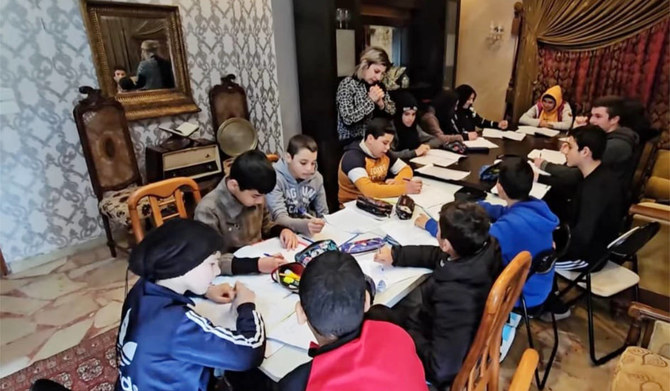

LEBANON: More than 43,000 students in Lebanon — including the children of Syrian and Palestinian refugees — sat the official exams for the baccalaureate certificate.
The participation rate exceeded 97 percent on the first day, and the exams — covering general sciences, life sciences, economics, sociology and humanities — will continue until Thursday.
The Ministry of Education described the successful completion of the first day of exams as “an achievement” in light of the collapse of the country and its education sector.
The first day witnessed a shortage of observers in some of the 236 centers across Lebanon.
FASTFACT
Lebanon’s Ministry of Education described the successful completion of the first day of exams as ‘an achievement’ in light of the collapse of the country and its education sector.
This shortage was compensated for by reducing the number of observers to only one in some examination halls in the Mount Lebanon centers and by using surveillance cameras.
Arab News toured some of the examination centers in Beirut and Mount Lebanon, witnessing cases in which there was a delayed delivery of exam papers.
It was reported that unknown persons cut the cables of surveillance cameras in centers in the Bekaa region.
Exams were also delayed at some centers in North Lebanon because of power cuts.
To prevent exam questions from leaking, committees prepared them at the headquarters of the Ministry of Education on Monday morning.
The heads of the subject committees were asked to hand over their phones before entering the examination hall, and security agencies used a device to jam sound waves around the ministry to ensure that the questions were not leaked.
The exams were printed, copied immediately and distributed to the centers under security escort.
Students and observers received their admission cards just a few days before the exams to prevent cheating.
While some students talked about the leniency of the supervisors, others said that the questions were easy.
Lama, a student in life sciences and economics, said: “The questions were very easy, and we did not feel stressed because the observers were not strict with us.
They allowed us to ask questions, but they definitely did not allow any cheating. Of course, they also did not allow us to bring our mobile phones into the examination hall.”
Rabei, a student in general sciences, said: “The math questions were not easy, but they could be answered by those who studied well.
“Those of us who are taking the official exams this year were exempted from taking the intermediate certificate exam three years ago due to the COVID-19 pandemic, so we may have underestimated the official exams.
But now, I am more confident in myself, and there are still two more days of exams with a day of rest in between, and hopefully everything will go well.”
The academic year in Lebanon has been marred by setbacks due to continuous strikes by teachers in the public education sector to protest the collapse of the value of their salaries.
Public school students received fewer than 40 days of intensive education, while private school students had a relatively stable academic year.
As a result, a group of young people belonging to the Lebanese Student Union staged a protest when Education Minister Abbas Halabi visited an examination center at Shakib Arslan School in the Verdun neighborhood of Beirut.
They intercepted his car, shouted insults and attempted to throw stones at the car.
The young protesters received applause from bystanders and residents.
One protester said that political authorities were turning education into a privilege rather than a right for all students, saying: “There are students who have completed 70 percent of the curriculum, while there are public school students who have only completed 30 percent of it.”
Another protester said that the minister had announced there would be no second chance for students who did not pass exams, which he described as “a great injustice.”
He said: “We will follow the minister wherever he goes during the exams so that history will witness that there were students who struggled for education to be a right and not a privilege."
During his visit to examination centers, the minister asked students whether the curriculum they had studied had sufficiently prepared them to answer exam questions.
According to the minister’s office, the students responded that “the exams were reasonable.”
Halabi acknowledged that students objected to the exams because they believed they were unfair as some public high schools had not completed the curriculum.
“However, we took this into consideration when designing the exam questions. Had it not been for the determination of the Ministry of Education and the concerted efforts to make this process a success, these exams would not have taken place,” he said.
The Ministry of Education reduced the number of subjects tested on the exam and made some subjects optional in order to be fair to students, said Albert Chamoun, adviser to the minister.


