LONDON: President Joe Biden’s itinerary this week in Europe is dominated by the ongoing war in Ukraine and his continued efforts to rally an international coalition against Russia’s invasion of its neighbor.
But first, some tea.
The US president’s initial stop on his three-nation trip is Britain, where he’ll meet with King Charles III for the first time since the latter was crowned in May. Biden did not attend Charles’s coronation, sending first lady Jill Biden instead, and Monday’s visit will be marked by a bit of royal pomp — including a royal salute, a viewing of US-related artifacts at Windsor Castle and teatime for the two men.
Biden and Charles will also use their visit to bring attention to climate issues, hosting a forum focused on how to encourage private companies to engage in more clean energy efforts, specifically in developing economies.
The royal visit is paired with Biden’s sixth meeting with British Prime Minister Rishi Sunak since Sunak for talks on a range of global issues, including the war in Ukraine. The two nations are among the most stalwart defenders of Kyiv, and the United Kingdom has pushed the White House to take more aggressive steps in providing military aid to Ukraine.
The leader talks are meant to highlight the so-called enduring “special relationship” between the US and the UK When Biden declined to attend Charles’s coronation, he promised the king in a phone call that he would visit soon.
Biden last had formal talks with Charles, then prince, at the COP26 UN climate summit in Glasgow, Scotland, in November 2021. The US president also attended the state funeral of Charles’s mother, Queen Elizabeth II, in September as well as a reception for heads of state at Buckingham Palace the night before the service.
The climate portion of Biden’s visit with the king also underscores the high priority that the environment has been for the 74-year-old Charles, who has long fought to protect wildlife and battle climate change. Formally called the Climate Finance Mobilization Forum, Biden and Charles will be briefed by officials from the financial and philanthropic sectors on their discussions about expanding clean energy initiatives in developing nations.
Biden’s national security adviser, Jake Sullivan, said the president has “huge respect” for the king’s commitment on the climate issue in particular. He said Charles has been a “clarion voice” on climate and “someone who’s mobilized action and effort.”
“So the president comes at this with enormous goodwill,” Sullivan told reporters Sunday as Biden flew to London.
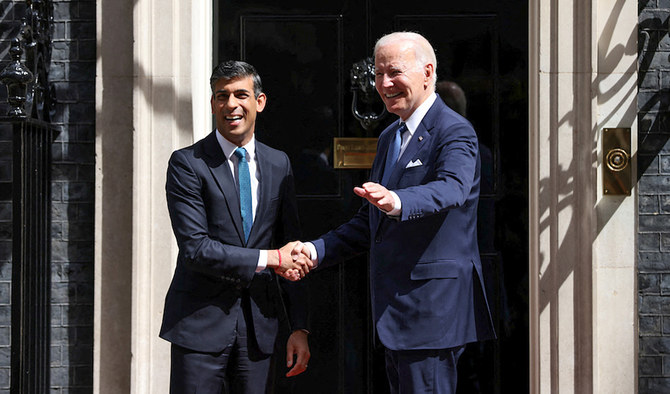
Before making his way to Windsor Castle, Biden sat down with Sunak at the prime minister’s official residence at 10 Downing St. in London to discuss Ukraine and other matters, possibly including the US president’s decision this week to provide Ukraine with cluster munitions, a weapon that more than two-thirds of the members of the NATO military alliance have barred for their potential threat to civilian life.
Biden has acknowledged that providing the bombs — which open mid-air and release smaller “bomblets” across a broad swath of land — was a “difficult decision” but he noted that the Ukrainians are running out of ammunition and that the weapons were necessary for them to continue to fight Russian forces.
“It took me a while to be convinced to do it,” Biden said in a CNN interview broadcast as he flew to London. “But the main thing is, they either have the weapons to stop the Russians ... from stopping the Ukrainian offensive through these areas, or they don’t. And I think they needed them.”
Sunak, for his part, has distanced himself from the US decision, and the prime minister’s spokesman said Monday the leaders spoke about Britain’s opposition to the use of cluster munitions during their meeting.
“The first thing to say is this was a difficult choice for the US that has been forced on them by Russia’s war of aggression,” said Sunak’s spokesman, Max Blain. “As the prime minister said over the weekend, the UK is a state party to the convention on cluster munitions. They discussed the commitments the UK has under that convention both not to produce or use cluster munitions and to discourage their use.”
The US is not a party to that agreement. Over the weekend, Sunak stressed that Britain will “continue to do our part to support Ukraine against Russia’s illegal and unprovoked invasion, but we’ve done that by providing heavy battle tanks and most recently long-range weapons, and hopefully all countries can continue to support Ukraine.”
Sullivan downplayed the disagreement over cluster munitions, saying, “I think you will find Prime Minister Sunak and President Biden on the same page strategically on Ukraine, in lockstep on the bigger picture of what we’re trying to accomplish and as united as ever — both in this conflict and writ large.”
And as the leaders met over tea in the 10 Downing St. garden on Monday, they continued to project that face of unity.
“We’ve only been meeting once a month,” Biden joked as he declared the relationship between the US and UK was “rock solid.” Sunak added that their countries are “two of the firmest allies in that alliance.”
The prime minister’s office said the meeting “will be an opportunity to monitor progress on measures and initiatives under the Atlantic Declaration,” which the two leaders signed when Sunak visited the White House last month.
“This includes negotiations which have now begun on a UK-US Critical Minerals Agreement, which will support the UK and US’ shared leadership in green technology,” the statement said.


![]()

After meeting Sunak, Biden heads for Windsor Castle to discuss clean energy with King Charles III
Short Url
https://arab.news/zpz9t
After meeting Sunak, Biden heads for Windsor Castle to discuss clean energy with King Charles III
- Biden and Charles will use their visit to bring attention to climate issues
- Royal visit paired with Biden’s sixth meeting with British PM Rishi Sunak
Latest updates


© 2026 SAUDI RESEARCH & PUBLISHING COMPANY, All Rights Reserved And subject to Terms of Use Agreement.