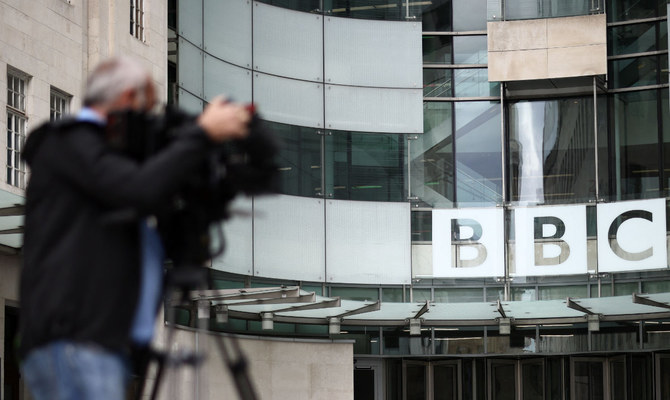
LONDON: The BBC said Sunday it had contacted the authorities and suspended a presenter following allegations that he had paid a teenager tens of thousands of pounds for sexually explicit photos.
UK culture minister Lucy Frazer said earlier she had spoken about the “deeply concerning” allegations with BBC Director General Tim Davie, who assured her the BBC is “investigating swiftly and sensitively.”
The Sun newspaper, which first reported the claims, cited the young person’s mother as saying that an unnamed BBC presenter paid her child more than £35,000 ($45,000) for the images over a three-year period.
It is also claimed that the presenter in question appeared on air for a month after the family of the young person — who was said to be 17 when the payments started — complained to the BBC in May.
In a statement on Sunday, the BBC confirmed that it “first became aware of a complaint in May.”
“New allegations were put to us on Thursday of a different nature and in addition to our own enquiries we have also been in touch with external authorities, in line with our protocols,” it added.
The statement said that “a male member of staff has been suspended.”
“This is a complex and fast moving set of circumstances and the BBC is working as quickly as possible to establish the facts in order to properly inform appropriate next steps,” the BBC added.
London’s Metropolitan Police released a statement later on Sunday confirming the BBC contacted it over the matter, “but no formal referral or allegation has been made.”
“We will require additional information before determining what further action should follow,” it added.
The BBC said it takes “any allegations seriously” and has “robust internal processes in place to proactively deal with such allegations.”
In an internal email sent to staff and quoted on the BBC website, Davie said he is “wholly condemning the unsubstantiated rumors being made on the Internet about some of our presenting talent.”
Since The Sun published the allegations, some BBC presenters have taken to social media to deny that they are the broadcaster in question.
The British broadcaster, whose chairman resigned in April after an inquiry found he failed to disclose a loan to ex-prime minister Boris Johnson, has come under fire over its handling of the claim.
Former home secretary and an MP from the ruling Conservative party, Priti Patel, has said the BBC’s response was “derisory,” adding: “They must provide the victim and his family a full and transparent investigation.”
“The BBC, but also other broadcasters, do need to get a grip because we seem to lurch from one scandal to another and more needs to be done,” opposition Labour party lawmaker Rachel Reeves told Sky News on Sunday.
In May, British star TV host Phillip Schofield resigned from the ITV channel after admitting to an “unwise but not illegal” relationship with a younger colleague.

BBC suspends presenter after explicit images allegations
https://arab.news/rxd4j
BBC suspends presenter after explicit images allegations
- The BBC said it takes “any allegations seriously” and has “robust internal processes in place to proactively deal with such allegations”
UK, France mull social media bans for youth as debate rages
- Countries including France and Britain are considering following Australia’s lead by banning children and some teenagers from using social media
PARIS: Countries including France and Britain are considering following Australia’s lead by banning children and some teenagers from using social media, but experts are still locked in a debate over the effectiveness of the move.
Supporters of a ban warn that action needs to be taken to tackle deteriorating mental health among young people, but others say the evidence is inconclusive and want a more nuanced approach.
Australia last month became the first nation to prohibit people under-16s from using immensely popular and profitable social media platforms such as Instagram, Facebook, Tiktok and YouTube.
France is currently debating bills for a similar ban for under-15s, including one championed by President Emmanuel Macron.
The Guardian reported last week that Jonathan Haidt, an American psychologist and supporter of the Australian ban, had been asked to speak to UK government officials.
Haidt argued in his bestselling 2024 book “The Anxious Generation” that too much time looking at screens — particularly social media — was rewiring children’s brains and “causing an epidemic of mental illness.”
While influential among politicians, the book has proven controversial in academic circles.
Canadian psychologist Candice Odgers wrote in a review of the book that the “scary story” Haidt was telling was “not supported by science.”
One of the main areas of disagreement has been determining exactly how much effect using social media has on young people’s mental health.
Michael Noetel, a researcher at the University of Queensland in Australia, told AFP that “small effects across billions of users add up.”
There is “plenty of evidence” that social media does harm to teens, he said, adding that some were demanding an unrealistic level of proof.
“My read is that Haidt is more right than his harshest critics admit, and less right than his book implies,” Noetel said.
Given the potential benefit of a ban, he considered it “a bet worth making.”
After reviewing the evidence, France’s public health watchdog ANSES ruled last week that social media had numerous detrimental effects for adolescents — particularly girls — while not being the sole reason for their declining mental health.
Everything in moderation?
Noetel led research published in Psychological Bulletin last year that reviewed more than 100 studies worldwide on the links between screens and the psychological and emotional problems suffered by children and adolescents.
The findings suggested a vicious cycle.
Excessive screen time — particularly using social media and playing video games — was associated with problems. This distress then drove youngsters to look at their screens even more.
However, other researchers are wary of a blanket ban.
Ben Singh from the University of Adelaide tracked more than 100,000 young Australians over three years for a study published in JAMA Pediatrics.
The study found that the young people with the worst wellbeing were those who used social media heavily — more than two hours a day — or not at all. It was teens who used social networks moderately that fared the best.
“The findings suggest that both excessive restriction and excessive use can be problematic,” Singh told AFP.
Again, girls suffered the most from excessive use. Being entirely deprived of social media was found to be most detrimental for boys in their later teens.
’Appallingly toxic’
French psychiatrist Serge Tisseron is among those who have long warned about the huge threat that screens pose to health.
“Social media is appallingly toxic,” he told AFP.
But he feared a ban would easily be overcome by tech-savvy teens, at the same time absolving parents of responsibility.
“In recent years, the debate has become extremely polarized between an outright ban or nothing at all,” he said, calling for regulation that walks a finer line.
Another option could be to wait and see how the Australian experiment pans out.
“Within a year, we should know much more about how effective the Australian social media ban has been and whether it led to any unintended consequences,” Cambridge University researcher Amy Orben said.
Last week, Australia’s online safety watchdog said that tech companies have already blocked 4.7 million accounts for under 16s.


