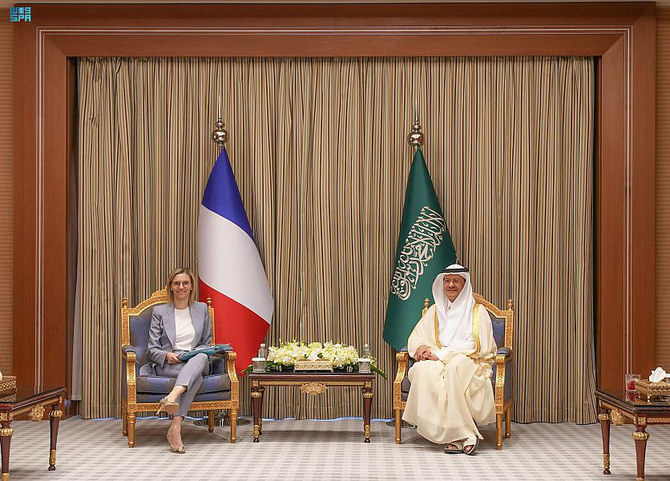


RIYADH: Saudi Energy Minister Prince Abdulaziz bin Salman and his French counterpart, Agnes Pannier-Runacher, on Saturday signed a memorandum of understanding to cooperate in the field of energy, with a focus on clean energy from renewable resources.
In a joint statement published by the Saudi Press Agency, France and Saudi Arabia agreed on a roadmap for hydrogen cooperation and electricity produced from renewable resources, focusing on three pillars:
• Technology development: Cooperation to advance hydrogen and electricity produced from renewable technology deployment from production, transportation and conversion at demand centers;
• Business co-operation: The private sector has a critical role to play. Saudi Arabia–France welcomes joint efforts between Saudi and French companies to partner in the energy supply chain to unlock business and hydrogen trade;
• Policies and regulation: The roadmap will promote the development of the hydrogen industry through a mutual recognition of a certification framework, including emission life cycle assessment from all possible sources necessary for consistency in international trade.
“Both countries will work to enhance their cooperation in developing and sustaining supply chains for the energy sectors and to enable cooperation between companies to maximize the utilization of local resources in both countries, which contributes to achieving flexibility and effectiveness of energy supplies,” the statement said.
The MoU also calls for the creation of a “French-Saudi task force” to carry out the cooperation arrangement.
According to the statement, both countries acknowledge the importance of advancing the implementation of the United Nations Framework on Climate Change, and the Paris Agreement, in accordance with the principles, objectives and goals defined, including pursuing efforts to limit the temperature increase to 1.5C.
“Addressing climate change and promoting secure, reliable, affordable and sustainable supplies of energy are shared strategic priorities of Saudi Arabia and France,” the statement said.
“Moreover, the two countries recognize that clean hydrogen is an essential fuel to reach the shared objective of promoting a sustainable economic development while mitigating the impact of climate change,” it said.
Both countries agreed to enhance cooperation on all aspects of energy production, including generation from renewable energy resources, grid interconnection projects, as well as encouraging the participation of the private sector in power sector projects.
“Both countries have agreed to engage in joint efforts to enhance energy efficiency, enhance cooperation in the field of nuclear energy in a peaceful and safe framework, the management of radioactive waste and the nuclear applications, and the development of human capabilities,” the statement said.
“Both countries agreed to cooperate on advancing climate technologies and solutions including carbon capture utilization and storage for hard-to-abate sectors such as cement, aviation, marine, and petrochemicals, among others,” the statement added.
Saudi Arabia aims to become the leading exporter of hydrogen and electricity produced from low-emission resources globally, capitalizing on its ability to produce hydrogen and electricity from low-emission resources at a competitive cost.
The Kingdom has the necessary resources of renewable energy, natural gas and carbon sinks to export hydrogen in addition to its strategic location with proximity to major global demand centers.
The French strategy for the development of decarbonized hydrogen aims to have a significant contribution to the decarbonization of industry and transport. The strategy includes a public investment program, France 2030. This is aimed at accelerating investment and innovative solutions in sectors of French excellence to decarbonize industry and to develop renewable energy with the goal to increase the renewable power installed capacity up to 100GW by 2050, with more than 40GW coming from offshore wind farms.