

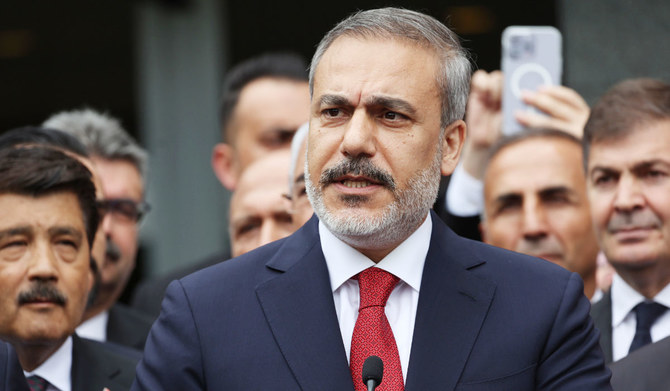

ANKARA: Turkiye’s foreign minister said on Tuesday that Swedish authorities’ failure to prevent Qur’an-burning protests in the country is raising security concerns and questions about Sweden’s credentials for possible NATO membership.
But Hakan Fidan said Turkiye would still approve Sweden’s membership in the military alliance if Stockholm “completes its homework” and presses ahead with efforts to address Turkiye’s concerns.
“The fact that the Swedish security system is incapable of preventing provocations and is presenting an image of a (country) that brings problems to NATO — instead of more power — is making us think in terms of the strategic and security aspects,” Fidan said at a joint news conference with his Jordanian counterpart. “When it comes to Sweden’s membership in NATO, whether it will become a burden or a benefit has become more open to debate.”
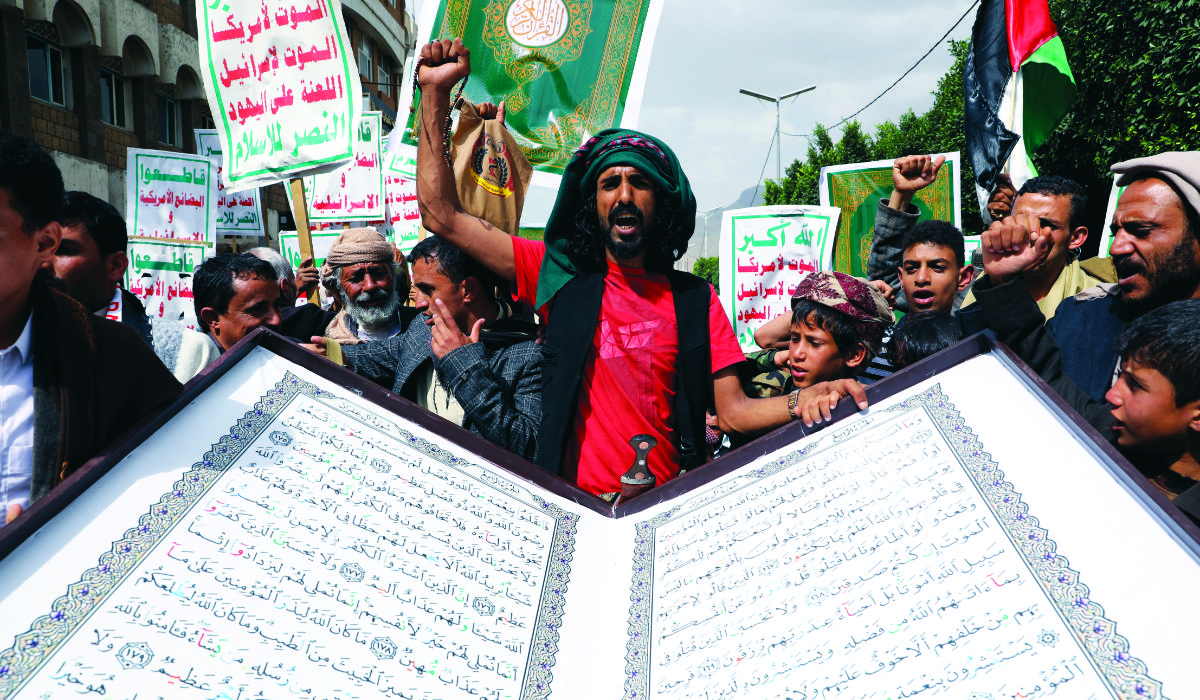
People rally in Sanaa to denounce the burning of the holy Qur’an in Sweden and the Israeli military operation in the West Bank. (Reuters)
Sweden and Finland abandoned their decades-long neutrality and applied to join NATO last year following Russia’s invasion of Ukraine.
Turkiye has been holding off ratifying Sweden’s membership in the alliance, accusing the country of being too soft toward groups that Ankara regards as threats to its security, including Kurdish militants and members of a network that Ankara blames for a failed coup in 2016.
Ankara has also been angered by a series of demonstrations in Sweden by supporters of the outlawed Kurdistan Workers’ Party, or PKK, as well as Qur’an-burning protests, including one that took place last week that was condemned by Muslim countries.
The PKK has waged a 38-year insurgency against Turkiye that has left tens of thousands dead. It is designated a terrorist organization by the US and the EU.
NATO wants to bring Sweden into the fold by the time the alliance’s leaders meet in Lithuania on July 11 to 12, and NATO Secretary-General Jens Stoltenberg has called a meeting of senior officials from Turkiye, Sweden and Finland for July 6 to try to overcome Turkish objections to Sweden’s membership.
NATO requires the unanimous approval of all existing members to expand. Turkiye and Hungary are the only countries that have not yet ratified Sweden’s bid.
Sweden has changed its anti-terror legislation after applying for membership. Fidan, Turkiye’s former intelligence chief who was appointed foreign minister last month, maintained that terror groups were able to continue to stage demonstrations, raise money and recruit members in Sweden.
”If Sweden continues with its efforts and does its homework, there are always alternatives, just as there was in the case of Finland,” Fidan said. He was referring to a memorandum that Sweden and Finland signed with Turkiye last year under which they agreed to address Ankara’s concerns.
Meanwhile, Pope Francis lamented last week’s Qur’an-burning protest outside a mosque in central Stockholm in an interview with the UAEs’ Al-Ittihad newspaper. Swedish police allowed it to take place, citing freedom of speech, after a court overturned a ban on a similar Qur’an-burning.
“Any book considered sacred by its authors must be respected out of respect for its believers, and freedom of expression must never be used as an excuse to despise others, and to allow this, must be rejected and condemned,” the pope was quoted as saying.
Ayman Safadi, the Jordanian foreign minister, also called for mutual respect of religious values and for the prevention of such protests.
A spokesperson for the UN Human Rights Council said that following a request by Pakistan, the council will discuss “the alarming rise” in acts of religious hatred such as the desecration of the Qur’an.


