

Major Saudi cybersecurity improvements attracting investors, London forum told

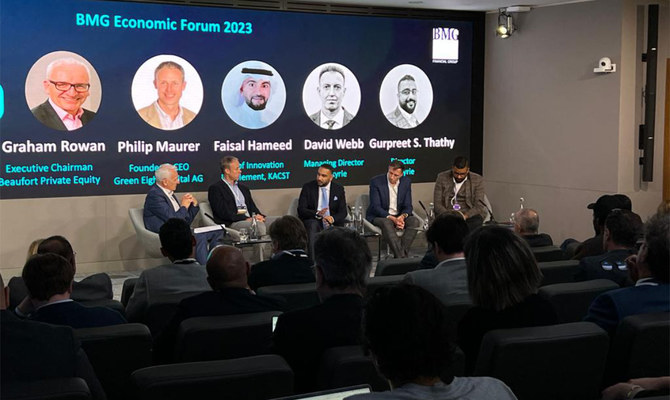
Major improvements in Saudi cybersecurity are increasing the Kingdom’s attractiveness to investors and seeing it develop a reputation as a specialist in the field, the BMG Economic Forum was told on Wednesday. (Supplied)
Short Url
Updated 05 July 2023
Follow

Major Saudi cybersecurity improvements attracting investors, London forum told

  • Kingdom has risen to second place in Global Cyber Security Index since 2017 launch of Vision 2030
  • ‘With what Saudi has done in terms of training and education, if ever there was a sector for youth employment, it’s cybersecurity’

LONDON: Major improvements in Saudi cybersecurity are increasing the Kingdom’s attractiveness to investors and seeing it develop a reputation as a specialist in the field, the BMG Economic Forum was told on Wednesday.

Faisal Hameed, vice president for innovation enablement at King Abdulaziz City for Science and Technology, said Saudi Arabia had climbed from 46th to second place in the Global Cyber Security Index since the 2017 launch of the Vision 2030 reform plan.

“The Cyber Security Authority and Cyber Security Act have both been big changes that leave us only second to the US,” he told the forum, which was held at the London Stock Exchange and attended by Arab News.

“We’ve come a long way since a 2012 attack against Aramco turned thousands of computers into bricks.

“We have training camps and bachelor’s and master’s degrees in cybersecurity, which is building domestic expertise in the field and transforming investment opportunities.”

Hameed said improvements in cybersecurity are attracting startups from fields including artificial intelligence, quantum and post-quantum computing as the Kingdom pushes to diversify its economy.

David Webb, managing director of security risk management firm Valkyrie, said confidence in Saudi Arabia as an investment destination is increasing, and this can be seen in a change in the queries the company is receiving.

“Saudi was always bound up in the misconstrued notion that there were physical threats to investing there — tied to what one might term its ‘noisy neighbours’,” said Webb.

“But what we’re seeing more of now, especially in recent years, is a move from questions of physical security and whether it’s strong on cybersecurity, and we always say ‘yes’ as now is a great time to invest in the country.”

Gurpreet Thathy, Valkyrie’s director of cybersecurity, said when advising on cybersecurity the company always tells clients they must build it in and future-proof it.

He added: “There must be cybersecurity embedded in the design, not a bolt on, and employees need to be told about the cyber threats out there.

“In Saudi, we see that this is the mindset from the outset, rather than a bolt on, and it’s very good to see this.”

Both Thathy and Webb said no cybersecurity system will ever be impenetrable, and what is also needed is the expertise to react swiftly to breaches.

Webb added: “We also see a lot of companies not building this reactive expertise in, and it leads to the system come crashing down.

“But with what Saudi has done in terms of training and education, if ever there was a sector for youth employment, it’s cybersecurity.”


Saudi Arabia, Japan trade rises 38% between 2016 and 2024, minister says

Updated 11 January 2026
Follow

Saudi Arabia, Japan trade rises 38% between 2016 and 2024, minister says

RIYADH: Trade between Saudi Arabia and Japan has increased by 38 percent between 2016 and 2024 to reach SR138 billion ($36 billion), the Kingdom’s investment minister revealed.

Speaking at the Saudi-Japanese Ministerial Investment Forum 2026, Khalid Al-Falih explained that this makes the Asian country the Kingdom’s third-largest trading partner, according to Asharq Bloomberg.

This falls in line with the fact that Saudi Arabia has been a very important country for Japan from the viewpoint of its energy security, having been a stable supplier of crude oil for many years.

It also aligns well with how Japan is fully committed to supporting Vision 2030 by sharing its knowledge and advanced technologies.

“This trade is dominated by the Kingdom's exports of energy products, specifically oil, gas, and their derivatives. We certainly look forward to the Saudi private sector increasing trade with Japan, particularly in high-tech Japanese products,” Al-Falih said.

He added: “As for investment, Japanese investment in the Kingdom is good and strong, but we look forward to raising the level of Japanese investments in the Kingdom. Today, the Kingdom offers promising opportunities for Japanese companies in several fields, including the traditional sector that links the two economies: energy.”

The minister went on to note that additional sectors that both countries can also collaborate in include green and blue hydrogen, investments in advanced industries, health, food security, innovation, entrepreneurship, among others.

During his speech, Al-Falih shed light on how the Kingdom’s pavilion at Expo 2025 in Osaka achieved remarkable success, with the exhibition receiving more than 3 million visitors, reflecting the Japanese public’s interest in Saudi Arabia.

“The pavilion also organized approximately 700 new business events, several each day, including 88 major investment events led by the Ministry of Investment. Today, as we prepare for the upcoming Expo 2030, we look forward to building upon Japan’s achievements,” he said.

The minister added: “During our visit to Japan, we agreed to establish a partnership to transfer the remarkable Japanese experience from Expo Osaka 2025 to Expo Riyadh 2030. I am certain that the Japanese pavilion at Expo Riyadh will rival the Saudi pavilion at Expo Osaka in terms of organization, innovation, and visitor turnout.”

Al-Falih also shed light on how Saudi-Japanese relations celebrated their 70th anniversary last year, and today marks the 71st year of these relations as well as how they have flourished over the decades, moving from one strategic level to an even higher one.