


WARSAW: When she left the place she had known all her life to spend the next seven years in Poland, Danah Al-Abduljabbar knew that being thousands of miles away from home would not be easy, but she had a dream — and it was just beginning to come true.
It was the summer of 2016 when she left her home in Al-Qatif, eastern Saudi Arabia, to study at the Medical University of Warsaw.
One of the largest cities in Eastern Europe, the Polish capital was for her quieter than expected, which somehow made it feel comfortable, especially as everything else was so new and overwhelming.
She was only 17 at the time, “too young to open a bank account or sign an apartment lease,” which she remembers frightened her a bit, but she was not alone. Her father was in Warsaw too, making sure nothing would hinder her plans.
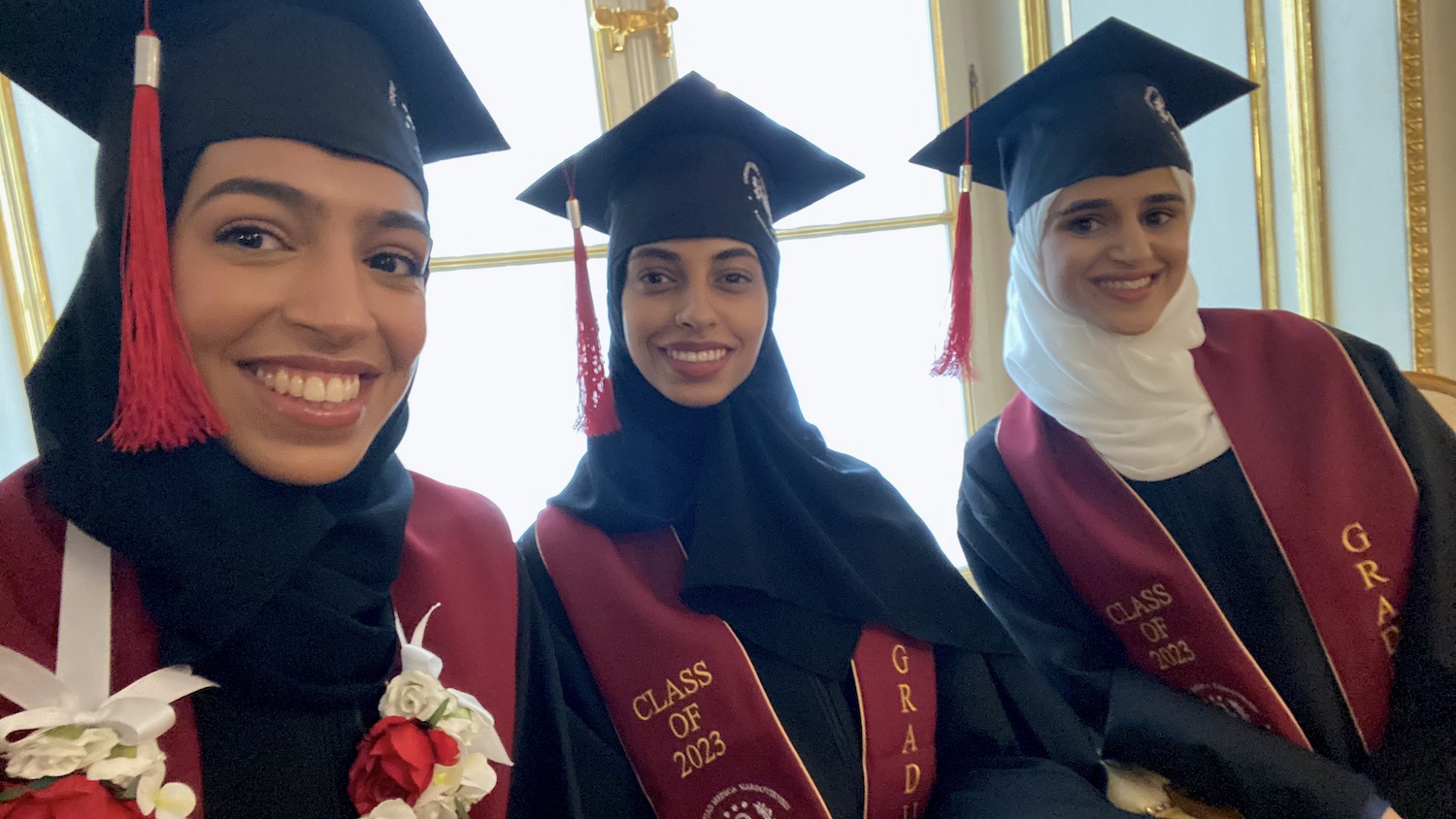
Danah Al-Abduljabbar, left, Tahirah Al-Garrous and Noor Al-Awami pose during their graduation ceremony at the Medical University of Warsaw, Poland, on June 19, 2023. (AN Photo by Danah Al-Abduljabbar)
“My dad left around 10 days later. Then I really felt I was on my own, but for some reason I felt safe,” she said. “I have dreamt about studying abroad and being independent since middle school.”
Al-Abduljabbar was not afraid of being in a new place, in a different culture, among people whose language had only one thing in common with her native Arabic: being one of the world’s most difficult tongues.
“Definitely knowing who I am and my identity and being proud of it is what gave me the strength,” she told Arab News.
“The language barrier did not scare me as much as one would think. I was fortunate enough to travel when I was younger, and my dad would always teach us a few words in the spoken language of each country.”
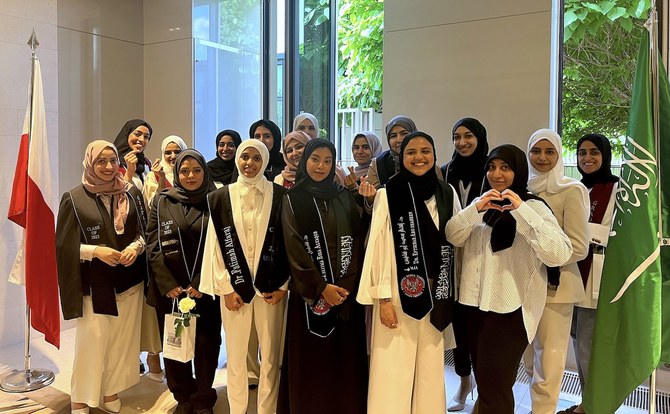
Those few words soon grew into sentences, the sentences grew into conversations, and the conversations into friendships, not only for Al-Abduljabbar, but also for the other 34 Saudi students who last month graduated from different universities across Poland.
All of them now know how to speak Polish, navigate Eastern European culture, cope in subfreezing temperatures in the winter, and have experienced being dependent only on themselves.
For Noor Al-Awami, who graduated together with Al-Abduljabbar, that self-reliance was one of the most important things she learnt throughout those years.
“There’s nothing that empowers you as much as being alone,” she said.
But it was not always easy.
In difficult moments, what gave her strength was remembering where she came from, that her family believed in her and she would “always be in their prayers.”
Tahirah Al-Garrous, another student from the same group, would remind herself that she “came to Poland to achieve a goal,” and every such moment only got her closer to it.
“I’ve also learnt how to accept and tolerate people the way they are, without judging them,” she said. “I’ve learnt so many things, but one of the most important is how to enjoy the journey, not only the destination.”
The journey is not over yet — neither for her, nor for Al-Abduljabbar, Al-Awami and other medical graduates. As they return home, they will apply for one-year internships at hospitals to explore various specializations that will help them choose their own and become resident doctors.
But before that happens, they want to spend some time at home.
Al-Abduljabbar could not wait to be back as her mother and father arrived in Warsaw to help her pack and close the Polish chapter of her life.
“I’m a big family girl and I’ve missed them these past seven years,” she said.
“Staying in contact with them, video calling them from time to time, looking forward to the time I’m going to meet them again, is what kept me going.”
Poland offers a wide range of degree programs, but medicine has always been among the top choices of Saudi students.
This year’s graduates were mostly from medical schools. In Warsaw, more than half of them were women.
For the Kingdom’s envoy to Poland, Ambassador Saad Al-Saleh, it has been the reason for much pride.
“By 2030 we will have 70,000 students sent to study all over the world, and a large percentage of this number are and will be female students,” he told Arab News.
“It certainly makes me feel proud and happy. It also shows that Vision 2030 simply works, as the fact of their graduation fulfils our national objectives. I myself am a father to four daughters and it is very comforting to see that they have the chance to get the best education, in my country or abroad, and this will create an amazing platform to build their future and their careers.”
He knew well — and appreciated — the effort and determination of all those who, like the young women from the Medical University of Warsaw, chose difficult fields of study that for years separated them from home.
“I truly admire the persistence of our students in their striving for obtaining education at some of the most demanding faculties and academic paths,” he said.
“Being sometimes very far from their homes and families, they stay focused and reach their goals. That’s incredible.”


