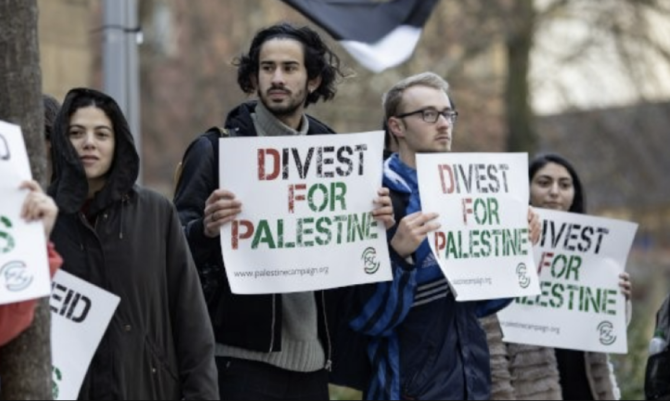

LONDON: Palestinian rights organizations and NGOs have criticized the UK Parliament’s passing of a bill that aims to restrict the role of the Boycott, Divestment and Sanctions movement in Britain.
The House of Commons late on Monday backed the Economic Activity of Public Bodies (Overseas Matters) Bill by 268 to 70 votes following hours of debate.
The bill permits the fining of public bodies in the UK that launch boycotts of, or campaign against, a particular territory, unless in line with the government’s own foreign policy.
But the new regulations are understood as targeting the pro-Palestinian BDS movement, which has received support from several major councils in Britain.
Michael Gove, the communities secretary, said the bill will ensure that foreign policy remains the undertaking of the UK government, as opposed to smaller public bodies.
He claimed that the BDS movement, which calls for economic pressure on Israel over its treatment of Palestinians in the Occupied Territories, has resulted in an “increase in antisemitic events.”
But Chris Doyle, director of the Council for Arab-British Understanding, told Arab News that the “dreadful” proposed legislation would curtail local democracy in the UK and strip the ability of public bodies to practice due diligence.
He said the bill represents a “major restriction on freedom of speech and conscience,” and would fail to achieve its goal of curtailing antisemitism.
Doyle added that the proposed legislation would also contradict the UK’s established legal positions toward Israel and the Occupied Territories, and would give the former a “protective shield” over its crimes.
The UK’s longstanding foreign policy toward Israel calls for an end to the military occupation of the Palestinian territories through a two-state solution.
As part of that stance, Israeli settlement expansion in the Occupied Territories is viewed as an illegal obstacle to peace under international law.
If the bill becomes UK policy, Israel would be the only country in the world that a local British public body cannot disinvest from, Doyle warned.
Peter Leary, campaigns officer at the Palestine Solidarity Campaign, told Arab News: “While Israel is unleashing some of its most extreme violence in decades against the Palestinian people, the British government has chosen to single it out by name in the anti-boycott bill, alongside the ‘occupied Palestinian territories’ and ‘occupied Golan Heights,’ as territories that the law explicitly protects from public sector boycotts.
“This bill will actively promote impunity for violations of international law and well-documented discrimination against Palestinians.
“Despite assertions that foreign policy remains unchanged, for the first time, a piece of British legislation will require Israel and the territories it illegally occupies to be treated in the same way, a departure from decades of international consensus on the illegality of settlements.”
MPs have also criticized the bill, including Alicia Kearns of the governing Conservative Party, who chairs the Foreign Affairs Committee.
She said the government should remove references to Israel and Palestine from the legislation’s text as it “essentially gives exceptional impunity to Israel.”
A UK government spokesperson said: “Public bodies should not be pursuing their own foreign policy agenda … The ban on boycotts does not apply to individuals, including publicly elected officials, when carrying out private acts that are protected by the Human Rights Act.”