

Conservative MP Gove faces backlash from his own party over bill banning boycotts of Israeli goods

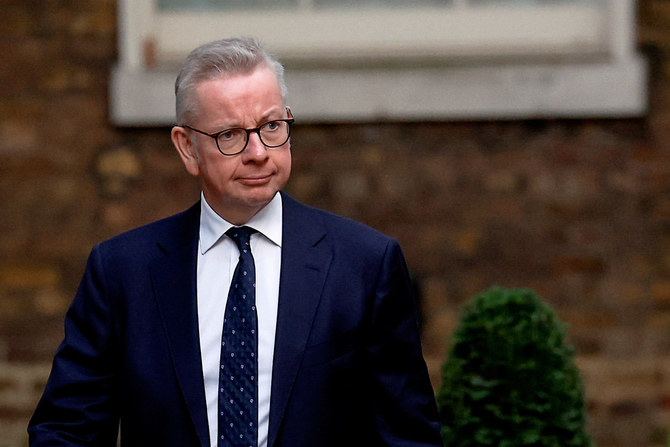
Conservative politicians in the UK have voiced concerns over MP Michael Gove’s (pictured) bill designed to stop public bodies from boycotting Israeli goods and services. (Reuters/File Photo)
Short Url
Updated 24 June 2023
Follow

Conservative MP Gove faces backlash from his own party over bill banning boycotts of Israeli goods

  • The Economic Activity of Public Bodies Bill aimed at stopping local councils from supporting the BDS movement

LONDON: Conservative politicians in the UK have voiced concerns over MP Michael Gove’s bill designed to stop public bodies from boycotting Israeli goods and services.

The Economic Activity of Public Bodies Bill, which is set for a second reading in the British Parliament in the coming weeks, is aimed at stopping local councils from supporting the Boycott, Divestment and Sanctions movement, which opposes Israel’s occupation of Palestinian territories.

A group of Tory lawmakers have told the Levelling Up, Housing and Communities secretary they have reservations about the proposed law, The Guardian reported on Saturday.

Opposition-led councils in the English cities of Leicester and Lancaster, both of which have Labour as the largest party, have approved the imposition of boycotts on Israeli goods by organizations.

“These (BDS) campaigns not only undermine the UK’s foreign policy but lead to appalling antisemitic rhetoric and abuse. My message to these organizations is to get on with your job and focus on delivering for the public,” Gove said.

However, those within his own party have said they take issue with the singling out of Israel and how the bill may stop public bodies from targeting goods and firms from other countries such as China, the report added.

“I support the principle that taxpayers’ money should not be politicized and should not be used to undermine the government’s foreign policy,” Alicia Kearns, Conservative party chair of the foreign affairs select committee, told the newspaper.

“My concern is we should not specifically name Israel on the face of the bill. We should not do country-specific legislation as it undermines our foreign policy. I also worry whether this will undermine community cohesion,” she added.

Several civil society groups in the UK have also called on the British government to drop the bill, including the International Center of Justice for Palestinians and Amnesty International, who slammed the proposed law as “outrageous.”

A spokesperson for the government said public bodies should not be pursuing their own foreign policy agenda, adding that the bill would ensure the UK spoke “with one voice internationally” and that the “taxpayer only has to pay for foreign policy once.”


Brazil, India eye critical minerals deal as leaders meet

Updated 1 sec ago
Follow

Brazil, India eye critical minerals deal as leaders meet

  • The two leaders are expected to sign a memorandum on critical minerals and discuss efforts to increase trade links
NEW DELHI: India’s Prime Minister Narendra Modi and Brazilian President Luiz Inacio Lula da Silva are set to meet in New Delhi on Saturday, seeking to boost cooperation on critical minerals and rare earths.
Brazil has the world’s second-largest reserves of these elements, which are used in everything from electric vehicles, solar panels and smartphones to jet engines and guided missiles.
India, seeking to cut its dependence on top exporter China, has been expanding domestic production and recycling while scouting for new suppliers.
Lula, heading a delegation of more than a dozen ministers as well as business leaders, arrived in New Delhi on Wednesday for a global summit.
Officials have said that in talks with Modi on Saturday, the two leaders are expected to sign a memorandum on critical minerals and discuss efforts to increase trade links.
The world’s most populous nation is already the 10th largest market for Brazilian exports, with bilateral trade topping $15 billion in 2025.
The two countries have set a trade target of $20 billion to be achieved by 2030.
With China holding a near-monopoly on rare earths production, some countries are seeking alternative sources.
Rishabh Jain, an expert with the Delhi-based Council on Energy, Environment and Water think tank, said India’s growing cooperation with Brazil on critical minerals complements recent supply chain engagements with the United States, France and the European Union.
While these partnerships grant India access to advanced technologies, finance and high-end processing capabilities, “Global South alliances are critical for securing diversified, on-ground resource access and shaping emerging rules of global trade,” Jain said.
‘Challenges’
Modi and Lula are also expected to discuss global economic headwinds and strains on multilateral trade systems after both of their countries were hit by US tariffs in 2025, prompting the two leaders to call for stronger cooperation.
Washington has since pledged to roll back duties on Indian goods under a trade deal announced earlier this month.
“Lula and Modi will have the opportunity to exchange views on … the challenges to multilateralism and international trade,” said Brazilian diplomat Susan Kleebank, the secretary for Asia and the Pacific.
Brazil is India’s biggest partner in Latin America.
Key Brazilian exports to India include sugar, crude oil, vegetable oils, cotton and iron ore.
Demand for iron ore has been driven by rapid infrastructure expansion and industrial growth in India, which is on track to become the world’s fourth largest economy.
Brazilian firms are also expanding in the country, with Embraer and Adani Group announcing plans last month to build aircraft in India.
Lula addressed the AI Impact summit in Delhi on Thursday, calling for a multilateral and inclusive global governance framework for artificial intelligence.
He will travel on to South Korea for meetings with President Lee Jae Myung and to attend a business forum.