

Pakistan grants extra powers to graft body probing Imran Khan — media

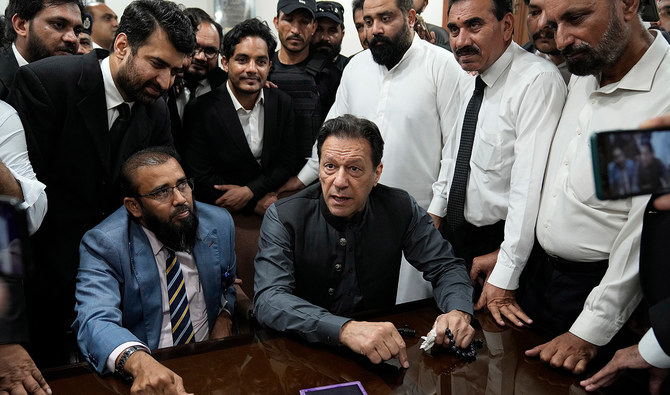
Pakistan's former Prime Minister Imran Khan, center seated, talks to lawyers after submitting surety bonds for his bails in different cases, at an office of Lahore High Court in Lahore on July 3, 2023. (AP)
Short Url
Updated 04 July 2023
Follow

Pakistan grants extra powers to graft body probing Imran Khan — media

  • The National Accountability Bureau can now detain suspects for 30 days if they don’t cooperate with investigations
  • Move came hours before Khan and his wife were set to appear before NAB in Islamabad and at hearings in other cases

KARACHI: Pakistan has issued a presidential ordinance granting extra detention powers to the country’s anti-graft body, which is currently investigating a case involving former Prime Minister Imran Khan, media reported on Tuesday.

Khan, the country’s main opposition leader who has faced a string of cases since being ousted from power last year, was arrested in the graft case in May, which led to violent protests across the country. He was later released on bail.

The legal tweaks involved granting the anti-graft body, the National Accountability Bureau (NAB), the ability to issue arrest warrants and detain suspects for 30 days if they did not cooperate with an investigation, Geo News reported.

Pakistan’s information minister did not immediately respond to a Reuters request for comment.

The move came hours before Khan and his wife were set to appear before the NAB in Islamabad and at hearings in other cases. The former premier left his home in the city of Lahore for Islamabad early on Tuesday, his party said.

The government can pass laws swiftly through a presidential ordinance when parliament is not in session, but the assembly has to endorse the law within 90 days.

Parliament was in session but was prorogued on Monday through a government notification uploaded on its website. The ordinance was issued on Monday night.

Government officials allege that Khan and his wife received land worth millions of dollars as a bribe from a real estate tycoon Malik Riaz through a charitable trust. Khan and his aides, as well as the tycoon, have previously denied any wrongdoing.

Khan and his party have faced a country-wide crackdown after the violence that followed his arrest, that included the ransacking of military installations. Hundreds of supporters and dozens of leaders were detained, and many have left his party.


At ECO meeting, Pakistan proposes ‘Regional Innovation Hub’ to curb natural disasters

Updated 21 January 2026
Follow

At ECO meeting, Pakistan proposes ‘Regional Innovation Hub’ to curb natural disasters

  • Pakistan hosts high-level 10th ECO Ministerial Meeting on Disaster Risk Reduction in Islamabad
  • Innovation hub to focus on early warning technologies, risk informed infrastructure planning

ISLAMABAD: Pakistan has proposed to set up a “Regional Innovation Hub on Disaster Risk Reduction” that focuses on early warning technologies and risk informed infrastructure planning, the Press Information Department (PID) said on Wednesday, as Islamabad hosts a high-level meeting of the Economic Cooperation Organization (ECO).

The ECO’s 10th Ministerial Meeting on Disaster Risk Reduction (DRR) is being held from Jan. 21-22 at the headquarters of the National Disaster Management Authority (NDMA) in Pakistan’s capital. 

The high-level regional forum brings together ministers, and senior officials from ECO member states, representatives of the ECO Secretariat and regional and international partner organizations. The event is aimed to strengthen collective efforts toward enhancing disaster resilience across the ECO region, the PID said. 

“Key agenda items include regional cooperation on early warning systems, disaster risk information management, landslide hazard zoning, inclusive disaster preparedness initiatives, and Pakistan’s proposal to establish a Regional Innovation Hub on Disaster Risk Reduction, focusing on early warning technologies, satellite data utilization, and risk-informed infrastructure planning,” the statement said. 

The meeting was attended by delegations from ECO member states including Pakistan, Türkiye, Azerbaijan, Iran, Kyrgyzstan, Tajikistan, Turkmenistan and Uzbekistan. Representatives of regional and international organizations and development partners were also in attendance.

Discussions focused on enhancing regional coordination, harmonizing disaster risk reduction frameworks, and strengthening collective preparedness against transboundary and climate-induced hazards impacting the ECO region, the PID said. 

ECO members states such as Pakistan, Türkiye, Afghanistan and others have faced natural calamities such as floods and earthquakes in recent years that have killed tens of thousands of people. 

Heavy rains triggered catastrophic floods in Pakistan in 2022 and 2025 that killed thousands of people and caused damages to critical infrastructure, inflicting losses worth billions of dollars. 

Islamabad has since then called on regional countries to join hands to cooperate to avert future climate disasters and promote early warning systems to avoid calamities in future.