

Plastic fantastic: Saudi artist uses 500,000 bottle caps to create mural

1 / 11
Saudi artist Khulood Al-Fadli has created a gigantic mural using recycled plastic bottle caps. (Supplied)
2 / 11
Saudi artist Khulood Al-Fadli has created a gigantic mural using recycled plastic bottle caps. (Supplied)
3 / 11
Saudi artist Khulood Al-Fadli has created a gigantic mural using recycled plastic bottle caps. (Supplied)
4 / 11
Saudi artist Khulood Al-Fadli has created a gigantic mural using recycled plastic bottle caps. (Supplied)
5 / 11
Saudi artist Khulood Al-Fadli has created a gigantic mural using recycled plastic bottle caps. (Supplied)
6 / 11
Saudi artist Khulood Al-Fadli has created a gigantic mural using recycled plastic bottle caps. (Supplied)
7 / 11
Khulood Al-Fadli got ample support from Green Leaves School students, family, friends and a growing number of plastic bottle cap donors for her project. (Supplied)
8 / 11
Saudi artist Khulood Al-Fadli has created a gigantic mural using recycled plastic bottle caps. (Supplied)
9 / 11
Saudi artist Khulood Al-Fadli has created a gigantic mural using recycled plastic bottle caps. (Supplied)
10 / 11
Saudi artist Khulood Al-Fadli has created a gigantic mural using recycled plastic bottle caps. (Supplied)
11 / 11
Saudi artist Khulood Al-Fadli has created a gigantic mural using recycled plastic bottle caps. (Supplied)
Short Url
Updated 03 July 2023
Follow

Plastic fantastic: Saudi artist uses 500,000 bottle caps to create mural

  • Corniche eco-mural raises awareness of environmental issues and impact of waste

JEDDAH: Saudi artist Khulood Al-Fadli, in collaboration with local environmental organizations and Jeddah municipality, has created a gigantic mural using recycled plastic bottle caps.

In a festive atmosphere, the artist inaugurated the mural along with local authorities after spending over eight months and using almost a ton of plastic waste to build it along with volunteers.

Al-Fadli’s art strives to eliminate plastic waste pollution. The eco-mural prevented thousands of pieces of plastic from ending up in the trash.


Khulood Al-Fadli got ample support from Green Leaves School students, family, friends and a growing number of plastic bottle cap donors for her project. (Supplied) 

The artist told Arab News she wanted “to do something that really impacted people,” and raise awareness on environmental issues in the Kingdom.

“Alhamdullah, we opened the mural to be the most beautiful and largest mural of reused plastic caps in the world, symbolizing a green Saudi Arabia and its goal to preserve the environment,” Al-Fadli said.

A large number of corniche visitors witnessed the unveiling of the new mural, which covers an area of 383 square meters and is covered with 500,000 plastic caps.

The project could be in contention for a Guinness World Record, according to the artist.
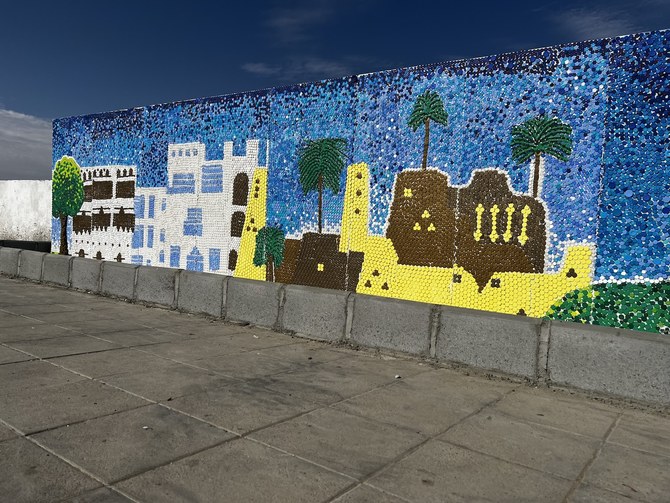


Saudi artist Khulood Al-Fadli has created a gigantic mural using recycled plastic bottle caps. (Supplied)

And it is not the first time Al-Fadli has beaten a record, as she claimed the Guinness World Record for the largest world map created using plastic water caps. The 250-square-meter world map was made using 350,000 plastic bottle caps in 2021.

The new mural as a sustainable project is in line with the aspirations of Saudi Vision 2030, and symbolizes a green Saudi Arabia, as well as representing its past, present and bright future.

In the past eight months, Al-Fadli and her team went through a number of steps in making the mural a reality. The plastic caps were collected as a community effort, with contributions from Green Leaves School students, family, friends and a growing number of plastic bottle cap donors. The caps were cleaned, positioned, and finishing touches added.

Al-Fadli’s students also helped created the mosaic mural and learned the importance of repurposing plastic in the process. The children also visited the mural with Al-Fadli, who is the school’s principal, after its completion.

The artist explained that the children participate in many environmental sustainability projects, including cleaning beaches and landscaping in public parks. They were also involved in the 2021 record-breaking world map.

On her future project, she added: “Until now, I have not decided what the other plan is, but it will certainly be a project that aims at reusing plastic with the participation of our community.

“I will not stop spreading awareness among the community in reusing plastic instead of returning it.”


Hafez Galley’s exhibition pays tribute to two Egyptian artists who shaped a visual era

Both artists emerged in an era when newspapers and magazines played a central role in shaping Egypt’s visual culture. (Supplied)
Updated 17 January 2026
Follow

Hafez Galley’s exhibition pays tribute to two Egyptian artists who shaped a visual era

  • Artworks by Attyat Sayed and El Dessouki Fahmi will be on display until Feb. 28

JEDDAH: Hafez Gallery in Jeddah has opened an exhibition showcasing the works of influential Egyptian artists Attyat Sayed and El Dessouki Fahmi. The exhibition runs until Feb. 28.

Kenza Zouari, international art fairs manager at the gallery, said the exhibition offers important context for Saudi audiences who are becoming increasingly engaged with Arab art histories.

Artworks by Attyat Sayed and El Dessouki Fahmi will be on display at Hafez Gallery until Feb. 28. (Supplied)

“Attyat Sayed and El Dessouki Fahmi’s decades-long practice in Cairo established foundational models for how artists across the region approach archives, press, and ultimately collective memory,” Zouari told Arab News. 

Both artists emerged in an era when newspapers and magazines played a central role in shaping Egypt’s visual culture. Their early work in press illustration “demanded speed, clarity, the ability to distill complex realities into a single, charged image,” the gallery’s website states.

Seeing the works of both artists side-by-side is breathtaking. It’s fascinating to witness how press illustration shaped such profound and lasting artistic voices.

Lina Al-Mutairi, Local art enthusias

Heba El-Moaz, director of artist liaison at Hafez Gallery, said that this is the second time that the exhibition — a posthumous tribute to the artists —has been shown, following its debut in Cairo.

“By placing their works side by side, it highlights how press illustration, often considered ephemeral, became a formative ground for artistic depth, narrative power, and lasting influence, while revealing two distinct yet deeply interconnected artistic paths within modern Egyptian visual culture,” she told Arab News. 

Artworks by Attyat Sayed and El Dessouki Fahmi will be on display at Hafez Gallery until Feb. 28. (Supplied)

Sayed’s work evolved from black-and-white illustration into “layered, dynamic compositions that translate lived emotion into physical gesture, echoing an ongoing negotiation between the inner world and its outward form,” the website states. Viewed together, the works of Sayed and Fahmi “reveal two distinct yet deeply interconnected artistic paths that contributed significantly to modern Egyptian visual culture.”

The exhibition “invites visitors into a compelling dialogue between instinct and intellect, emotion and structure, spontaneity and reflection; highlighting how artistic rigor, cultural memory, and sustained creative exploration were transformed into enduring visual languages that continue to resonate beyond their time,” the gallery states.

Lina Al-Mutairi, a Jeddah-based art enthusiast, said: “Seeing the works of both artists side-by-side is breathtaking. It’s fascinating to witness how press illustration shaped such profound and lasting artistic voices. The exhibition really brings their vision and influence to life.”