Israeli warplanes target Syrian air defense battery; Damascus says most missiles intercepted

1 / 3
Israeli authorities inspect the remains of what the military said is a Syrian anti-aircraft rocket that exploded in the air, in the town of Rahat, Israel, on July 2, 2023. (AP Photo)
2 / 3
This picture released by the Syrian Arab News Agency on Feb. 24, 2020, reportedly shows Syrian air defense intercepting an Israeli missile in the sky over Damascus. SANA on Sunday said local air defenses shot down most of the Israeli missiles targetting Homs region. (AFP)
3 / 3
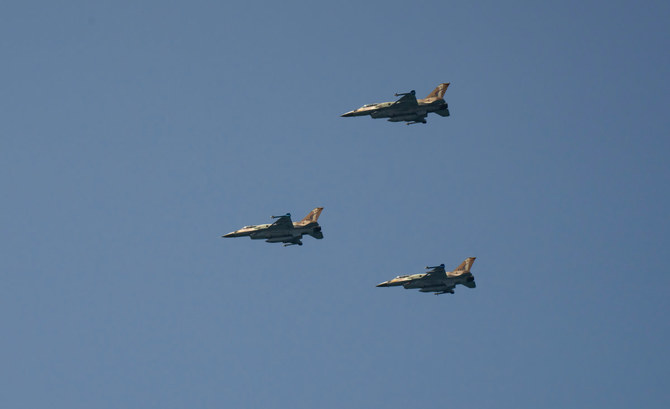
Israeli F-16 warplanes, shown in this file photo, have figured in repeated Israeli airstrikes on targets in Syria over the past years. (Shutterstock image)
Short Url
Updated 02 July 2023
Follow

Israeli warplanes target Syrian air defense battery; Damascus says most missiles intercepted

  • The target was used to launch an anti-aircraft missile toward Israel, says military
  • An army statement said the missiles that were able to evade air defenses  destroyed some structures in Homs

AMMAN: Syria said it repelled a missile salvo on Sunday from Israel, where police reported that remnants of a Syrian anti-aircraft missile struck a remote town without causing injuries.
Israel has in recent months intensified strikes on Syrian airports and air bases to disrupt Iran’s increasing use of aerial supply lines to deliver arms to allies in Syria and Lebanon, including Lebanon’s Hezbollah.
Syrian state media said air defenses intercepted Israeli missiles across central parts of the country, downing most of them. A Syrian army statement said missiles that flew over parts of Lebanon’s capital Beirut hit locations in the vicinity of the city of Homs, resulting only in material damage.
An Israeli military spokesperson said warplanes struck targets including a Syrian air defense battery from which an anti-aircraft missile was launched toward Israel.
After a mid-air explosion heard across Israel, remnants of the Syrian missile landed in Rahat, a town some 180 km (110 miles) south of the armistice line between the countries, Israeli police said. There was no word of any casualties.
Local media showed what appeared to be the blackened front end of a large missile, standing upright in an open area among residential buildings, and tail-fins in a field.
The Israeli military said its warplanes were unscathed.
The Israeli strikes are part of an escalation of what has been a low-intensity conflict continuing for years with a goal of slowing Iran’s growing entrenchment in Syria, Israeli military experts say.
Tehran’s influence has grown in Syria since it began supporting President Bashar Assad in the civil war that started in 2011.
Fighters allied to Iran, including Hezbollah, now hold sway in areas in eastern, southern and northwestern Syria and in several suburbs around the capital.  


Sudan defense minister dismisses ‘intelligence document’ as fabrication after convoy strike

Updated 12 February 2026
Follow

Sudan defense minister dismisses ‘intelligence document’ as fabrication after convoy strike

  • Gen. Hassan Kabroun tells Arab News claims that army hid weapons in aid convoy are “completely false”

RIYADH: Sudan’s defense minister has firmly denied reports attributed to Sudanese intelligence alleging that a convoy targeted in North Kordofan was secretly transporting weapons under the cover of humanitarian aid.

Gen. Hassan Kabroun described the claims as “false” and an attempt to distract from what he called a militia crime.

The controversy erupted after news reports emerged that a document attributed to Sudan’s General Intelligence Service claimed the convoy struck in Al-Rahad on Friday was not a purely humanitarian mission, but was instead carrying “high-quality weapons and ammunition” destined for Sudanese Armed Forces units operating in the state.

The report further alleged that the convoy had been outwardly classified as humanitarian in order to secure safe passage through conflict zones, and that the Rapid Support Forces had destroyed it after gathering intelligence on its route and cargo.

Kabroun categorically rejected the narrative.

“First of all, we would like to stress the fact that this news is false,” he told Arab News. “Even the headline that talks about the security of the regions, such as Al-Dabbah, is not a headline the army would use.”

He described the document as fabricated and politically motivated, saying it was designed to “cover up the heinous crime they committed.”

The minister affirmed that the area targeted by drones is under full control of the Sudanese Armed Forces and does not require any covert military transport.

“Second, we confirm that the region that was targeted by drones is controlled by the army and very safe,” Kabroun said. “It does not require transporting any military equipment using aid convoys as decoys because it is a safe area controlled by the army, which has significant capabilities to transport humanitarian aid.”

According to the minister, the Sudanese military has both the logistical capacity and secure routes necessary to move equipment openly when needed.

“The army is professional and does not need to deliver anything to Kadugli or Dalang on board aid convoys,” he said. “The road between Dalang and Kadugli is open. The Sudanese forces used that road to enter and take control of the region. The road is open and whenever military trucks need to deliver anything, they can do so without resorting to any form of camouflage.”

Kabroun further rejected any suggestion that the military uses humanitarian operations as cover.

“Aid is transported by dedicated relief vehicles to the areas in need of this assistance,” he said. “Aid is not transported by the army. The army and security apparatus do not interfere with relief efforts at all, and do not even accompany the convoys.”

He stressed that the Sudanese Armed Forces maintains a clear institutional separation between military operations and humanitarian work, particularly amid the country’s crisis.

“These are false claims,” he said. “This fake news wanted to cover up the heinous crime they committed.”

Sudan has been gripped by conflict since April 2023, when fighting broke out between the Sudanese Armed Forces and the Rapid Support Forces, plunging the country into what the United Nations has described as one of the world’s worst humanitarian disasters.

The latest dispute over the convoy comes amid intensified fighting in South Kordofan, a strategically sensitive region linking central Sudan with the contested areas of Darfur and Blue Nile.

The false report suggested that intelligence monitoring had enabled the RSF to strike what it described as a military convoy disguised as humanitarian aid. But Kabroun dismissed that version outright.

“The intelligence agency is well aware of its duties,” he said. “The Sudanese Army has enough weapons and equipment to use in the areas of operations. These claims are completely false.”

He argued that the narrative being circulated seeks to shift blame for attacks on civilian infrastructure and humanitarian movements.

“This shows that they are trying to cover up the atrocities,” he added, referring to the militia.

Kabroun maintained that the army has regained momentum on multiple fronts and remains fully capable of sustaining its operations without resorting to deception.

“The region is secure, the roads are open, and the army does not need camouflage,” he said. “We are operating professionally and transparently.”

“These claims are completely false,” Kabroun said. “The Sudanese Army does not use humanitarian convoys for military purposes.”