

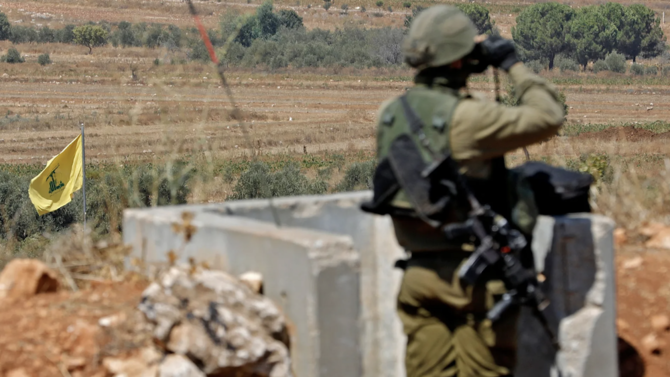

BEIRUT: Hezbollah is refusing Israeli demands that it dismantle an outpost set up in the disputed hills of Kfarshouba on the border between Lebanon and Israel.
Amid a tense standoff between the militant group and Israel over the issue, Israeli warplanes violated Lebanese airspace at low altitude over the border towns of Bint Jbeil and Marjayoun on Saturday.
The presence of the outpost — two military tents and a temporary structure occupied by Hezbollah fighters — gained prominence after it was discussed in the Foreign Affairs and Defense Committee in the Knesset last Tuesday.
The Israeli army had tried to keep the issue under wraps for weeks.
BACKGROUND
A security source told an Israeli news site that Israel had sent messages to Lebanon through diplomatic and military channels in June regarding Hezbollah’s placement of military tents beyond the borders.
Israeli news sites recently claimed that “Israel is preparing to forcibly remove military points established by Hezbollah on the border with Lebanon.”
MP Mohammed Raad, head of Hezbollah’s parliamentary bloc, said on Saturday that “the time has passed when the Israelis bombed Osirak nuclear reactor without batting an eyelid.
“Now the Israelis cannot remove two tents because there is strong resistance, strong men, and believers in this country.”
In a remark directed at Israel, Raad said: “If you do not want a war, then be quiet.”
He added: “Neither you nor anyone else can demand that the resistance removes what belongs to Lebanon.”
Raad also said the Israeli side had been protesting against the two tents on the border for a month, claiming that they were placed in an advanced position on the Blue Line — as they interpret it.
He added: “Israel demands their removal, and prefers that the resistance removes them because if the Israel remove the tents, a war will occur and Israel does not want that.”
Last Wednesday, a security source told the Israeli news site Walla News that Israel had sent messages to the Lebanese through diplomatic and military channels in June regarding Hezbollah’s placement of military tents beyond the borders.
However, the response was that “this is Lebanese territory.”
According to the Israeli news site, the security source said that the Israeli army is preparing to carry out “an engineering operation to remove Hezbollah’s tents using bulldozers and tanks.”
The source also claimed that Hezbollah is transferring forces from the elite unit (Al-Ridwan) to the border areas with Israel, in preparation for infiltration operations in northern settlements.
Hezbollah also establishes military positions every two weeks a few meters away from the border, the source alleged.
Citing Israeli and US sources, the Israeli news site reported that Israel — with the support of the US — was trying to pressure the Lebanese government to remove the outpost by sending “harsh messages to the Lebanese government, the Lebanese army, and UNIFIL forces.”
A source at the Israeli Foreign Ministry said that Hezbollah members set up a tent about 30 meters south of the Blue Line on April 8 and then added another tent a few weeks later, as well as a water tank and a power generator.
At the end of 2022, Lebanon completed the demarcation of its maritime borders with Israel through US mediation.
However, the indirect negotiations between the two sides did not cover the land borders.
The Blue Line is a temporary and non-final line drawn by UNIFIL forces after Israel’s withdrawal from southern Lebanon in 2000.
The Lebanese army counts 13 points with different border demarcations with Israel.
There is still an ongoing dispute over the Shebaa Farms and Kfarshouba hills.
Israel occupied these areas during the June 1967 war, and they were not demarcated within the Blue Line after Israel’s withdrawal from southern Lebanon in 2000.
According to documents held by the UN, these areas are considered Syrian territory, while Lebanon claims that they are Lebanese lands.
Syria has not yet submitted documents confirming their Lebanese identity to the UN despite verbal recognition by Syrian officials of their Lebanese identity.
Lebanese from Kfarshouba protested about a month ago against the excavations carried out by the Israeli army in lands that they consider to be their property and are currently occupied.
They crossed into the Israeli-occupied area and remained there to demonstrate their objection to these excavations.
Hezbollah continued to carry out resistance operations in the hills of Kfarshouba and on the outskirts of the Shebaa Farms area after 2000.
However, Hezbollah has scaled back its activities after the 2006 war in light of UN Security Council Resolution 1701.
The new tension in the Kfarshouba hills area coincides with the approaching deadline for the renewal of UNIFIL forces’ mandate in southern Lebanon at the end of August in the Security Council, according to the renewal formula adopted in 2022.
The renewal included an expansion of UNIFIL’s powers, such that it does not have to coordinate with the Lebanese army.
Lebanon rejected this amendment, which was demanded by the US, France and Britain.
The Israeli and Lebanese violations of Resolution 1701 that have taken place this year could further complicate discussions on the renewal of UNIFIL’s mandate.
These violations include the launch of unidentified rockets from southern Lebanon toward Israeli-occupied territories, the attack on an Irish UNIFIL patrol resulting in the death of a soldier and the injury of others, and the Lebanese military judiciary’s accusation of individuals belonging to Hezbollah of responsibility for this attack.


