Saudi interior minister commends officials, security forces for Hajj efforts

1 / 4
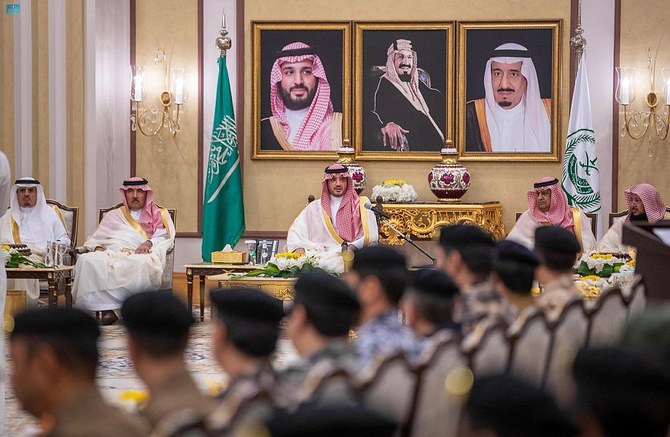
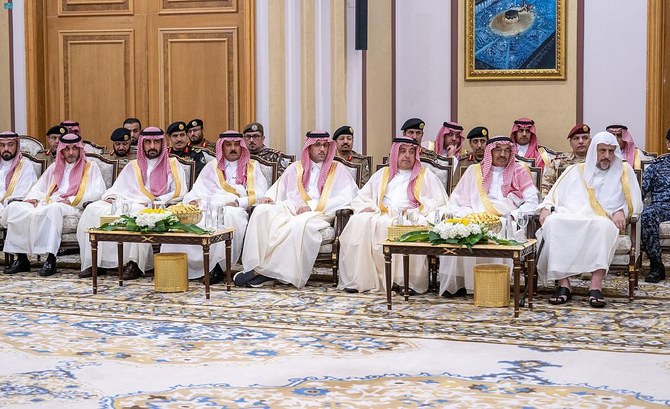
Saudi Minister of Interior Prince Abdulaziz bin Saud bin Naif receives senior officials and leaders of the military and security sectors. (SPA)
2 / 4
Saudi Minister of Interior Prince Abdulaziz bin Saud bin Naif receives senior officials and leaders of the military and security sectors. (SPA)
3 / 4
Saudi Minister of Interior Prince Abdulaziz bin Saud bin Naif receives senior officials and leaders of the military and security sectors. (SPA)
4 / 4
Saudi Minister of Interior Prince Abdulaziz bin Saud bin Naif receives senior officials and leaders of the military and security sectors. (SPA)
Short Url
Updated 01 July 2023
Follow

Saudi interior minister commends officials, security forces for Hajj efforts

JEDDAH: Saudi Arabia’s Minister of Interior Prince Abdulaziz bin Saud bin Naif on Friday conveyed greetings from King Salman and Crown Prince Mohammed bin Salman to the employees of the ministry, the Presidency of State Security, and the military forces participating in this year’s Hajj security efforts.
Prince Abdulaziz, who is also the chairman of the Supreme Hajj Committee, also conveyed the king and crown prince’s congratulations on Eid Al-Adha and for the success of security and organizational plans that contributed to maintaining the security and safety of pilgrims.
His comments came during a meeting at the ministry’s headquarters in Makkah with senior officials, commanders of the security sectors and the Hajj security forces, and the supporting forces from the military and security sectors and agencies, the Saudi Press Agency reported.
Prince Abdulaziz stressed the importance of advanced technologies in supporting the security forces in performing their duties during the Hajj season, hailing the progress achieved in benefiting from artificial intelligence applications this year, which improved the quality of field performance, and said that the utilization of AI technologies will continue to expand in the coming years.
The interior minister said that the integrated work among all military and security sectors contributed greatly to the success of the Hajj security plan, which saw the number of pilgrims return to what they were before the COVID-19 pandemic.
During the meeting, Director of Public Security Lt. Gen. Mohammed Al-Bassami said that the participating security sectors were keen to exert all efforts to ensure the success of the security plans in integration with all parties, and achieved positive results.
He added that one of the most significant gains in this year’s annual pilgrimage was employing artificial intelligence in managing and organizing crowds at the Grand Mosque in Makkah and the holy sites, which helped maintain the security and safety of pilgrims.


Saudi Post issues commemorative stamp to mark Al-Faw’s UNESCO recognition

Updated 8 sec ago
Follow

Saudi Post issues commemorative stamp to mark Al-Faw’s UNESCO recognition

RIYADH: Saudi Post has issued a SR3 ($0.79) commemorative stamp to celebrate the registration of Al-Faw Archaeological Area on the list of UNESCO World Heritage Sites, making it the eighth Saudi site on this prestigious list.

Located south of Riyadh at the junction of a vast plain and the Tuwaiq mountain range, Al-Faw is strategically positioned along ancient trade routes connecting the southern Arabian Peninsula to its center and east.

The area in Wadi Ad-Dawasir, at the intersection of the Empty Quarter desert and the Tuwaiq mountain range, is home to almost 12,000 archaeological remains and has a history of human habitation stretching back more than 6,000 years.

The site features a landscape shaped over millennia by human interaction with the environment and which was abandoned in the 5th century AD owing to depleted water sources.

The commemorative stamps issued honor significant national and international events, highlighting key chapters of Saudi history making them collectible for philatelists, researchers, and heritage enthusiasts, the Saudi Press Agency reported.

UNESCO, while recognizing the site last year, has said the site was a strategic point on the ancient trade routes of the Arabian Peninsula, but was abruptly abandoned around the fifth century.

Archaeological remains uncovered at the site range from prehistoric times to the late pre-Islamic era, testifying to successive occupations by three different populations.

Features include paleolithic and neolithic tools, tapered structures, cairns and circular constructions, the sacred mountain of Khashm Qaryah, rock carvings, funeral cairns, an ancient water management system, and remains of the city of Qaryat Al-Faw.

Other Saudi sites on the UNESCO Heritage List are Al-Hijr (2008), At-Turaif in Diriyah (2010), Historic Jeddah (2014), rock art in the Hail Region (2015), Al-Ahsa Oasis (2018), Hima Cultural Area (2021), and Uruq Bani Maarid protected area (2023).