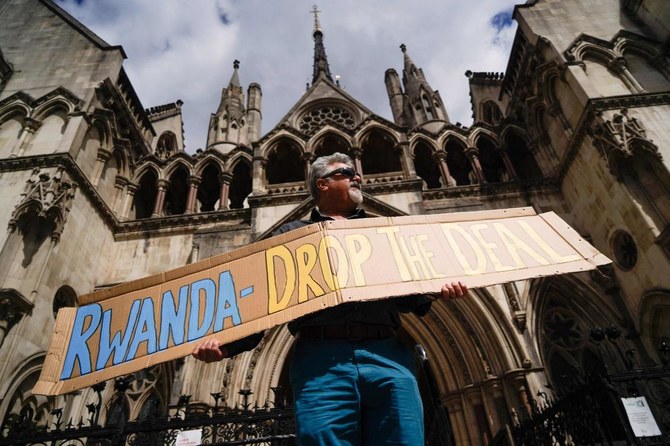
LONDON: A British court ruled Thursday that a UK government plan to send asylum-seekers on a one-way trip to Rwanda is unlawful, delivering a blow to the Conservative administration’s pledge to stop migrants making risky journeys across the English Channel.
In a split two-to-one ruling, three Court of Appeal judges said Rwanda could not be considered a “safe third country” where migrants from any country could be sent.
But the judges said that a policy of deporting asylum seekers to another country deemed safe was not in itself illegal, and the government said it would challenge the ruling at the UK Supreme Court. It has until July 6 to lodge an appeal.
Prime Minister Rishi Sunak said that “while I respect the court I fundamentally disagree with their conclusions.”
Sunak has pledged to “stop the boats” — a reference to the overcrowded dinghies and other small craft that make the journey from northern France carrying migrants who hope to live in the UK More than 45,000 people arrived in Britain across the Channel in 2022, and several died in the attempt.
The UK and Rwandan governments agreed more than a year ago that some migrants who arrive in the UK as stowaways or in small boats would be sent to Rwanda, where their asylum claims would be processed. Those granted asylum would stay in the East African country rather than return to Britain.
The UK government argues that the policy will smash the business model of criminal gangs that ferry migrants on hazardous journeys across one of the world’s busiest shipping lanes.
Home Secretary Suella Braverman, who is known for her hard-line rhetoric about migrants, said after the ruling that the existing asylum system “incentivizes mass flows of economic migration into Europe, lining the pockets of people smugglers and turning our seas into graveyards, all in the name of a phony humanitarianism.”
Human rights groups say it is immoral and inhumane to send people more than 4,000 miles (6,400 kilometers) to a country they don’t want to live in, and argue that most Channel migrants are desperate people who have no authorized way to come to the UK They also cite Rwanda’s poor human rights record, including allegations of torture and killings of government opponents.
Yasmine Ahmed, UK director of Human Rights Watch, welcomed the verdict and urged Braverman to “abandon this unworkable and unethical fever dream of a policy and focus her efforts on fixing our broken and neglected migration system.”
Britain has already paid Rwanda 140 million pounds ($170 million) under the deal, but no one has yet been deported there.
Britain’s High Court ruled in December that the policy is legal and doesn’t breach Britain’s obligations under the UN Refugee Convention or other international agreements.
But the court allowed a group of claimants, who include asylum-seekers from Iraq, Iran and Syria facing deportation under the government plan, to challenge that decision on issues including whether the plan is “systemically unfair” and whether asylum-seekers would be safe in Rwanda.
In a partial victory for the government, the appeals court ruled Thursday that the UK’s international obligations did not rule out removing asylum-seekers to a safe third country.
But two of the three ruled Rwanda was not safe because its asylum system had “serious deficiencies.” They said asylum seekers “would face a real risk of being returned to their countries of origin,” where they could be mistreated.
Lord Chief Justice Ian Burnett, the most senior judge in England and Wales, disagreed with his two colleagues. He said assurances given by the Rwandan government were enough to ensure the migrants would be safe.
Rwanda insisted the nation is “one of the safest countries in the world.”
“As a society, and as a government, we have built a safe, secure, dignified environment, in which migrants and refugees have equal rights and opportunities as Rwandans,” said government spokeswoman Yolande Makolo. “Everyone relocated here under this partnership will benefit from this.”
However, Rwanda opposition leader Frank Habineza said Britain should not seek to foist its responsibilities on refugees.
“The UK is a bigger country than Rwanda, huge resources, unlike impoverished Rwanda,” he said. “Sending migrants to Rwanda, the UK will be relinquishing responsibility of protecting those running to the UK for safety.”
Even if the plan is ultimately ruled legal, it’s unclear how many people could be sent to Rwanda. The government’s own assessment acknowledges it would be extremely expensive, coming in at an estimated 169,000 pounds ($214,000) per person.
But it is doubling down on the idea, drafting legislation barring anyone who arrives in the UK in small boats or by other unauthorized means from applying for asylum. If passed, the bill would compel the government to detain all such arrivals and deport them to their homeland or a safe third country.
Refugee law expert David Cantor said the ruling would “send a ripple effect more widely through this idea of sending asylum seekers to third countries.”
“Any country that might wish to enter into this kind of memorandum with the UK government, as Rwanda did, would equally be quite likely to be a government which had weak asylum procedures, (where) there were questions about safety in the country,” said Cantor, director of the Refugee Law Initiative at the University of London’s School of Advanced Study.
He said the UK “has had negotiations with many countries which do have robust court structures and asylum procedures, and there’s very little willingness there to contemplate these sorts of schemes.”


![]()

UK government vows to challenge court ruling that its plan to send migrants to Rwanda is unlawful
Short Url
https://arab.news/m9pfn
UK government vows to challenge court ruling that its plan to send migrants to Rwanda is unlawful
- In a split two-to-one ruling, three Court of Appeal judges said Rwanda could not be considered a “safe third country”


Latest updates


Recommended


© 2026 SAUDI RESEARCH & PUBLISHING COMPANY, All Rights Reserved And subject to Terms of Use Agreement.