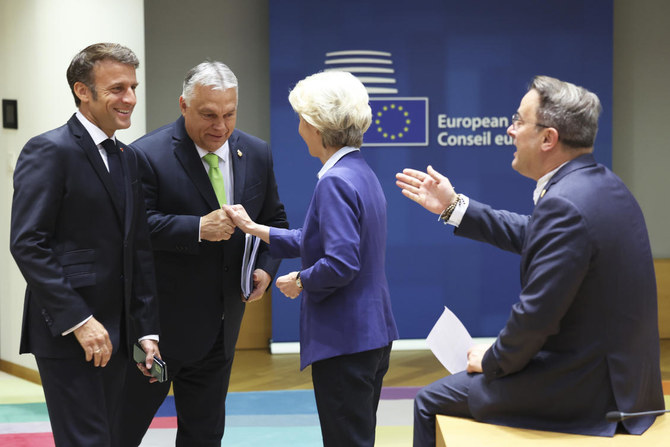
BRUSSELS: European Union leaders opened a second day of migration talks Friday as Poland and Hungary continued to block progress after they were outvoted earlier this month on a plan to share refugees arriving in Europe among the 27 member countries.
Some leaders said that Poland and Hungary seemed to be fighting a battle started years ago, when well over 1 million migrants entered Europe, most of them refugees fleeing Syria, in 2015 and sparked one of the bloc’s biggest crises. Others said the two simply must not be permitted to break EU rules.
“My feeling was there’s a lot of bitterness about the debates on migration from 2015,” Estonian Prime Minister Kaja Kallas told reporters at EU headquarters in Brussels. “If you just say no to everything and everybody else tries to compromise that doesn’t really work out.”
Slovenian Prime Minister Robert Golob said that “Hungary was totally adamant” about having the issue removed altogether from the leader’s final summit communique. “It was not about let’s do it this way or the other way. It was like, ‘we don’t want to see migration being mentioned at all.’”
Golob confirmed that European Council President Charles Michel, who is chairing the summit, is likely to issue a separate chairman’s statement that does not require the endorsement of member countries.
Earlier this month, EU countries made a breakthrough on asylum law reform, sealing an agreement on a plan to share responsibility for migrants entering Europe without authorization.
The deal balanced the obligation for countries where most migrants arrive to process and lodge them against the requirement for other members to provide support, whether financial or by hosting refugees. Countries refusing to take migrants in could pay 20,000 euros ($21,400) per person instead.
The agreement was sealed with a qualified majority vote of around two-thirds. Only Poland and Hungary voted against. Their aim at the summit has been to challenge the legal validity of that decision.
Prime Minister Viktor Orban told Hungarian state radio he would continue blocking new migration rules until consensus was reached, casting the proposal as a grave threat to his country.
“We will only accept any rule if everyone agrees on it, if there’s a consensus decision,” Orban said Friday.
“They want to require us to build migrant ghettos in Hungary,” he continued. “We do not intend to carry out these decisions, we say this openly.”
Luxembourg Prime Minister Xavier Bettel said that caving in to such demands would set a dangerous precedent.
“The fact is, Poland and Hungary do not agree with the (EU) treaty,” he told reporters. “It has been decided, so we cannot come back and say now, ‘ok, we do not agree,’ because then everybody will open the list of all the decisions we took the last 10 years.”
Ahead of the meeting, Poland’s prime minister had insisted that his country wouldn’t be forced to accept European Union rules on migration, and he vowed to veto any plan that might force countries to take in refugees.
“An attack on Europe is underway. Europe’s borders are not secure. The safety of the inhabitants of our continent is at stake,” Prime Minister Mateusz Morawiecki said in a video statement. He said he would propose “a plan for secure borders” to the leaders.
Morawiecki said that his “plan is clear — ‘no’ to forced relocation of immigrants, ‘no’ to violations of veto rights by individual states and ‘no’ to violations of the principle of freedom, the principle of decision-making by states alone, ‘no’ to Brussels-imposed penalties on states.”
Poland and Hungary, along with the Czech Republic, refused to accept migrant quotas hastily imposed in 2015. The EU’s top court ruled in 2020 that they had failed to respect the bloc’s laws.
The number of people trying to enter the EU without authorization is on the rise. The border and coast guard agency Frontex said that more than 50,300 attempts were made from January to May. It’s more than double in the same period last year, and the most since 2017. But migrant arrivals in Europe dwarf those seen in Turkiye, Lebanon or Jordan.
At the same time, Poland is looking after around 1 million refugees from Ukraine.
While Hungary and Poland are unlikely to succeed in their quest to have the rules overturned, their anti-immigrant stance — backed by other members like Austria, Denmark or Sweden — has helped ensure that the EU’s policies focus on keeping people out and quickly deporting those not entitled to stay.


![]()


EU leaders resume migration talks as Poland and Hungary demand that the rules be changed
Short Url
https://arab.news/bgpb6
EU leaders resume migration talks as Poland and Hungary demand that the rules be changed
- Some leaders said that Poland and Hungary seemed to be fighting a battle started years ago, when well over 1 million migrants entered Europe


US judge blocks Trump admin from detaining refugees in Minnesota
MINNEAPOLIS: A US federal judge temporarily blocked the administration of President Donald Trump Wednesday from detaining refugees in Minnesota awaiting permanent resident status and ordered the release of those in detention.
Trump has sent thousands of federal immigration agents to the Democratic state as part of a sweeping crackdown that has sparked outrage over two civilian deaths at the hands of officers.
Authorities launched a program this month to re-examine the legal status of the approximately 5,600 refugees in Minnesota who have not yet been given green cards.
In his order Wednesday, US District Judge John Tunheim said that the Trump administration could continue to enforce immigration laws and review refugees’ status, but that it must do so “without arresting and detaining refugees.”
“Refugees have a legal right to be in the United States, a right to work, a right to live peacefully — and importantly, a right not to be subjected to the terror of being arrested and detained without warrants or cause in their homes or on their way to religious services or to buy groceries,” Tunheim wrote.
“At its best, America serves as a haven of individual liberties in a world too often full of tyranny and cruelty. We abandon that ideal when we subject our neighbors to fear and chaos.”
The order drew a quick rebuke from White House Deputy Chief of Staff Stephen Miller, a powerful figure who leads Trump’s hard-line immigration policy.
“The judicial sabotage of democracy is unending,” Miller wrote on X.
Tunheim’s order requires any refugee detained under the Minnesota status review, known as Operation PARRIS, to be “immediately released from custody.”
Refugees awaiting their permanent resident status “have undergone rigorous background checks and vetting, been approved by multiple federal agencies for entry, been given permission to work, received support from the government, and been resettled in the United States,” Tunheim wrote.
“These individuals were admitted to the country, have followed the rules, and are waiting to have their status adjusted to lawful permanent residents of the United States.”
Trump has sent thousands of federal immigration agents to the Democratic state as part of a sweeping crackdown that has sparked outrage over two civilian deaths at the hands of officers.
Authorities launched a program this month to re-examine the legal status of the approximately 5,600 refugees in Minnesota who have not yet been given green cards.
In his order Wednesday, US District Judge John Tunheim said that the Trump administration could continue to enforce immigration laws and review refugees’ status, but that it must do so “without arresting and detaining refugees.”
“Refugees have a legal right to be in the United States, a right to work, a right to live peacefully — and importantly, a right not to be subjected to the terror of being arrested and detained without warrants or cause in their homes or on their way to religious services or to buy groceries,” Tunheim wrote.
“At its best, America serves as a haven of individual liberties in a world too often full of tyranny and cruelty. We abandon that ideal when we subject our neighbors to fear and chaos.”
The order drew a quick rebuke from White House Deputy Chief of Staff Stephen Miller, a powerful figure who leads Trump’s hard-line immigration policy.
“The judicial sabotage of democracy is unending,” Miller wrote on X.
Tunheim’s order requires any refugee detained under the Minnesota status review, known as Operation PARRIS, to be “immediately released from custody.”
Refugees awaiting their permanent resident status “have undergone rigorous background checks and vetting, been approved by multiple federal agencies for entry, been given permission to work, received support from the government, and been resettled in the United States,” Tunheim wrote.
“These individuals were admitted to the country, have followed the rules, and are waiting to have their status adjusted to lawful permanent residents of the United States.”
Latest updates


© 2026 SAUDI RESEARCH & PUBLISHING COMPANY, All Rights Reserved And subject to Terms of Use Agreement.