

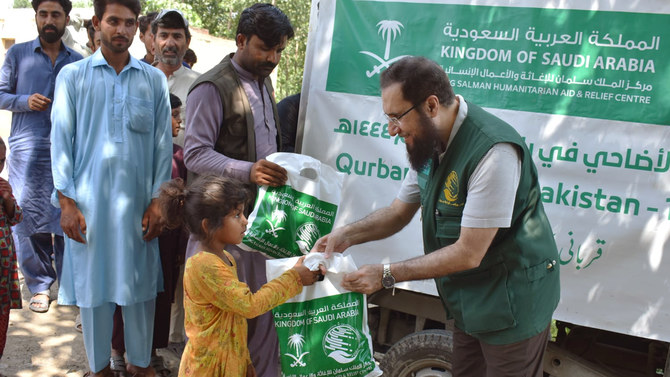
KSrelief distributes sacrificial meat in seven Pakistani districts

KSrelief workers distribute meat among low income communities on June 29, 2023. (Photo courtesy: KSrelief)
Short Url
Updated 30 June 2023
Follow

KSrelief distributes sacrificial meat in seven Pakistani districts

  • KSrelief has one of the largest humanitarian budgets for aid agencies across the world
  • Pakistan is the fifth largest beneficiary of the organization’s aid operations

ISLAMABAD: The King Salman Humanitarian Aid and Relief Center (KSrelief) has distributed sacrificial meat in seven Pakistani districts in Pakistan this Eid Al-Adha, the charity said in a statement. 

KSrelief, with one of the largest budgets for aid agencies across the world, has been undertaking humanitarian projects across 88 countries. Pakistan is the fifth largest beneficiary of the organization’s aid operations.

“King Salman Humanitarian Aid and Relief Center has implemented the Qurbani Project 1444H in Pakistan,” the statement said. 

“KSrelief has organized the sacrifice of 1700 sheeps on the occasion of Eid-ul-Adha in Seven districts of Pakistan so that deserving and affected people can also benefit from the sacrificial meat on eid day.”

“Under this program, sacrificial meat will be distributed in 7 districts of Khyber Pakhtunkhwa (Nowshera, D.I Khan, Swat, Dir upper, Koli palus/Kohistan, Mardan, and Charsadda) so that these people can also enjoy Eid,” KSRelief said. 

“This sacrificial program is carried out in collaboration with the National Disaster Management Authority, local government and local NGO. More than 79331 people will benefit from this project.”


Pakistan cabinet reviews private Hajj policy as mandatory pilgrim training enforced

Updated 14 January 2026
Follow

Pakistan cabinet reviews private Hajj policy as mandatory pilgrim training enforced

  • Cabinet sends draft Private Hajj Policy 2027–2030 to committee for further review
  • Religion minister warns pilgrims who skip mandatory training will be barred from Hajj

ISLAMABAD: Pakistan’s federal cabinet on Wednesday reviewed proposals for stricter oversight of private Hajj operators, as authorities separately warned that pilgrims who failed to complete mandatory training would be barred from performing Hajj next year.

The cabinet, chaired by Prime Minister Shehbaz Sharif, was briefed on a draft Private Hajj Policy for 2027–2030, which includes third-party registration and scrutiny of private Hajj operator companies, according to a statement from the Prime Minister’s Office.

“The Federal Cabinet directed that the draft Private Hajj Policy 2027–2030, presented by the Ministry of Religious Affairs and Interfaith Harmony regarding third-party registration and scrutiny of private Hajj operators’ companies, be referred to the Hajj Policy Committee for further deliberation in light of the views of Cabinet members,” the prime minister’s office said in a statement.

The development comes as Religious Affairs Minister Sardar Muhammad Yousaf said on Wednesday pilgrims who failed to attend both phases of mandatory Hajj training would not be allowed to perform the pilgrimage.

“Pilgrims who do not complete mandatory Hajj training will be barred from performing Hajj,” the ministry quoted Yousaf as saying during a training workshop in Islamabad.

Around 120,000 pilgrims are currently undergoing training at 200 locations nationwide, with the second phase scheduled to begin after Ramadan. The training aims to familiarize pilgrims with Saudi laws, Hajj rituals and safety protocols to prevent accidents in crowded areas.

Saudi Arabia has allocated 179,210 pilgrims to Pakistan for Hajj 2026, including about 118,000 seats under the government scheme, while the remainder will be handled by private tour operators.

Under Pakistan’s government Hajj package, the estimated cost ranges from Rs1.15 million to Rs1.25 million ($4,049.93 to $4,236), subject to final agreements with service providers.