

The untold heroism of Saudi Red Crescent Authority

1 / 3
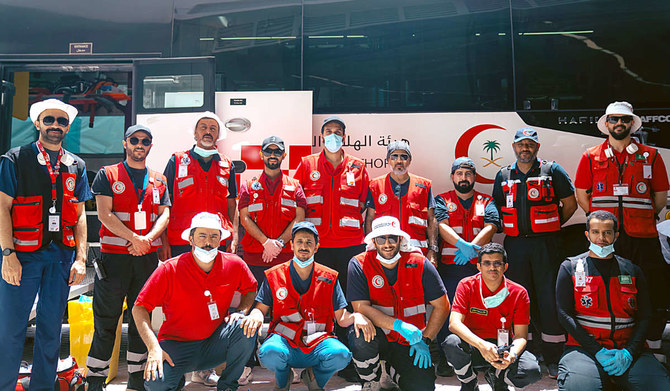
The Tuwaiq medical bus, a state-of-the-art facility equipped with 10 medical beds, has been utilized during Hajj to treat pilgrims experiencing heatstroke and other ailments. (AN photos by Abdulrahman Bin Shalhoubh)
2 / 3
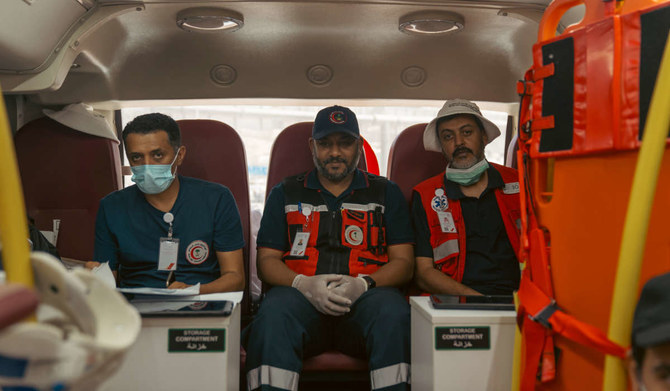
The Tuwaiq medical bus, a state-of-the-art facility equipped with 10 medical beds, has been utilized during Hajj to treat pilgrims experiencing heatstroke and other ailments. (AN photos by Abdulrahman Bin Shalhoubh)
3 / 3
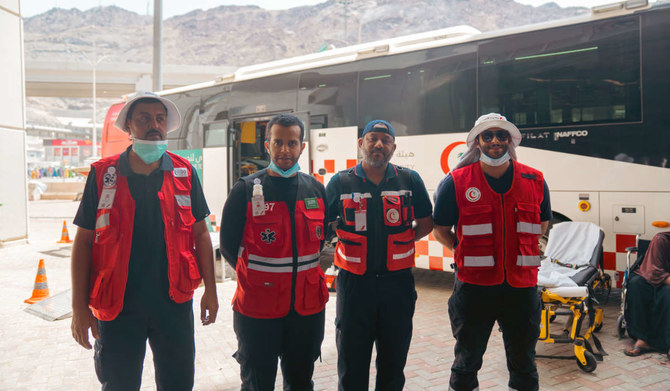
The Tuwaiq medical bus, a state-of-the-art facility equipped with 10 medical beds, has been utilized during Hajj to treat pilgrims experiencing heatstroke and other ailments. (AN photos by Abdulrahman Bin Shalhoubh)
Short Url
Updated 30 June 2023
Follow

The untold heroism of Saudi Red Crescent Authority

  • High-tech Tuwaiq bus delivers important help to Hajj pilgrims

JAMARAT: The dedicated team from the Saudi Red Crescent Authority — comprising doctors, paramedics, and medical specialists — stands prepared in the intense summer heat, armed with its medical equipment. Its personnel are ready to address any medical issues that pilgrims may encounter during their Hajj journey.

Mohammed Tarraf, the authority’s paramedic team leader, told Arab News: “I am very happy to be able to help the people in Hajj, and I am very proud to (have) the chance to help them.”

Tarraf, an experienced paramedic, has been serving during Hajj for three years. Utilizing his wealth of experience, he takes charge of a team of 14 individuals during each shift in Jamarat.


The Tuwaiq medical bus, a state-of-the-art facility equipped with 10 medical beds, has been utilized during Hajj to treat pilgrims experiencing heatstroke and other ailments. (AN photos by Abdulrahman Bin Shalhoubh)

Tarraf said it was important for him and his team to be present during Hajj. Their priority is to deliver top-notch medical care to the pilgrims, ensuring their well-being throughout the journey.

He quoted a line in the Qur’an to refer to his passion for saving the lives of pilgrims, saying: “And whoever saves a life, it is as though he had saved the lives of all mankind.”  

The Saudi Red Crescent Authority team is honored at serving the pilgrims’ pivotal Islamic pilgrimage to the holy city of Makkah this year.  

HIGHLIGHT

Equipped with advanced equipment and a specialized medical bus, the team works tirelessly in rotating shifts across the holy sites, ensuring the well-being of the pilgrims and upholding the spirit of the Hajj.

With the lifting of COVID-19 restrictions, this year’s Hajj season has witnessed a significant increase in the number of pilgrims. It is the largest attendance since 2019, with over 1.8 million pilgrims in the sacred city of Makkah to partake in the pilgrimage.

According to a recent statistic on its Twitter page, as of the 10th day of Dul Hijjah on Wednesday, the authority had received a total of 9,531 calls.

It said that 293 of those had come from within the Grand Mosque; 2,125 from Makkah; and 7,113 from sacred sites such as Arafat, Muzdalifah, Mina, and Jamarat.

According to the authority, within Arafat and Muzdalifah there were 27 ambulatory centers, 286 specialized teams, and more than 560 health practitioner volunteers ready to treat pilgrims.

The professionals of the Saudi Red Crescent Authority have been tirelessly working in rotating 12-hour shifts across various areas of the sacred sites.

Their efforts align with the movement of pilgrims as they progress through the different stages of their pilgrimage.

Tarraf said: “There are other teams arriving during the mornings and the nights.”

He explained that his colleagues had undergone specialized training to equip them with the necessary skills and knowledge to handle any potential medical emergencies.

The head paramedic allowed Arab News to inspect the authority’s Tuwaiq medical bus, which is a state-of-the-art facility equipped with 10 medical beds specifically designed to help in the treatment of victims during situations of “massive or multiple casualties.”

The bus has been used during Hajj to help pilgrims suffering from heatstroke, along with other complaints.

Tarraf told Arab News: “We saw many patients during Hajj, including some with abdominal pain, heatstroke, and general body weakness.

“(Our duty) is to provide first aid for the patient, and if the patient needs any medications or any interventions, we have doctors here and specialists for that.”

One of the doctors working with Tarraf’s team was Dr. Mohammed Al-Zubair.  

Focusing on the bus, Al-Zubair said: “We have lots of equipment. One item is an amazing device called Lifepak 15 that can monitor vital signs like pulse, oxygen saturation, and blood pressure.

“The device can also support patients with bradycardia, tachycardia, and arrhythmia.

“It is an amazing device and we use it to help patients and pilgrims.”


Riyadh takes shape at Tuwaiq Sculpture Symposium 2026

Updated 16 January 2026
Follow

Riyadh takes shape at Tuwaiq Sculpture Symposium 2026

RIYADH: This season, one of Riyadh’s busiest streets has taken on an unexpected role.

Under the theme “Traces of What Will Be,”sculptors are carving granite and shaping reclaimed metal at the seventh Tuwaiq Sculpture Symposium, running from Jan. 10 to Feb. 22.

The symposium is unfolding along Prince Mohammed bin Abdulaziz Road, known locally as Al‑Tahlia, a name that translates to desalination. The choice of location is deliberate.

The area is historically linked to Riyadh’s early desalination infrastructure, a turning point that helped to shift the city from water scarcity toward long‑term urban growth.

Twenty‑five artists from 18 countries are participating in this year’s event, producing large‑scale works in an open‑air setting embedded within the city.

The site serves as both workplace and eventual exhibition space, with sculptures remaining in progress throughout the symposium’s duration.

In her opening remarks, Sarah Al-Ruwayti, director of the Tuwaiq Sculpture Symposium, said that this year new materials had been introduced, including recycled iron, reflecting a focus on sustainability and renewal.

She added that the live-sculpting format allowed visitors to witness the transformation of raw stone and metal into finished artworks.

Working primarily with local stone and reclaimed metal, the participating artists are responding to both the material and the place.

For Saudi sculptor Wafaa Al‑Qunaibet, that relationship is central to her work, which draws on the physical and symbolic journey of water.

“My work … presents the connection from the salted water to sweet water,” Al‑Qunaibet told Arab News.

Using five pieces of granite and two bronze elements, she explained that the bronze components represented pipes, structures that carry saline water and allow it to be transformed into something usable.

The sculpture reflected movement through resistance, using stone to convey the difficulty of that transition, and water as a force that enables life to continue.

“I throw the stone through the difficult to show how life is easy with the water,” she said, pointing to water’s role in sustaining trees, environments and daily life.

Formally, the work relies on circular elements, a choice Al‑Qunaibet described as both technically demanding and socially resonant.

“The circle usually engages the people, engages the culture,” she said. Repeated circular forms extend through the work, linking together into a long, pipe‑like structure that reinforces the idea of connection.

Sculpting on site also shaped the scale of the piece. The space and materials provided during the symposium allowed Al‑Qunaibet to expand the work beyond her initial plans.

The openness of the site pushed the sculpture toward a six‑part configuration rather than a smaller arrangement.

Working across stone, steel, bronze and cement, American sculptor Carole Turner brings a public‑art perspective to the symposium, responding to the site’s historical and symbolic ties to desalination.

“My work is actually called New Future,” Turner told Arab News. “As the groundwater comes up, it meets at the top, where the desalination would take place, and fresh water comes down the other side.”

Her sculpture engages directly with the symposium’s theme by addressing systems that often go unseen. “Desalination does not leave a trace,” she said. “But it affects the future.”

Turner has been sculpting for more than two decades, though she describes making objects as something she has done since childhood. Over time, she transitioned into sculpture as a full‑time practice, drawn to its ability to communicate across age and background.

Public interaction remains central to her approach. “Curiosity is always something that makes you curious, and you want to explore it,” she said. Turner added that this sense of discovery is especially important for children encountering art in public spaces.

Saudi sculptor Mohammed Al‑Thagafi’s work for this year’s symposium reflects ideas of coexistence within Riyadh’s evolving urban landscape, focusing on the relationships between long‑standing traditions and a rapidly changing society.

The sculpture is composed of seven elements made from granite and stainless steel.

“Granite is a national material we are proud of. It represents authenticity, the foundation, and the roots of Saudi society,” Al‑Thagafi told Arab News.

“It talks about the openness happening in society, with other communities and other cultures.”

That dialogue between materials mirrors broader social shifts shaping the capital, particularly in how public space is shared and experienced.

Because the sculpture will be installed in parks and public squares, Al‑Thagafi emphasized the importance of creating multi‑part works that invite engagement.

Encountering art in everyday environments, he said, encouraged people to question meaning, placement, simplicity and abstraction, helping to build visual‑arts awareness across society.

For Al‑Thagafi, this year marked his fifth appearance at the symposium. “I have produced more than 2,600 sculptures, and here in Riyadh alone, I have more than 30 field works.”

Because the works are still underway, visitors can also view a small on‑site gallery displaying scaled models of the final sculptures.

These miniature models offer insight into each artist’s planning process, revealing how monumental forms are conceived before being executed at full scale.

As the symposium moves toward its conclusion, the completed sculptures will remain on site, allowing the public to encounter them in the environment that shaped their creation.