



PARIS: Astronomers across the world announced on Thursday that they have found the first evidence of a long-theorized form of gravitational waves that create a “background hum” rumbling throughout the universe.
The breakthrough — made by hundreds of scientists using radio telescopes in North America, Europe, China, India and Australia after years of work — was hailed as a major milestone that opens a new window into the universe.
First predicted by Albert Einstein more than a century ago, gravitational waves are ripples in the fabric of the universe that travel through everything at the speed of light almost entirely unimpeded.
Their existence was not confirmed until 2015, when the US and Italian observatories detected the first gravitational waves created by two black holes colliding.
These “high-frequency” waves were the result of a single violent event that sends a strong, short burst rippling toward Earth.
But for decades scientists have been searching for low-frequency gravitational waves, thought to be constantly rolling through space like background noise.
Joining forces under the banner of the International Pulsar Timing Array consortium, scientists working at gravitational wave detectors on several continents revealed on Thursday they have finally found strong evidence of these background waves.
“We now know that the universe is awash with gravitational waves,” Michael Keith of the European Pulsar Timing Array told AFP.
An artistic interpretation of an array of pulsars being affected by gravitational ripples produced by a supermassive black hole binary in a distant galaxy. (Aurore Simonnet/NANOGrav Collaboration/Handout via REUTERS)
As gravitational waves travel through space, they very subtly squeeze and stretch everything they pass through.
To find evidence of this squeezing and stretching at low frequencies, astronomers looked at pulsars, the dead cores of stars that exploded in a supernova.
Some spin hundreds of times a second, flashing beams of radio waves at extremely regular intervals, like cosmic lighthouses.
This means they can act as “a very, very precise clock,” Keith said.
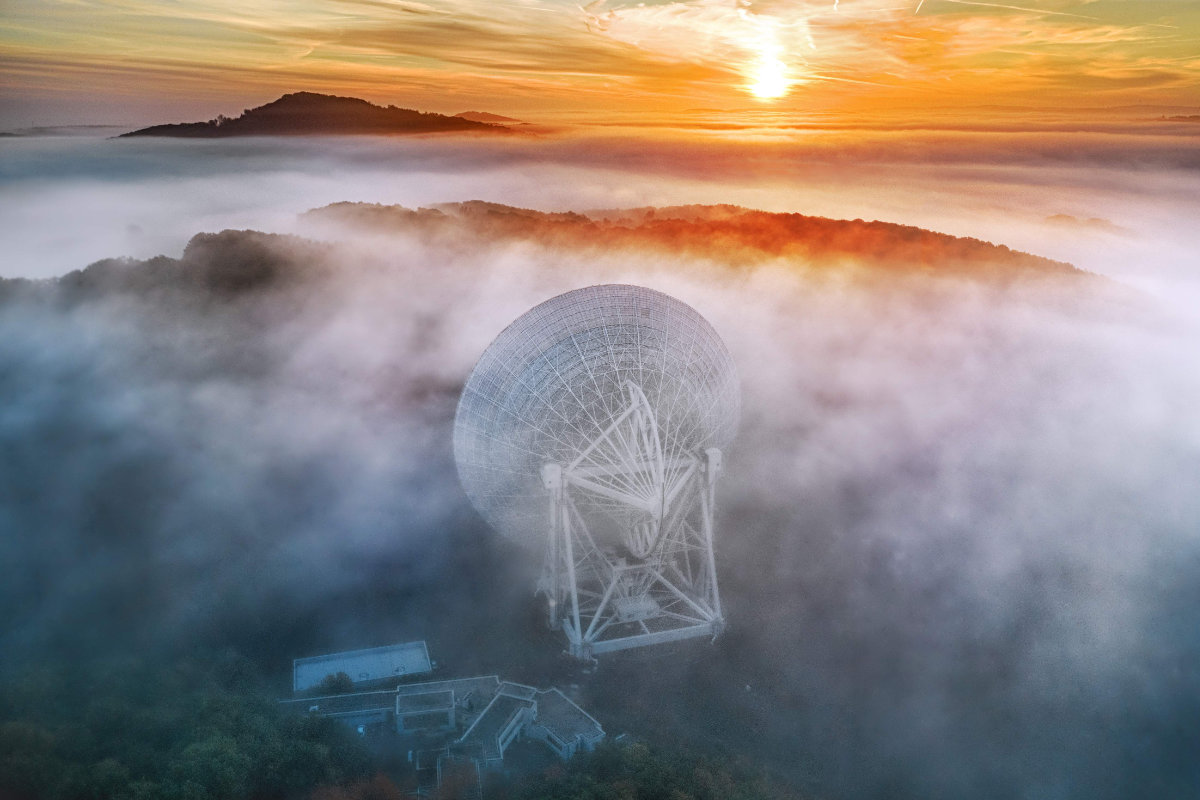
For the new research, radio telescopes around the world were aimed at a total of 115 pulsars throughout the Milky Way.
Scientists then measured the incredibly small differences in the timing of the pulses, searching for telltale signs of gravitational waves.
French astrophysicist Antoine Petiteau said they were able to “detect changes of less than one millionth of a second across more than 20 years.”
Maura McLaughlin of the US Pulsar Search Collaboratory program said they were “awestruck” after first seeing evidence of the waves in 2020.
It was “really a magical moment,” she told a press conference.
The early evidence was consistent with Einstein’s theory of relativity and science’s current understanding of the universe, the scientists said.
But they emphasised they have not yet definitively “detected” the waves, because they have not reached the gold-standard five sigma level of certainty. Five sigma indicates that there is a one-in-a-million chance of something being a statistical fluke.
“We’re frustratingly just shy of the mark,” Keith said, adding that there was a 99-percent probability that the evidence points to gravitational waves.
Each country or group in the consortium published their research separately in a range of journals.
Steve Taylor, chair of North America’s NANOGrav gravitational wave observatory, said that once all the data was combined, the five sigma mark could be reached in a year or two.
The leading theory is that the waves are coming from pairs of supermassive black holes sitting at the center of galaxies that are slowly merging.
Unlike those that caused the previously detected gravitational waves, these black holes are almost unimaginably huge — sometimes billions of times bigger than the Sun.
Daniel Reardon, a member of Australia’s Parkes Pulsar Timing Array, told AFP that — if confirmed — the waves would be “the sum of all of the supermassive black hole binary systems whirling around each other at the cores of galaxies everywhere in the universe.”
Keith said the “background hum of all these black holes” was “like sitting in a noisy restaurant and hearing all these people talking.”
Another theory is that the gravitational waves could be from the rapid expansion that came within a second after the Big Bang, a period called cosmic inflation that is hidden from the view of scientists.
Keith said the galaxies between Earth and the Big Bang were likely “drowning out” such waves.
But in the future, low-frequency gravitational waves could reveal more about this early expansion and possibly shed light on the mystery of dark matter, the scientists said.
It could also help them understand more about how black holes and galaxies form and evolve.


