

Scientists detect Einstein gravitational waves for a third time

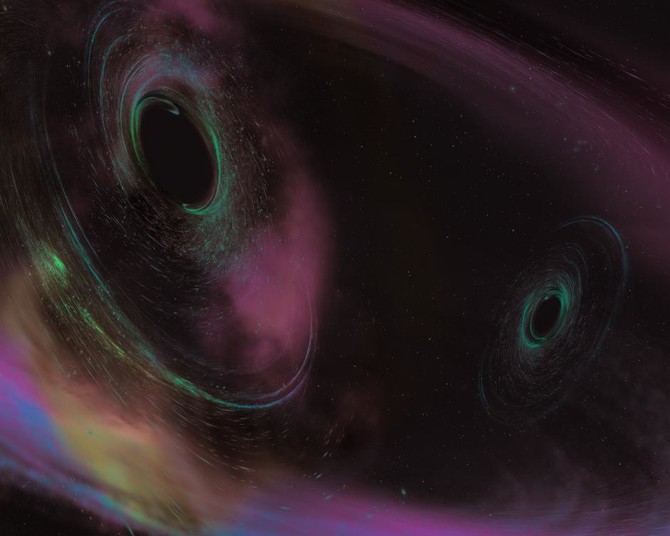
An artist's rendering showing two merging black holes similar to those detected by Laser Interferometer Gravitational-wave Observatory (LIGO) in this handout provided June 1. 2017. (Courtesy of Caltech/MIT/LIGO Laboratory/Handout via Reuters)
Updated 02 June 2017
Follow

Scientists detect Einstein gravitational waves for a third time

Scientists have for a third time detected ripples in space from black holes that crashed together billions of light years from Earth, a discovery that confirms a new technique for observing cataclysmic events in the universe, research published on Thursday shows.
Such vibrations, known as gravitational waves, were predicted by Albert Einstein more than 100 years ago and were detected for the first time in September 2015. They are triggered by massive celestial objects that crash and merge, setting off ripples through space and across time.
The latest detection occurred on Jan. 4, 2017. Twin lasers in Louisiana and Washington picked up the faint vibrations of two black holes that were 20 and 30 times more massive than the sun, respectively, before they spiraled toward each other and merged into a larger black hole.
The discovery marks a turning point in the nascent field of gravitational-wave astronomy, which scientists are developing to learn more about how the universe formed. The first detection of gravitational waves created a scientific sensation.

WATCH: Videographic showing colliding black holes

“We’re really moving from novelty to a new observational science,” said Massachusetts Institute of Technology astrophysicist David Shoemaker.

A team of more than 1,000 scientists published their findings in this week’s issue of Physical Review Letters.
Like the previous two detections, the gravitational waves discovered in January slightly jiggled the L-shaped, 2.5 mile-long (4 km) laser beams that comprise the heart of the Laser Interferometer Gravitational-Wave Observatory, or LIGO.
By matching the shape of the waves with computer models, scientists confirmed the collision took place about 3 billion light years from Earth, twice as far as previous detections.
Black holes are regions so dense with matter that not even photons of light can escape their gravitational pull.
Analysis shows the pair likely were spinning in different directions before merging, a clue that they formed separately in a dense cluster of stars, sank to the core of the cluster and then paired up, Georgia Institute of Technology physicist Laura Cadonati told reporters during a conference call.
A second gravitational wave observatory in Italy is scheduled to begin operations this summer and will enhance LIGO’s ongoing studies. Scientists eventually expect to be able to find black holes merging about once a day.
They also are on the hunt for other objects, including colliding neutron stars, which are the dense remnants of collapsed stars so packed with matter that a single teaspoon would weigh 10 million tons on Earth.

Apple to update EU browser options, make more apps deletable

Updated 22 August 2024
Follow

Apple to update EU browser options, make more apps deletable

  • iPhone maker came under pressure from regulators to make changes after the EU’s sweeping Digital Markets Act took effect on March 7
  • Apple users will be able to select a default browser directly from the choice screen after going through a mandatory list of options

STOCKHOLM: Apple will change how users choose browser options in the European Union, add a dedicated section for changing default apps, and make more apps deletable, the company said on Thursday.
The iPhone maker came under pressure from regulators to make changes after the EU’s sweeping Digital Markets Act took effect on March 7, forcing big tech companies to offer mobile users the ability to select from a list of available web browsers on a “choice screen.”
The new rules require mobile software makers to show the choice screen where users can select a browser, search engine and virtual assistant as they set up their phones, which earlier came with preferred options from Apple and Google.
In an update later this year, Apple users will be able to select a default browser directly from the choice screen after going through a mandatory list of options.
A randomly ordered list of 12 browsers per EU country will be shown to the user with short descriptions, and the chosen one will be automatically downloaded, Apple said. The choice screen will also be available on iPads through an update later this year.
Apple released a previous update in response to the new rules in March, but browser companies criticized the design of its choice screen, and the Commission opened an investigation on March 25 saying it suspected that the measures fell short of effective compliance.
The company said it has been in dialogue with the European Commission and believes the new changes will address regulators’ concerns.
It also plans to introduce a dedicated area for default apps where a user will be able to set defaults for messaging, phone calls, spam filters, password managers and keyboards.
Users will also be able to delete certain Apple-made apps such as App Store, Messages, Camera, Photos and Safari. Only Settings and Phone apps would not be deletable.