




PORTLAND, Maine: Human remains have likely been recovered from the wreckage of the submersible that imploded during an underwater voyage to view the Titanic, the US Coast Guard said Wednesday.
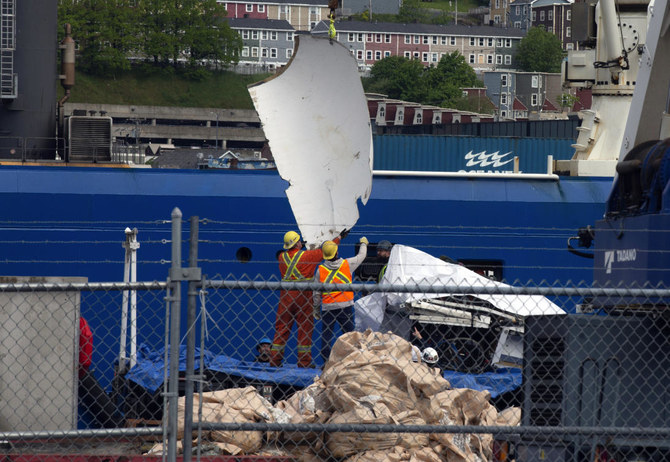
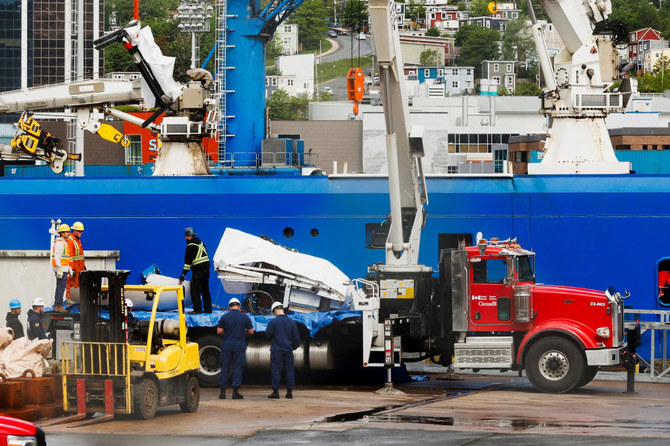
The news came hours after the announcement that debris from the Titan, collected from the seafloor more than 12,000 feet (3,658 meters) below the surface of the North Atlantic, had arrived in St. John’s, Newfoundland. Twisted chunks of the submersible were unloaded at a Canadian Coast Guard pier.
Recovering and scrutinizing the wreckage is a key part of the investigation into why the Titan imploded last week, killing all five people on board. The multiday search and eventual recovery of debris from the 22-foot (6.7-meter) vessel captured the world’s attention.
“There is still a substantial amount of work to be done to understand the factors that led to the catastrophic loss of the Titan and help ensure a similar tragedy does not occur again,” Coast Guard Chief Capt. Jason Neubauer said in a statement released late Wednesday afternoon.
The “presumed human remains” will be brought to the United States, where medical professionals will conduct a formal analysis, Neubauer said. He added that the Coast Guard has convened an investigation of the implosion at the highest level. The Marine Board of Investigation will analyze and test evidence, including pieces of debris, at a port in the US The board will share the evidence at a future public hearing whose date has not been determined, the Coast Guard said.
Neubauer said the evidence will provide “critical insights” into the cause of the implosion.
Debris from the Titan, which is believed to have imploded on June 18 as it made its descent, was located about 12,500 feet (3,810 meters) underwater and roughly 1,600 feet (488 meters) from the Titanic on the ocean floor. The Coast Guard is leading the investigation, in conjunction with several other government agencies in the US and Canada.
Authorities have not disclosed details of the debris recovery, which could have followed several approaches, according to Carl Hartsfield, who directs a lab at the Woods Hole Oceanographic Institution that designs and operates autonomous underwater vehicles and has been serving as a consultant to the Coast Guard.
“If the pieces are small, you can collect them together and put them in a basket or some kind of collection device,” Hartsfield said Monday. Bigger pieces could be retrieved with a remote-operated vehicle, or ROV, such as the one brought to the wreckage site by the Canadian ship Horizon Arctic to search the ocean floor. For extremely big pieces, a heavy lift could be used to pull them up with a tow line, he said.
Representatives for Horizon Arctic did not respond to requests for comment. The ROV’s owner, Pelagic Research Services, a company with offices in Massachusetts and New York, is “still on mission” and cannot comment on the investigation, company spokesperson Jeff Mahoney said Wednesday.
“They have been working around the clock now for 10 days, through the physical and mental challenges of this operation,” Mahoney said.
Analyzing the recovered debris could reveal important clues about what happened to the Titan, and there could be electronic data recorded by the submersible’s instruments, Hartsfield said.
“So the question is, is there any data available? And I really don’t know the answer to that question,” he said Monday.
The Transportation Safety Board of Canada, which is conducting a safety investigation into the Titan’s Canadian-flagged mother ship, the Polar Prince, said Wednesday that it has sent that vessel’s voyage data recorder to a lab for analysis.
Stockton Rush, the Titan’s pilot and CEO of OceanGate Expeditions, the company that owned the submersible, was killed in the implosion along with two members of a prominent Pakistani family, Shahzada Dawood and his son Suleman Dawood; British adventurer Hamish Harding; and Titanic expert Paul-Henri Nargeolet.
OceanGate is based in the US but the submersible was registered in the Bahamas.
The company charged passengers $250,000 each to participate in the voyage. The implosion of the Titan has raised questions about the safety of private undersea exploration operations. The Coast Guard wants to use the investigation to improve the safety of submersibles.


