

After US-India statement, Washington acknowledges Islamabad’s ‘important steps’ to counter terrorism

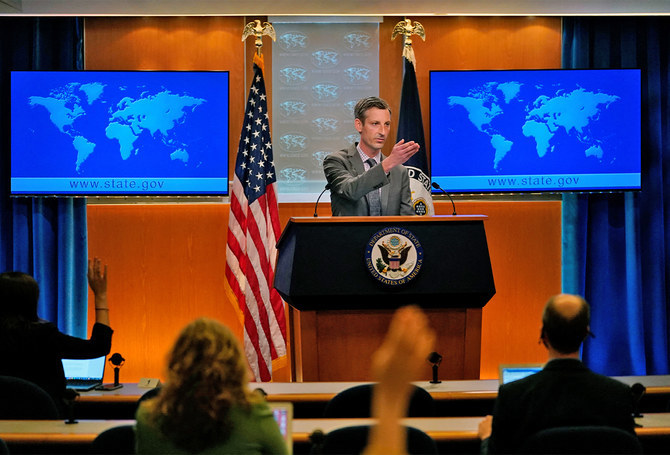
In this file photo, taken on March 31, 2021, US State Department spokesman Ned Price takes questions from reporters during a press briefing at the State Department in Washington, DC. (AFP/File)
Short Url
Updated 27 June 2023
Follow

After US-India statement, Washington acknowledges Islamabad’s ‘important steps’ to counter terrorism

  • Biden and Modi released statement after meeting at White House on Friday
  • Relations between India and Pakistan have been fraught since 1947

ISLAMABAD: The US State Department said on Monday Pakistan had taken “some important steps” to counter terror groups, while urging it to do more to “permanently disband” outfits like the Lashkar-e-Taiba and Jaish-e-Mohammed, and what Washington described as their various front organizations.

The State Department statement comes as Pakistan’s foreign ministry on Monday summoned the US embassy’s deputy chief of mission to express concern over a statement last week by US President Joe Biden and Indian Prime Minister Narendra Modi that called on Pakistan to ensure its territory was not used as a base for militant attacks.

The statement from the United States and India was released after a meeting between the two countries’ leaders at the White House on Friday and had received criticism from Pakistan, which called it contrary to diplomatic norms.

“We do recognize that Pakistan has taken some important steps to counter terrorist groups in line with the completion of its Financial Action Task Force actions plans,” a State Department spokesperson said, referring to a global financial watchdog that had put Pakistan on a grey list until late last year over weak terror financing controls.

“At the same time, however, we have also been consistent on the importance of Pakistan continuing to take steps to permanently disband all terrorist groups, including Lashkar-e-Taiba, Jaish-e-Mohammed, and their various front organizations. And we will raise the issue regularly with Pakistani officials, and will continue to work together to counter mutual terrorist threats.”

LeT is the group blamed for the 2008 Mumbai attacks in which more than 160 people were killed, while Jaish-e-Mohammad claimed responsibility for a 2019 bombing in Indian Kashmir that killed 40 Indian paramilitary troops.

Earlier on Monday, the Pakistani foreign office urged the US to refrain from issuing statements “that may be construed as an encouragement of India’s baseless and politically motivated narrative against Pakistan.”

“It was also emphasized that counter-terrorism co-operation between Pakistan and the US had been progressing well and that an enabling environment, centered around trust and understanding, was imperative to further solidifying Pakistan-US ties.”

Since independence from Britain in 1947, India and Pakistan have fought three wars, two of them over the Muslim-majority Himalayan region of Kashmir, which they both claim in full but rule in part. Relations between them remain tense.


Pakistanis at remote border describe scramble to leave Iran

Updated 6 sec ago
Follow

Pakistanis at remote border describe scramble to leave Iran

  • Returning Pakistani nationals recount missile fire in Tehran, transport gridlock as people rush to exit Iran
  • PM Sharif condemns targeting of Iranian leader as embassies urge citizens to leave amid escalating strikes

TAFTANT, Pakistan: Pakistani nationals hauled suitcases across the border from neighboring Iran, describing missiles being launched and travel chaos as they scrambled to leave the country after the US and Israel launched strikes over the weekend.

AFP journalists saw a steady trickle of people passing through large metal gates at the remote border crossing between Iran’s Mirjaveh and Taftan in Pakistan’s western Balochistan province.

Powerful explosions have rocked Iran’s capital Tehran since Saturday, with embassies from countries around the world telling their citizens to leave.

“All our Pakistani brothers who were in Tehran and other cities had started to leave and were arriving at the terminal, which caused a lot of crowd pressure,” 38-year-old trader Ameer Muhammad told AFP on Monday.

“Due to the crowds, there were major transport problems.”

The isolated Taftan border lies around 500 kilometers (310 miles) from Balochistan’s capital and largest city, Quetta.

AFP journalists saw the Iranian flag flying at half-mast as soldiers stood guard.

Most people wheeled bulky luggage over the frontier’s foot crossing, while freight lorries formed a long line.

Irshad Ahmed, a 49-year-old pilgrim, told AFP he was staying at a hostel in Tehran when he saw missiles being fired nearby.

“There was an army base near the hostel, and we saw many missiles being fired,” he said.

“After that, we went to the Pakistani embassy so that they could evacuate us from there. They brought us here safely.”

Pakistan’s Prime Minister Shehbaz Sharif has said the killing of Ayatollah Ali Khamenei was a “violation” of international law.

“It is an age old convention that the Heads of State/Government should not be targeted,” Sharif wrote on X.

The “people of Pakistan join the people of Iran in their hour of grief and sorrow and extend the most sincere condolences on the martyrdom” of Khamenei, he added.

A teacher at Tehran’s Pakistani embassy, who gave his name as Saqib, told AFP: “Before we left, the situation was normal. The situation was not that bad.”

The 38-year-old said the strikes on Tehran on Saturday “pushed us to leave the city.”

“The situation became bad on Saturday night, when attacks caused precious lives to be lost,” he said.