

Desperation over inflation undercuts typically booming Eid trade at Islamabad cattle market

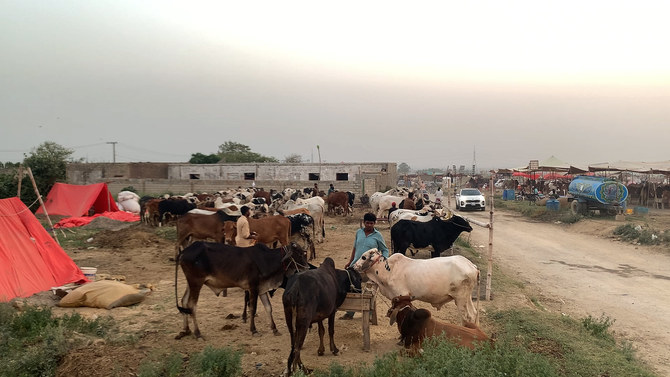
This photograph taken on June 23, 2023, shows a general view of an animal market for the Muslim annual festival of Eid Al-Adha or the Festival of Sacrifice, on the outskirts of the Pakistani capital, Islamabad. (AN Photo)
Short Url
Updated 27 June 2023
Follow

Desperation over inflation undercuts typically booming Eid trade at Islamabad cattle market

  • Many buyers at Islamabad’s main cattle market said they couldn’t afford livestock for the ritual sacrifice 
  • Sellers complained they had to source animals at exorbitant rates this year, rearing cattle more expensive 

ISLAMABAD: On the outskirts of the Pakistani capital of Islamabad, thousands of sacrificial animals are up for sale at a cattle market especially set up ahead of Eid Al-Adha later this week. 

There’s just one problem: there are very few customers, as millions of Pakistanis reckon with record inflation.  

Known as the “Feast of Sacrifice,” the revered observance of Eid Al-Adha coincides with the final rites of the annual Hajj in Saudi Arabia. It is a joyous occasion, of which food is a hallmark. Many Muslims celebrate the four-day feast by ritually slaughtering livestock and distributing the meat among family, friends and the poor. 

But with Pakistan’s annual inflation rate rising to 37.97 percent in May, setting a national record for the second month, many buyers at Islamabad’s main cattle market said they couldn’t afford the livestock for the ritual sacrifice while sellers complained they had to source the animals at exorbitant rates this year and rearing the cattle cost them three times more than before. 

At Islamabad’s cattle market last week, a thin crowd was evidence that desperation over the cost of living has undercut the typically booming holiday trade in goats, cows and sheep. 

“We bought 20 animals and have sold only five so far,” seller Nusrat Ali Khan told Arab News at the market, which is spread over 15,000 hectares and can accommodate around 6,000 animals.
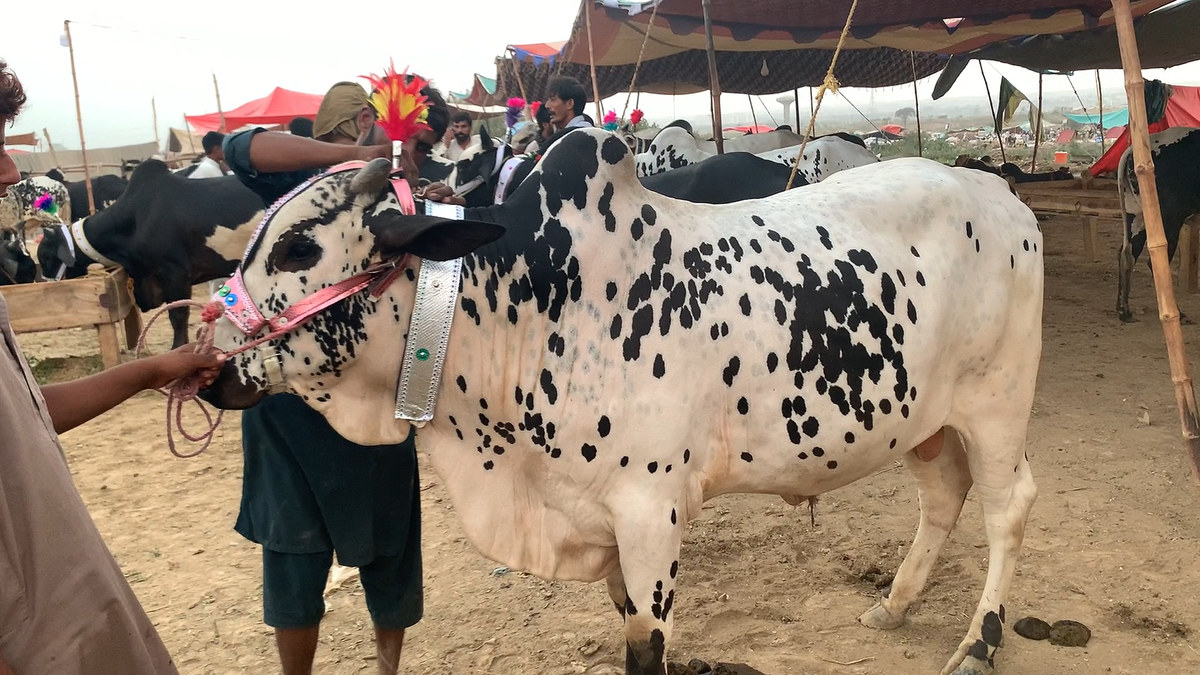


A local cattle vendor poses with his buffalo at the animal market for the Muslim annual festival of Eid Al-Adha or the Festival of Sacrifice, in Islamabad on June 23, 2023. (AN Photo)

 At least 4,000 animals have been brought to the market from different parts of the country ahead of Eid Al-Adha. 

“We can’t really see any customers. The expenses are quite a lot and customers are not coming.” 

Khan wondered if he would be able to sell any of his animals before Eid, which falls on Thursday in Pakistan.  

“If they are sold, only then we can earn something for our children,” he said. 

Buyers complained sellers’ prices were unfair. 

“My budget was somewhere around Rs300,000 ($1,047) to Rs350,000 ($1,222) but when we came here, the animal which should be Rs350,000 is priced at Rs700,000 ($2,445) and the Rs700,000 animal is available at Rs1,400,000 ($4,890),” buyer Shaikh Romail said. 

“The rates are double, and it was not what we expected.” 
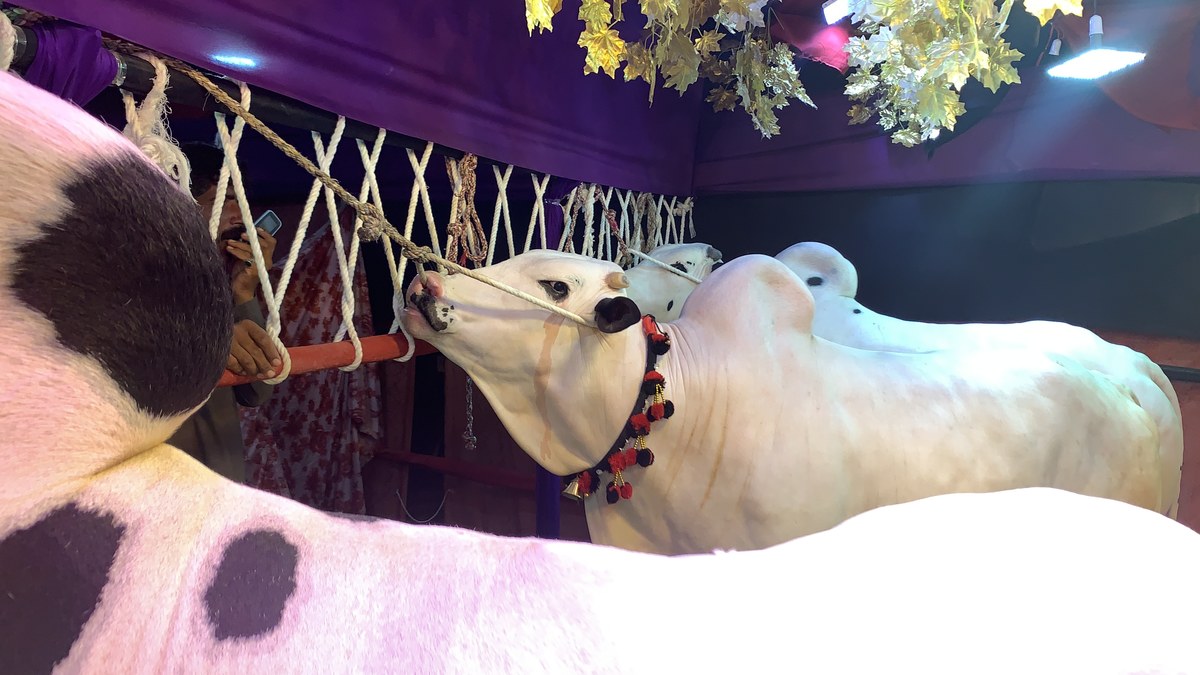


This photograph taken on June 23, 2023, shows three bulls, priced over $2,400 each. present at the Islamabad animal market for the Muslim annual festival of Eid Al-Adha or the Festival of Sacrifice on the outskirts of the Pakistani capital. (AN Photo)

Explaining the high rates this year, Raja Tahir, the cattle market contractor, said rearing the cattle was neither an easy nor a cheap task. 

“It is difficult to take care of them. You can gauge that from the fact that what you can’t afford to eat yourself, you feed them,” Tahir told Arab News, saying sellers fed wheat, milk, ghee, barley, nuts, and other natural ingredients to their animals to enhance their beauty, weight, and physique. 

But the higher cost has meant fewer customers. 

“Customers are fewer as compared to the number of animals [in the market],” Azhar Siddiqui, who was shopping for a goat, said. 

“The buying power has been affected due to inflation. This will have an effect, people will sacrifice less as compared to the past. People who used to buy full animals will now go for buying parts.” 


Pakistan capital market transitions to T+1 settlement cycle ahead of multiple advanced markets

Updated 10 February 2026
Follow

Pakistan capital market transitions to T+1 settlement cycle ahead of multiple advanced markets

  • A T+1 settlement cycle means that securities transactions are finalized and settled one business day after trade date
  • Effective from Feb. 9, all eligible trades at the PSX are now settled on a T+1 basis, replacing the previous T+2 cycle

KARACHI: Pakistan’s capital market has officially transitioned to the Trade plus one (T+1) settlement cycle, a landmark reform that strengthens efficiency, reduces risk and aligns the country with international best practices, the Pakistan Stock Exchange (PSX) said on Tuesday.

A T+1 settlement cycle means that securities transactions are finalized and settled one business day after the trade date, which reduces counterparty risk and improves capital efficiency in the exchange of funds and securities. 

Effective from Feb. 9, all eligible trades at the PSX are now settled on a T+1 basis, replacing the previous T+2 cycle. The transition was implemented under the guidance of the Securities and Exchange Commission of Pakistan (SECP) through close collaboration among all stakeholders, according to the PSX.

It aligns Pakistan’s capital market with leading markets such as the United States, Canada, Mexico, Argentina, Jamaica and China, which have already adopted shorter settlement cycles. Europe, the UK and Switzerland are set to follow by 2027. By moving early, Pakistan has demonstrated its commitment to modernization and investor protection.

“The transition to the T+1 settlement cycle brings important advantages for Pakistan’s capital market. It enables faster access to funds and securities, improving liquidity, while reducing settlement and counterparty risk through shorter exposure periods,” the PSX said.

“Quicker trade finalization enhances efficiency and the reform strengthens investor confidence, particularly among institutional and foreign investors. Together, these benefits support a stronger and more resilient market aligned with global best practices.”

Pakistan’s stock market has touched historic highs in recent months as broad institutional buying boosted investor confidence amid ongoing economic reforms under international lending programs. Pakistani state media reported in Jan. around 135,000 new investors had joined the PSX over the last 18 months.

SECP Chairman Dr. Kabir Ahmed Sidhu commended the PSX, the Central Depository Company and the National Clearing Company of Pakistan for the successful implementation of the T+1 settlement system.

“The reform brings Pakistan’s capital market at par with modern jurisdictions by accelerating trade settlement, reducing counterparty and market risks, and enhancing liquidity,” he was quoted as saying by the PSX.

“The adoption of T+1 will strengthen investor confidence and align Pakistan’s capital market with evolving international standards and global best practices.”