The next big advance in cancer treatment could be a vaccine

1 / 2
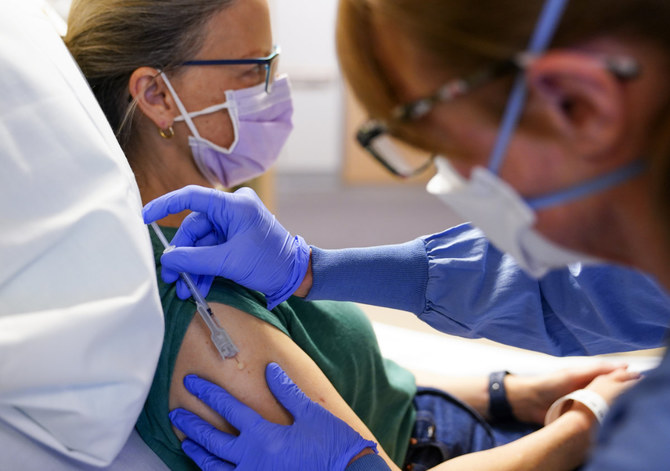
Cancer patient Kathleen Jade receiving her third dose of an experimental breast cancer vaccine at University of Washington Medical Center - Montlake, on May 30, 2023, in Seattle. (AP Photo/Lindsey Wasson)
2 / 2
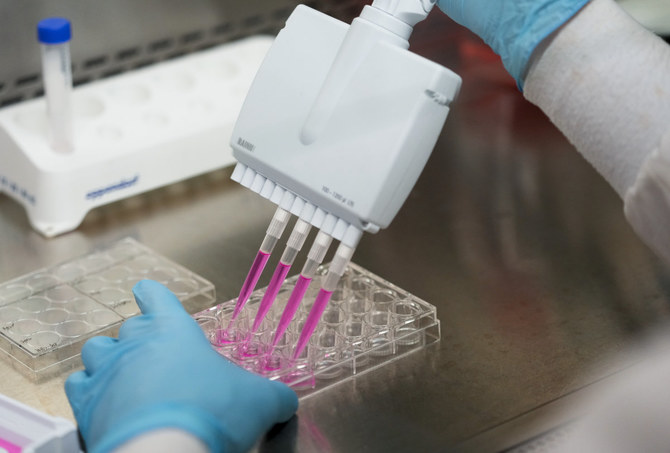
Research scientist Kevin Potts uses a multichannel pipette to dissociate ovarian cancer cells with the enzyme trypsin at UW Medicine's Cancer Vaccine Institute on May 25, 2023, in Seattle. (AP Photo/Lindsey Wasson)
Short Url
Updated 27 June 2023
Follow

The next big advance in cancer treatment could be a vaccine

SEATTLE, US: The next big advance in cancer treatment could be a vaccine.
After decades of limited success, scientists say research has reached a turning point, with many predicting more vaccines will be out in five years.
These aren’t traditional vaccines that prevent disease, but shots to shrink tumors and stop cancer from coming back. Targets for these experimental treatments include breast and lung cancer, with gains reported this year for deadly skin cancer melanoma and pancreatic cancer.
“We’re getting something to work. Now we need to get it to work better,” said Dr. James Gulley, who helps lead a center at the National Cancer Institute that develops immune therapies, including cancer treatment vaccines.
More than ever, scientists understand how cancer hides from the body’s immune system. Cancer vaccines, like other immunotherapies, boost the immune system to find and kill cancer cells. And some new ones use mRNA, which was developed for cancer but first used for COVID-19 vaccines.
For a vaccine to work, it needs to teach the immune system’s T cells to recognize cancer as dangerous, said Dr. Nora Disis of UW Medicine’s Cancer Vaccine Institute in Seattle. Once trained, T cells can travel anywhere in the body to hunt down danger.
“If you saw an activated T cell, it almost has feet,” she said. “You can see it crawling through the blood vessel to get out into the tissues.”
Patient volunteers are crucial to the research.
Kathleen Jade, 50, learned she had breast cancer in late February, just weeks before she and her husband were to depart Seattle for an around-the-world adventure. Instead of sailing their 46-foot boat, Shadowfax, through the Great Lakes toward the St. Lawrence Seaway, she was sitting on a hospital bed awaiting her third dose of an experimental vaccine. She’s getting the vaccine to see if it will shrink her tumor before surgery.
“Even if that chance is a little bit, I felt like it’s worth it,” said Jade, who is also getting standard treatment.


Kathleen Jade is examined by Dr. Will Gwin before receiving her third dose of an experimental breast cancer vaccine at University of Washington Medical Center - Montlake, on May 30, 2023, in Seattle. (AP Photo/Lindsey Wasson)


Progress on treatment vaccines has been challenging. The first, Provenge, was approved in the US in 2010 to treat prostate cancer that had spread. It requires processing a patient’s own immune cells in a lab and giving them back through IV. There are also treatment vaccines for early bladder cancer and advanced melanoma.
Early cancer vaccine research faltered as cancer outwitted and outlasted patients’ weak immune systems, said Olja Finn, a vaccine researcher at the University of Pittsburgh School of Medicine.
“All of these trials that failed allowed us to learn so much,” Finn said.
As a result, she’s now focused on patients with earlier disease since the experimental vaccines didn’t help with more advanced patients. Her group is planning a vaccine study in women with a low-risk, noninvasive breast cancer called ductal carcinoma in situ.
More vaccines that prevent cancer may be ahead too. Decades-old hepatitis B vaccines prevent liver cancer and HPV vaccines, introduced in 2006, prevent cervical cancer.
In Philadelphia, Dr. Susan Domchek, director of the Basser Center at Penn Medicine, is recruiting 28 healthy people with BRCA mutations for a vaccine test. Those mutations increase the risk of breast and ovarian cancer. The idea is to kill very early abnormal cells, before they cause problems. She likens it to periodically weeding a garden or erasing a whiteboard.
Others are developing vaccines to prevent cancer in people with precancerous lung nodules and other inherited conditions that raise cancer risk.
“Vaccines are probably the next big thing” in the quest to reduce cancer deaths, said Dr. Steve Lipkin, a medical geneticist at New York’s Weill Cornell Medicine, who is leading one effort funded by the National Cancer Institute. “We’re dedicating our lives to that.”
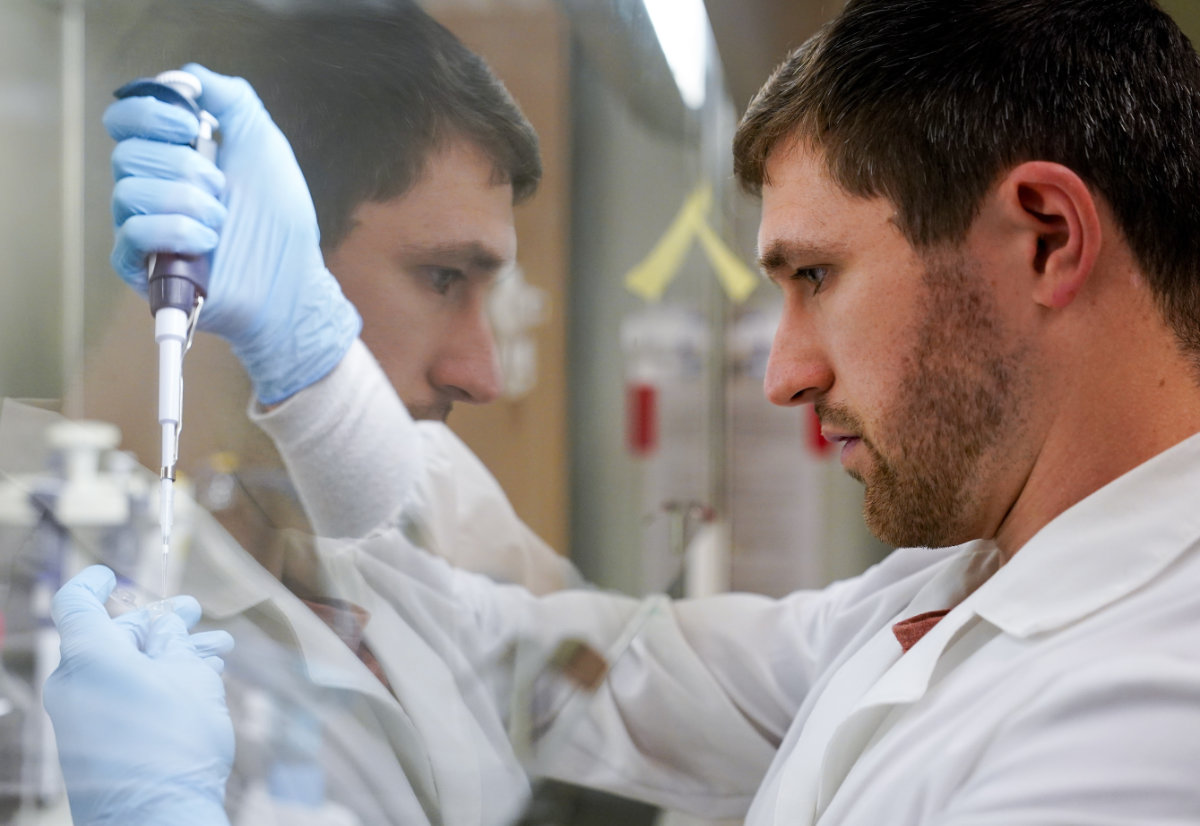


Research scientist Kevin Potts uses ovarian cancer cells to set up an experiment at UW Medicine's Cancer Vaccine Institute on May 25, 2023, in Seattle. (AP Photo/Lindsey Wasson)

People with the inherited condition Lynch syndrome have a 60 percent to 80 percent lifetime risk of developing cancer. Recruiting them for cancer vaccine trials has been remarkably easy, said Dr. Eduardo Vilar-Sanchez of MD Anderson Cancer Center in Houston, who is leading two government-funded studies on vaccines for Lynch-related cancers.
“Patients are jumping on this in a surprising and positive way,” he said.
Drugmakers Moderna and Merck are jointly developing a personalized mRNA vaccine for patients with melanoma, with a large study to begin this year. The vaccines are customized to each patient, based on the numerous mutations in their cancer tissue. A vaccine personalized in this way can train the immune system to hunt for the cancer’s mutation fingerprint and kill those cells.
But such vaccines will be expensive.
“You basically have to make every vaccine from scratch. If this wasn’t personalized, the vaccine could probably be made for pennies, just like the COVID vaccine,” said Dr. Patrick Ott of Dana-Farber Cancer Institute in Boston.
The vaccines under development at UW Medicine are designed to work for many patients, not just a single patient. Tests are underway in early and advanced breast cancer, lung cancer and ovarian cancer. Some results may come as soon as next year.
Todd Pieper, 56, from suburban Seattle, is participating in testing for a vaccine intended to shrink lung cancer tumors. His cancer spread to his brain, but he’s hoping to live long enough to see his daughter graduate from nursing school next year.
“I have nothing to lose and everything to gain, either for me or for other people down the road,” Pieper said of his decision to volunteer.
One of the first to receive the ovarian cancer vaccine in a safety study 11 years ago was Jamie Crase of nearby Mercer Island. Diagnosed with advanced ovarian cancer when she was 34, Crase thought she would die young and had made a will that bequeathed a favorite necklace to her best friend. Now 50, she has no sign of cancer and she still wears the necklace.
She doesn’t know for sure if the vaccine helped, “But I’m still here.”


Trump warns Maduro against playing ‘tough’ as US escalates pressure campaign on Venezuela

Updated 23 December 2025
Follow

Trump warns Maduro against playing ‘tough’ as US escalates pressure campaign on Venezuela

  • Venezuelan President Nicolas Maduro on Monday fired back at Donald Trump, who has ordered US naval forces to blockade the South American country's oil wealth, saying the US president would be "better off" focusing on domestic issues rather than threatenin
  • The Defense Department, under Trump’s orders, continues its campaign of attacks on smaller vessels in the Caribbean and eastern Pacific Ocean that it alleges are carrying drugs to the United States and beyond

WEST PALM BEACH, Florida: President Donald Trump on Monday delivered a new warning to Venezuelan President Nicolás Maduro as the US Coast Guard steps up efforts to interdict oil tankers in the Caribbean Sea as part of the Republican administration’s escalating pressure campaign on the government in Caracas.
Trump was surrounded by his top national security aides, Secretary of State Marco Rubio and Defense Secretary Pete Hegseth, as he suggested that he remains ready to further escalate his four-month pressure campaign on the Maduro government, which began with the stated purpose of stemming the flow of illegal drugs from the South American nation but has developed into something more amorphous.
“If he wants to do something, if he plays tough, it’ll be the last time he’ll ever be able to play tough,” Trump said of Maduro as he took a break from his Florida holiday vacation to announce plans for the Navy to build a new, large warship.
Trump levied his latest threat as the US Coast Guard on Monday continued for a second day to chase a sanctioned oil tanker that the Trump administration describes as part of a “dark fleet” Venezuela is using to evade US sanctions. The tanker, according to the White House, is flying under a false flag and is under a US judicial seizure order.
“It’s moving along and we’ll end up getting it,” Trump said.
It is the third tanker pursued by the Coast Guard, which on Saturday seized a Panama-flagged vessel called Centuries that US officials said was part of the Venezuelan shadow fleet.
The Coast Guard, with assistance from the Navy, seized a sanctioned tanker called Skipper on Dec. 10, also part of the shadow fleet of tankers that the US says operates on the fringes of the law to move sanctioned cargo. That ship was registered in Panama.
Trump, after that first seizure, said the US would carry out a “blockade” of Venezuela. Trump has repeatedly said that Maduro’s days in power are numbered.
Last week, Trump demanded that Venezuela return assets that it seized from US oil companies years ago, justifying anew his announcement of a blockade against sanctioned oil tankers traveling to or from the South American country.
Homeland Security Secretary Kristi Noem, whose agency oversees the Coast Guard, said in a Monday appearance on “Fox & Friends” that the targeting of tankers is intended to send “a message around the world that the illegal activity that Maduro is participating in cannot stand, he needs to be gone, and that we will stand up for our people.”
Russian diplomats evacuate families from Caracas
Meanwhile, Russia’s Foreign Ministry started evacuating the families of diplomats from Venezuela, according to a European intelligence official speaking on condition of anonymity to discuss sensitive information.
The official told The Associated Press the evacuations include women and children and began on Friday, adding that Russian Foreign Ministry officials are assessing the situation in Venezuela in “very grim tones.” The ministry said in an X posting that it was not evacuating the embassy but did not address queries about whether it was evacuating the families of diplomats.
Venezuela’s Foreign Minister Yván Gil on Monday said he spoke by phone with his Russian counterpart, Sergey Lavrov, who he said expressed Russia’s support for Venezuela against Trump’s declared blockade of sanctioned oil tankers.
“We reviewed the aggressions and flagrant violations of international law that have been committed in the Caribbean: attacks against vessels and extrajudicial executions, and the unlawful acts of piracy carried out by the United States government,” Gil said in a statement.
The scene on a Venezuelan beach near a refinery
While US forces targeted the vessels in international waters over the weekend, a tanker that’s considered part of the shadow fleet was spotted moving between Venezuelan refineries, including one about three hours west of the capital, Caracas.
The tanker remained at the refinery in El Palito through Sunday, when families went to the town’s beach to relax with children now on break from school.
Music played on loudspeakers as people swam and surfed with the tanker in the background. Families and groups of teenagers enjoyed themselves, but Manuel Salazar, who has parked cars at the beach for more than three decades, noticed differences from years past, when the country’s oil-dependent economy was in better shape and the energy industry produced at least double the current 1 million barrels per day.
“Up to nine or 10 tankers would wait out there in the bay. One would leave, another would come in,” Salazar, 68, said. “Now, look, one.”
The tanker in El Palito has been identified by Transparencia Venezuela, an independent watchdog promoting government accountability, to be part of the shadow fleet.
Area residents on Sunday recalled when tankers would sound their horns at midnight New Year’s Eve, while some would even send up fireworks to celebrate the holiday.
“Before, during vacations, they’d have barbecues; now all you see is bread with bologna,” Salazar said of Venezuelan families spending the holiday at the beach next to the refinery. “Things are expensive. Food prices keep going up and up every day.”
Venezuela’s ruling party-controlled National Assembly on Monday gave initial approval to a measure that would criminalize a broad range of activities that could be linked to the seizure of oil tankers.
Lawmaker Giuseppe Alessandrello, who introduced the bill, said people could be fined and imprisoned for up to 20 years for promoting, requesting, supporting, financing or participating in “acts of piracy, blockades or other international illegal acts against” commercial entities operating with the South American country.
The Defense Department, under Trump’s orders, continues its campaign of attacks on smaller vessels in the Caribbean and eastern Pacific Ocean that it alleges are carrying drugs to the United States and beyond.
At least 104 people have been killed in 28 known strikes since early September. The strikes have faced scrutiny from US lawmakers and human rights activists, who say the administration has offered scant evidence that its targets are indeed drug smugglers and that the fatal strikes amount to extrajudicial killings.