

US to send $500 million in weapons, military aid to Ukraine, officials say

1 / 3
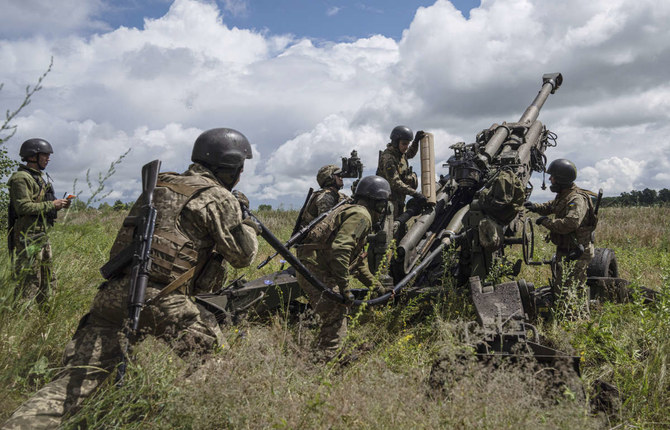
Ukrainian servicemen prepare to fire at Russian positions from a US-supplied M777 howitzer in Kharkiv region, Ukraine, July 14, 2022. (AP)
2 / 3
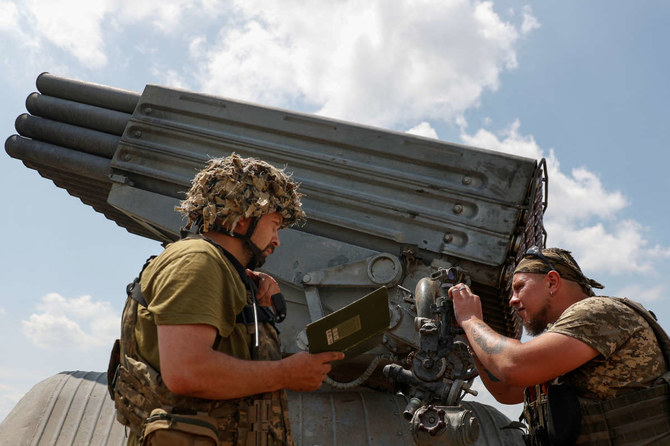
Ukrainian servicemen of the 47th Magura Separate Mechanised Brigade point a BM-21 Grad multiple launch rocket system before firing towards Russian troops near a front line, amid Russia's attack on Ukraine, in Zaporizhzhia region, Ukraine June 25, 2023. (REUTERS)
3 / 3
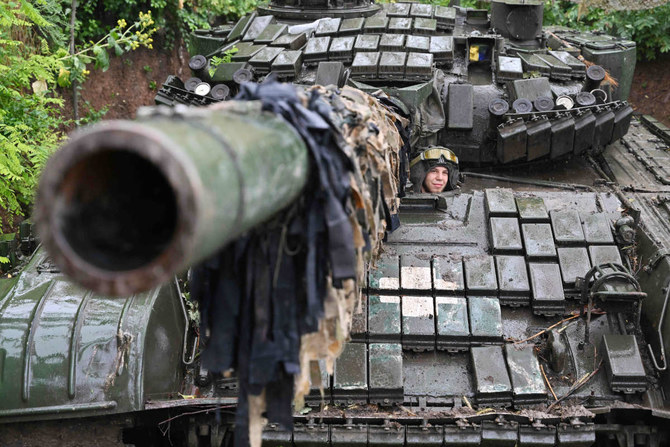
A Ukrainian serviceman sits on a T-72 tank at a position in the Donetsk region on June 25, 2023, amid the Russian invasion of Ukraine. (AFP)
Short Url
Updated 27 June 2023
Follow

US to send $500 million in weapons, military aid to Ukraine, officials say

  • This would be the 41st time since the Russian invasion into Ukraine in February 2022 that the US has provided military weapons and equipment through presidential drawdown authority

WASHINGTON: The Pentagon will announce it is sending up to $500 million in military aid to Ukraine, including more than 50 heavily armored vehicles and an infusion of missiles for air defense systems, US officials said Monday, as Ukrainian and Western leaders try to sort out the impact of the brief weekend insurrection in Russia.
The aid is aimed at bolstering Ukraine’s counteroffensive, which has been moving slowly in its early stages. It wasn’t clear Monday if Ukrainian forces will be able to take advantage of the disarray in the Russian ranks, in the aftermath of the short-lived rebellion by Yevgeny Prigozhin and the Wagner mercenary group that he has controlled.
An announcement on the aid package is expected Tuesday. This would be the 41st time since the Russian invasion into Ukraine in February 2022 that the US has provided military weapons and equipment through presidential drawdown authority. The program allows the Pentagon to quickly take items from its own stocks and deliver them to Ukraine.
Because the aid packages are generally planned in advance and recently included many of the same critical weapons for the battlefront, the contents weren’t likely chosen based on the weekend rebellion.
But, the missiles and heavy vehicles can be used as Ukraine tries to capitalize on what has been a growing feud between the Wagner Group leader and Russia’s military brass, with simmering questions about how many of Prigozhin’s forces may leave the fight.
The mercenaries left Ukraine to seize a military headquarters in a southern Russian city and moved hundreds of miles toward Moscow before turning around after less than 24 hours on Saturday.
According to the officials, the US will send 30 Bradley Fighting Vehicles and 25 of the armored Stryker vehicles to Ukraine, along with missiles for the High-Mobility Artillery Rocket System (HIMARS) and the Patriot air defense systems. The package will include Javelin and high-speed anti-radiation (HARM) missiles, demolition munitions, obstacle-clearing equipment and a wide range of artillery rounds and other ammunition.
The officials spoke on condition of anonymity because the aid has not yet been publicly announced.
According to the Pentagon, the US has delivered more than $15 billion in weapons and equipment from its stocks to Ukraine since the Russian invasion, and has committed an additional $6.2 billion in supplies that haven’t yet been identified. The more than $6 billion extra is the result of an accounting error, because the military services overestimated the value of the weapons they pulled off the shelves and sent to Ukraine over the past year.
More broadly, the US has also promised to send more than $16.7 billion in longer-term funding for various weapons, training and other equipment through the Ukraine Security Assistance Initiative, and an additional roughly $2 billion in foreign military financing.
The US has at least $1.2 billion in drawdown authority that hasn’t yet been committed but will expire at the end of this fiscal year on Sept. 30. The remaining $1.9 billion in USAI funds does not expire until the end of the next fiscal year, in September 2024.


Germany says UN rights rapporteur for Palestinian territories should quit

Updated 7 sec ago
Follow

Germany says UN rights rapporteur for Palestinian territories should quit

BERLIN: German Foreign Minister Johann Wadephul on Thursday called for the resignation of the UN special rapporteur for the Palestinian territories, Francesca Albanese, over comments she made allegedly targeting Israel at a conference.
“I respect the UN system of independent rapporteurs. However, Ms Albanese has made numerous inappropriate remarks in the past. I condemn her recent statements about Israel. She is untenable in her position,” Wadephul wrote on X.
Albanese has said that her comments are being falsely portrayed. She denounced what she called “completely false accusations” and “manipulation” of her words in an interview with broadcaster France 24 on Wednesday.
Speaking via videoconference at a forum in Doha on Saturday organized by the Al Jazeera network, Albanese referred to a “common enemy of humanity” after criticizing “most of the world” and much of Western media for enabling the “genocide” in Gaza.
“And this is a challenge — the fact that instead of stopping Israel, most of the world has armed, given Israel political excuses, political sheltering, economic and financial support,” she said.
Albanese said that “international law has been stabbed in the heart” but added that there is an opportunity since “we now see that we as a humanity have a common enemy.”
Wadephul’s French counterpart Jean-Noel Barrot on Wednesday made the same call for Albanese to resign over the comments.
“France unreservedly condemns the outrageous and reprehensible remarks made by Ms Francesca Albanese, which are directed not at the Israeli government, whose policies may be criticized, but at Israel as a people and as a nation, which is absolutely unacceptable,” Barrot told French lawmakers.
Albanese posted video of her comments to X on Monday, writing in the post that “the common enemy of humanity is THE SYSTEM that has enabled the genocide in Palestine, including the financial capital that funds it, the algorithms that obscure it and the weapons that enable it.”
In her interview with France 24, which was recorded before Barrot’s statement, she contended that her comments were being misrepresented.
“I have never, ever, ever said ‘Israel is the common enemy of humanity’,” Albanese told the broadcaster.