Pakistani Hajj mission commends Saudi Arabia for excellent facilities at Mina camps

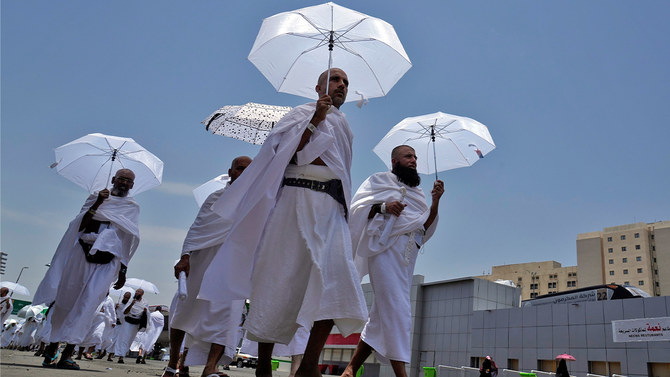
Muslim pilgrims walk, holding their umbrellas at the Mina tent camp, in Mecca, Saudi Arabia, during the annual hajj pilgrimage, on June 26, 2023. (AP)
Short Url
Updated 26 June 2023
Follow

Pakistani Hajj mission commends Saudi Arabia for excellent facilities at Mina camps

  • All Pakistani pilgrims on Monday reached Mina where they will stay the night in allotted camps 
  • The Kingdom has established hospitals, ensured improved air-conditioning among other facilities 

ISLAMABAD: Pakistan's Hajj mission on Monday commended Saudi authorities for making exemplary arrangements for the annual pilgrimage, after all Pakistani pilgrims arrived in Mina ahead of the Hajj’s climax at Mount Arafat. 

Hajj is one of the five pillars of Islam and must be undertaken by all Muslims with the means at least once in their lifetime. The pilgrimage includes series of rites completed over four days in Makkah and its surroundings in the west of Saudi Arabia.  

Millions of pilgrims arrived at the Grand Mosque in Makkah on Sunday to perform Tawaf Al-Qudum as the biggest annual pilgrimage in several years began. It is the first tawaf (circumambulation of the Kaaba) that pilgrims undertake after assuming the state of ihram.  

On the 8th of Dul Hijjah, known as the Day of Tarwiyah, pilgrims embark on the journey to Mina and spend an entire day and night, utilizing this time to prepare themselves mentally and physically for the profound spiritual experience that awaits them at Mount Arafat, where the Prophet Muhammad (Peace Be Upon Him) is believed to have delivered his final sermon.  

“All Pakistani Hajj pilgrims on Monday reached Mina through buses where they will stay in the allotted camps tonight,” Muhammad Umer Butt, a spokesperson for the Pakistani religious affairs ministry told Arab News over the phone from Mina. 

“This year, the Saudi authorities have made excellent arrangements and increased facilities in camps, especially improved air conditioning.” 


Pakistani Hajj pilgrims are seen writing down their issues at the Main Control Office to facilitate pilgrims at Mina, Saudi Arabia on June 26, 2023. (Photo courtesy: Pakistan's religious affairs ministry)

The Saudi authorities have established two main hospitals, while dispensaries have been set up for the pilgrims in every camp street in Mina, the spokesperson added. 

The Pakistani Hajj mission has established a Main Control Office (MCO) in Mina to facilitate Pakistani pilgrims. 

“So far, 81,500 [Pakistani] pilgrims have reached Saudi Arabia under the government scheme,” he said. 

Saudi Arabia this year reinstated Pakistan’s pre-pandemic Hajj quota of 179,210 pilgrims and scrapped the upper age limit of 65 in January. More than 81,000 Pakistani pilgrims are expected to perform the pilgrimage under the government scheme this year, and the rest have been facilitated by private tour operators.  

An Information Cell has been set up within the MCO to ensure smooth flow of information and communication, according to the Pakistani authorities.  

Additionally, a dedicated Lost and Found Cell has been established to help pilgrims retrieve any misplaced belongings. 


Pakistan condemns Sudan attack that killed Bangladeshi UN peacekeepers, calls it war crime

Updated 14 December 2025
Follow

Pakistan condemns Sudan attack that killed Bangladeshi UN peacekeepers, calls it war crime

  • Six peacekeepers were killed in a drone strike in Kadugli as fighting between Sudan’s army and the RSF grinds on
  • Pakistan, a major troop contributor to the UN, says perpetrators of the attack must be identified, brought to justice

ISLAMABAD: Pakistan on Sunday extended condolences to the government and people of Bangladesh after six United Nations peacekeepers from the country were killed in a drone strike in southern Sudan, condemning the attack and describing it as a war crime.

The attack took place amid a full-scale internal conflict that erupted in April 2023 between the Sudanese Armed Forces (SAF) and the Rapid Support Forces (RSF), a powerful paramilitary group, following a power struggle after the collapse of Sudan’s post-Bashir political transition.

Omar Al-Bashir, who ruled Sudan for nearly three decades, was ousted by the military in 2019 after months of mass protests, but efforts to transition to civilian rule later faltered, plunging the country back into violence that has since spread nationwide.

The drone strike hit a logistics base of the United Nations Interim Security Force for Abyei (UNISFA) in Kadugli, the capital of South Kordofan state, on Saturday, killing the Bangladeshi peacekeepers. Sudan’s army blamed the RSF for the attack, though there was no immediate public claim of responsibility.

“Pakistan strongly condemns the attack on @UNISFA in Kadugli, resulting in the tragic loss of 6 Bangladeshi peacekeepers & injuries to several others,” the country’s permanent mission to the UN said in a social media message. “We honor their supreme sacrifice in the service of peace, and express our deepest condolences to the government and people of #Bangladesh.”

“Such heinous attacks on UN peacekeepers amount to war crimes,” it added. “Perpetrators of this horrific attack must be identified and brought to justice. As a major troop-contributing country, we stand in complete solidarity with all Blue Helmets serving the cause of peace in the perilous conditions worldwide.”

According to Pakistan’s UN mission in July, the country has deployed more than 235,000 peacekeepers to 48 UN missions across four continents over the past eight decades.

Pakistan also hosts one of the UN’s oldest peacekeeping operations, the United Nations Military Observer Group in India and Pakistan (UNMOGIP), and is a founding member of the UN Peacebuilding Commission.

More than 180 Pakistani peacekeepers have lost their lives while serving under the UN flag.

Pakistan and Bangladesh have also been working in recent months to ease decades of strained ties rooted in the events of 1971, when Bangladesh — formerly part of Pakistan — became independent following a bloody war.

Relations have begun to shift following the ouster of former Bangladeshi prime minister Sheikh Hasina last year amid mass protests.

Hasina later fled to India, Pakistan’s neighbor and arch-rival, creating space for Islamabad and Dhaka to rebuild their relationship.