Indonesia police probe drug regulators over cough syrup

The World Health Organization is working with countries to investigate the global pharmaceutical supply chain for such syrups. (AFP)
Short Url
Updated 26 June 2023
Follow

Indonesia police probe drug regulators over cough syrup

  • BPOM has said a spike in cases of acute kidney injury occurred as several parties “exploited a gap in the safety guarantee system” and pharmaceutical companies did not sufficiently check the raw ingredients they used

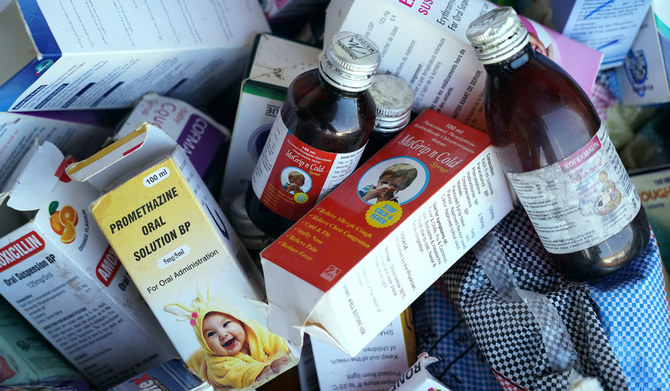
JAKARTA: Indonesia’s police are conducting preliminary inquiries into whether any actions by officials at the country’s drug regulator could amount to criminal wrongdoing, as they expand a probe into tainted cough syrups linked to the deaths of more than 200 children across the nation, two top inspectors told Reuters.
The police scrutiny of Indonesia’s food and drugs agency (BPOM) is the latest escalation by states seeking accountability for contaminated syrups that were linked to the deaths of dozens more children in Gambia and Uzbekistan last year. The World Health Organization is working with countries to investigate the global pharmaceutical supply chain for such syrups.
Late last year police arrested and charged eight individuals at Indonesian companies that imported and distributed raw materials to drugmakers whose cough syrups were found to contain toxic industrial-grade chemicals instead of the legitimate ingredient.
Andika Urrasyidin, lead police investigator of the case, told Reuters police have called in “many” BPOM officials for questioning, and the investigation is still underway.
“We’re still looking into it. But ... if there were actions, then yes there needs to be responsibility,” he said, declining to say what, if any, charges may be brought.
No one at BPOM has been accused of wrongdoing. The police could ultimately pursue criminal charges or close the probe without taking action.
Officials from the BPOM did not respond to a request for comment.
Hersadwi Rusdiyono, the director of Indonesia’s national police’s crimes detection unit, said BPOM officials were brought in as witnesses, but investigators are now checking if any wrongdoing was committed by drug regulators.
“We asked them according to their functions, as regulators, whether they’ve conducted supervision and what kind of supervision,” he told Reuters. “They were only interrogated as witnesses, we’re coordinating with the prosecutors.”
Hersadwi said the probe so far has focused on staff at lower levels and not included BPOM’S chief, Penny Lukito. Penny did not respond to a request for comment.
BPOM has said a spike in cases of acute kidney injury occurred as several parties “exploited a gap in the safety guarantee system” and pharmaceutical companies did not sufficiently check the raw ingredients they used.
In January, Pipit Rismanto, a senior police official, told reporters the authorities had found one company sold “industrial-grade” toxins as pharmaceutical-grade propylene glycol, a key base of syrupy medicines.
The toxins, ethylene glycol (EG) and diethyelene glycol (DEG), can be used by unscrupulous actors as a substitute for propylene glycol because they can cost less than half the price, several pharmaceutical experts told Reuters.
Police have charged four companies involved in the case — drugmaker Afi Farma, which allegedly sold tainted syrups, CV Samudera Chemical, which according to the police supplied the chemicals, and two of its distributors Tirta Buana Kemindo and Anugrah Perdana Gemilang.
A lawyer for Afi Farma, which attended its first court hearing on the case on Tuesday, said the company would respect the law.
Tirta Buana Kemindo declined to comment. CV Samudera and Anugerah Perdana Gemilang could not be reached.
BPOM is also named in a separate class action suit launched in January by parents whose children died or are suffering from long-term complications of the acute kidney injury.
The first day of trial has not been scheduled and a mediation process has just concluded, said the families’ lawyer.


Bangladesh’s Yunus announces resignation, end of interim govt

Bangladesh’s interim leader Muhammad Yunus stepped down on February 16, 2026 in a farewell broadcast to the nation.
Updated 7 sec ago
Follow

Bangladesh’s Yunus announces resignation, end of interim govt

  • Yunus handed over power after congratulating the Bangladesh Nationalist Party and its leader Tarique Rahman

DHAKA: Bangladesh’s interim leader Muhammad Yunus stepped down on Monday in a farewell broadcast to the nation before handing over to an elected government.
“Today, the interim government is stepping down,” the 85-year-old Nobel Peace Prize winner said.
“But let the practice of democracy, freedom of speech, and fundamental rights that has begun not be halted.”
Yunus returned from self-imposed exile in August 2024, days after the iron-fisted government of Sheikh Hasina was overthrown by a student-led uprising and she fled by helicopter to India.
“That was the day of great liberation,” he said. “What a day of joy it was! Bangladeshis across the world shed tears of happiness. The youth of our country freed it from the grip of a demon.”
He has led Bangladesh as its “chief adviser” since, and now hands over power after congratulating the Bangladesh Nationalist Party (BNP) and its leader Tarique Rahman on a “landslide victory” in elections last week.
“The people, voters, political parties, and stakeholder institutions linked to the election have set a commendable example,” Yunus said.
“This election has set a benchmark for future elections.”
Rahman, 60, chief of the BNP and scion of one of the country’s most powerful political dynasties, will lead the South Asian nation of 170 million.
Rebuilt institutions’
Bangladeshi voters endorsed sweeping democratic reforms in a national referendum, a key pillar of Yunus’s post-uprising transition agenda, on the same day as the elections.
The lengthy document, known as the “July Charter” after the month when the uprising that toppled Hasina began, proposes term limits for prime ministers, the creation of an upper house of parliament, stronger presidential powers and greater judicial independence.
“We did not start from zero — we started from a deficit,” he said.
“Sweeping away the ruins, we rebuilt institutions and set the course for reforms.”
The referendum noted that approval would make the charter “binding on the parties that win” the election, obliging them to endorse it.
However, several parties raised questions before the vote, and the reforms will still require ratification by the new parliament.
The BNP alliance won 212 seats, compared with 77 for the Jamaat-e-Islami-led alliance, according to the Election Commission.
Jamaat chief Shafiqur Rahman conceded on Saturday, saying his Islamist party would “serve as a vigilant, principled, and peaceful opposition.”
Newly elected lawmakers are expected to be sworn in on Tuesday, after which Tarique Rahman is set to become Bangladesh’s next prime minister.
Police records show that political clashes during the campaign period killed five people and injured more than 600.
However, despite weeks of turbulence ahead of the polls, voting day passed without major unrest and the country has responded to the results with relative calm.