

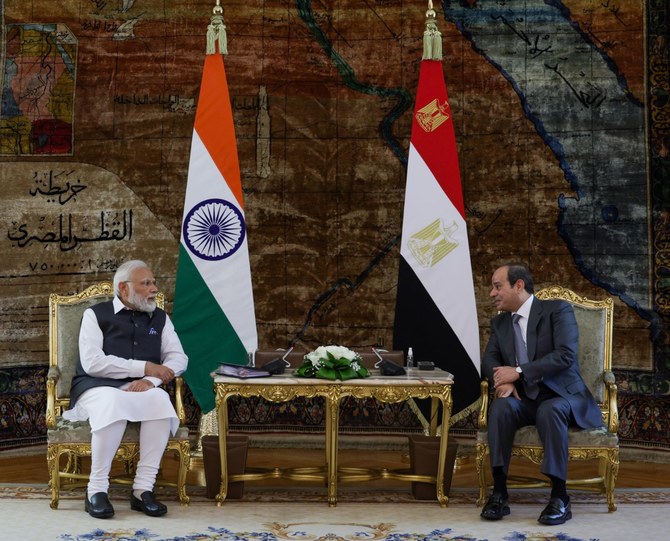
India, Egypt raise ties to strategic partnership on Modi’s visit to Cairo

Egypt and India share deep ties that date back to the 1950s, when the two nations played key roles in founding the Non-Aligned Movement (twitter/@MEAIndia)
Short Url
Updated 26 June 2023
Follow

India, Egypt raise ties to strategic partnership on Modi’s visit to Cairo

  • Modi’s visit is the first by an Indian premier since 1997
  • PM awarded with Order of the Nile civilian honor in Cairo

NEW DELHI: Indian Prime Minister Narendra Modi and Egyptian President Abdel Fattah El-Sisi signed on Sunday a strategic partnership agreement, underscoring growing ties between the two countries that experts say can spark geopolitical and economic significance. 

Modi arrived in Cairo on Saturday afternoon following a four-day trip to the US, marking the first state visit to Egypt by an Indian premier since 1997. 

He was awarded Egypt’s highest civilian honor, known as the Order of the Nile, during the trip that comes less than six months after El-Sisi’s visit to India earlier this year, when the leaders first announced plans to elevate their partnership. 

“An agreement to elevate the bilateral relationship to a ‘Strategic Partnership’ was signed by the leaders,” Arindam Bagchi, spokesperson of India’s Ministry of External Affairs, said in a tweet on Sunday. 

“The leaders discussed ways to further deepen the partnership between the two countries, including in trade & investment, defense & security, renewable energy, cultural and people to people ties.” 

Bagchi said their meeting was “productive,” with India and Egypt also signing three other memoranda of understanding in agriculture, archaeology and antiquities, and competition law. 

Modi also visited on Sunday the historic Al-Hakim Mosque in Cairo, recently renovated with the help of the India-based Dawoodi Bohra community, and met with Grand Mufti Shawki Allam, Egypt’s Islamic jurist. 

In January, Modi and El-Sisi agreed to increase bilateral trade to $12 billion in the next five years, up from $7.3 billion in 2021-22. 

The two countries signed several agreements in New Delhi then on expanding cooperation in cybersecurity, information technology, culture, and broadcasting.   

Navdeep Suri, former Indian ambassador to Egypt, said India and Egypt had been drifting apart prior to this year’s engagements. 

“After allowing the relationship to drift for years, it’s back on track,” Suri told Arab News. 

According to Suri, India had built momentum by inviting El-Sisi as a chief guest on India’s Republic Day in January and had Egypt among special invitees for meetings of the Group of 20 biggest economies under Delhi’s presidency this year, which he said sends “a strong signal.” 

Suri said: “​​There is now an opportunity to develop a special relationship with a country that, despite its present economic difficulties, will always be an important player in the Middle East. 

“This kind of intensity and engagement have been missing for a long time.” 

Closer ties with Egypt may also bring strategic benefits for India, experts say. 

“Egypt’s pivotal position in the region is important for growing India’s profile in the region,” Dr. Zakir Hussain, a Middle East expert based in New Delhi, told Arab News. 

“(India is) securing favorable treatment in trade, an industrial berth in the Suez Canal Free Zone, to access the Europe market and all those areas where Egypt has free trade deals such as Latin America, Africa, and the Middle East,” Hussain said, adding that “India needs to access these markets at preferential terms to achieve the target of $1 trillion merchandise exports by 2030.” 

Modi’s visit to Cairo “holds great significance” in strengthening India-Egypt bilateral relations, said Mohammed Soliman, tech program director at the Middle East Institute in Washington DC. 

With the countries discussing potential deals, such as the allocation of an economic zone for India in the Suez Canal area, they have the “potential to significantly impact the economic and strategic collaboration between the two nations,” he told Arab News.  

“With India now surpassing the UK as the fifth-largest global economy, it sees Egypt as a potential launchpad for Indian manufacturing and defense industries,” Soliman said.  

“Egypt’s strategic location, particularly with the Suez Canal, is central to Delhi’s global posture.” 


Baghdad says it will prosecute Daesh militants being moved from Syria to Iraq

Updated 6 sec ago
Follow

Baghdad says it will prosecute Daesh militants being moved from Syria to Iraq

  • The US military started the transfer process on Friday with the first Daesh prisoners moved from Syria to Iraq

BAGHDAD: Baghdad will prosecute and try militants from the Daesh group who are being transferred from prisons and detention camps in neighboring Syria to Iraq under a US-brokered deal, Iraq said Sunday.
The announcement from Iraq’s highest judicial body came after a meeting of top security and political officials who discussed the ongoing transfer of some 9,000 IS detainees who have been held in Syria since the militant group’s collapse there in 2019.
The need to move them came after Syria’s nascent government forces last month routed Syrian Kurdish-led fighters — once top US allies in the fight against Daesh — from areas of northeastern Syria they had controlled for years and where they had been guarding camps holding Daesh prisoners.
Syrian troops seized the sprawling Al-Hol camp — housing thousands, mostly families of Daesh militants — from the Kurdish-led force, which withdrew as part of a ceasefire. Troops last Monday also took control of a prison in the northeastern town of Shaddadeh, from where some Daesh detainees had escaped during the fighting. Syrian state media later reported that many were recaptured.
Now, the clashes between the Syrian military and the Kurdish-led Syrian Democratic Forces, or SDF, sparked fears of Daesh activating its sleeper cells in those areas and of Daesh detainees escaping. The Syrian government under its initial agreement with the Kurds said it would take responsibility of the Daesh prisoners.
Baghdad has been particularly worried that escaped Daesh detainees would regroup and threaten Iraq’s security and its side of the vast Syria-Iraq border.
Once in Iraq, Daesh prisoners accused of terrorism will be investigated by security forces and tried in domestic courts, Iraq’s Supreme Judicial Council said.
The US military started the transfer process on Friday with the first Daesh prisoners moved from Syria to Iraq. On Sunday, another 125 Daesh prisoners were transferred, according to two Iraqi security officials who spoke to The Associated Press on condition of anonymity in line with regulations.
So far, 275 prisoners have made it to Iraq, a process that officials say has been slow as the US military has been transporting them by air.
Both Damascus and Washington have welcomed Baghdad’s offer to have the prisoners transferred to Iraq.
Iraq’s parliament will meet later on Sunday to discuss the ongoing developments in Syria, where its government forces are pushing to boost their presence along the border.
The fighting between the Syrian government and the SDF has mostly halted with a ceasefire that was recently extended. According to Syria’s Defense Ministry, the truce was extended to support the ongoing transfer operation by US forces.
The Daesh group was defeated in Iraq in 2017, and in Syria two years later, but Daesh sleeper cells still carry out deadly attacks in both countries. As a key US ally in the region, the SDF played a major role in defeating Daesh.
During the battles against Daesh, thousands of extremists and tens of thousands of women and children linked to them were taken and held in prisons and at the Al-Hol camp. The sprawling Al-Hol camp hosts thousands of women and children.
Last year, US troops and their partner SDF fighters detained more than 300 Daesh militants in Syria and killed over 20. An ambush in December by Daesh militants killed two US soldiers and one American civilian interpreter in Syria.