

Israeli security chiefs vow crackdown on settler ‘terrorism’

1 / 2
Sven Kuhn von Burgsdorff, head of the European Union's mission to the West Bank and Gaza Strip, reacts as he stands inside a destroyed building during a visit with a diplomatic delegation to the village of Turmus Ayya near the occupied West Bank city of Ramallah on June 23, 2023, in the aftermath of an attack there by Israeli settlers. (AFP)
2 / 2
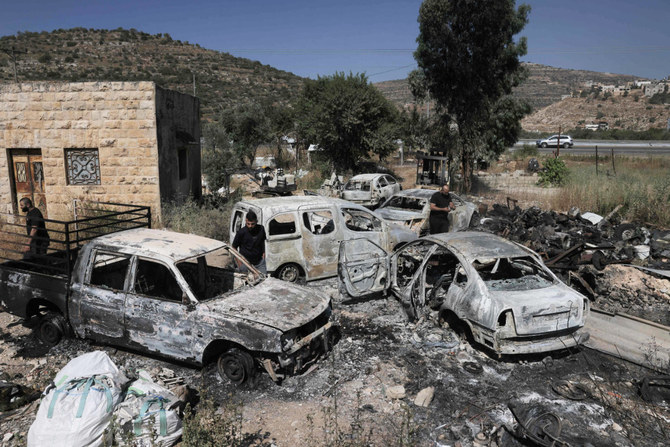
A picture shows burnt cars, reportedly set ablaze by Israeli settlers, in the area of in al-Lubban al-Sharqiya in the occupied West Bank on June 21, 2023. (AFP)
Short Url
Updated 25 June 2023
Follow

Israeli security chiefs vow crackdown on settler ‘terrorism’

  • That practice is largely used by Israel against Palestinian security suspects and is denounced by rights groups

JERUSALEM/UMM SAFA, West Bank: Israeli security chiefs on Saturday designated settler attacks on Palestinian villages in the occupied West Bank as “nationalist terrorism” that merits stepped-up counter measures, and their remarks drew anger from far-right cabinet ministers.
A surge of violence over the past week in the West Bank included rampages by scores of Israeli settlers on Palestinian towns and villages that drew international condemnation and concern from the White House.
On Saturday, settlers torched at least two homes in the Palestinian village Umm Safa near Ramallah, residents said. Israel’s military said at least one Israeli suspect had been arrested.
Defense Minister Yoav Gallant condemned the attack.
In a joint statement, Israel’s military, police and domestic security service chiefs said the settlers’ actions amounted to “nationalist terrorism” which they pledged to fight.
The military will boost its forces in the area to prevent such violence, they said, and the Shin Bet domestic security service will enhance arrests, including “administrative detention” in which suspects can be held without charge.
That practice is largely used by Israel against Palestinian security suspects and is denounced by rights groups.
The statement drew sharp rebuke by two members of Prime Minister Benjamin Netanyahu’s nationalist-religious government.
“The attempt to equate murderous Arab terrorism with civilian counter actions, as serious as they are, is immoral and dangerous,” said Finance Minister Bezalel Smotrich.
He called on security forces to step up their efforts against Palestinian attacks and on settlers to refrain from “taking the law into their own hands.”
National Security Minister Itamar Ben-Gvir, who has past convictions for support for terrorism and incitement against Arabs, echoed Smotrich’s remarks.
On Friday, White House national security adviser Jake Sullivan expressed concerns about settler attacks on Palestinian villages in a call with his Israeli counterpart, hours after Ben-Gvir called on settlers to expand their presence across the West Bank.
The settlers’ assaults this week followed intense gunbattles in Jenin that left seven Palestinians dead, a Palestinian shooting attack that killed four Israelis and a rare Israeli air strike in the area against militants.
Earlier on Saturday, a Palestinian militant opened fire at a West Bank Israeli checkpoint and wounded a security guard, Israel’s police said. They added that the Palestinian gunman was then shot dead by forces at the scene.
The gunman was claimed by Al-Aqsa Martyrs Brigade, an armed group associated with Palestinian President Mahmoud Abbas’ Fatah party.
US-brokered peace talks between the Palestinians and Israel aimed at establishing a Palestinian state in the West Bank, East Jerusalem and Gaza, collapsed in 2014 and show no sign of revival.
Most countries deem the settlements Israel built on land it seized in the 1967 war as illegal, a view Israel disputes.


First responders enter devastated Aleppo neighborhood after days of deadly fighting

Updated 12 January 2026
Follow

First responders enter devastated Aleppo neighborhood after days of deadly fighting

  • The US-backed SDF, which have played a key role in combating the Daesh group in large swaths of eastern Syria, are the largest force yet to be absorbed into Syria’s national army

ALEPPO, Syria: First responders on Sunday entered a contested neighborhood in Syria’ s northern city of Aleppo after days of deadly clashes between government forces and Kurdish-led forces. Syrian state media said the military was deployed in large numbers.
The clashes broke out Tuesday in the predominantly Kurdish neighborhoods of Sheikh Maqsoud, Achrafieh and Bani Zaid after the government and the Syrian Democratic Forces, the main Kurdish-led force in the country, failed to make progress on how to merge the SDF into the national army. Security forces captured Achrafieh and Bani Zaid.
The fighting between the two sides was the most intense since the fall of then-President Bashar Assad to insurgents in December 2024. At least 23 people were killed in five days of clashes and more than 140,000 were displaced amid shelling and drone strikes.
The US-backed SDF, which have played a key role in combating the Daesh group in large swaths of eastern Syria, are the largest force yet to be absorbed into Syria’s national army. Some of the factions that make up the army, however, were previously Turkish-backed insurgent groups that have a long history of clashing with Kurdish forces.
The Kurdish fighters have now evacuated from the Sheikh Maqsoud neighborhood to northeastern Syria, which is under the control of the SDF. However, they said in a statement they will continue to fight now that the wounded and civilians have been evacuated, in what they called a “partial ceasefire.”
The neighborhood appeared calm Sunday. The United Nations said it was trying to dispatch more convoys to the neighborhoods with food, fuel, blankets and other urgent supplies.
Government security forces brought journalists to tour the devastated area, showing them the damaged Khalid Al-Fajer Hospital and a military position belonging to the SDF’s security forces that government forces had targeted.
The SDF statement accused the government of targeting the hospital “dozens of times” before patients were evacuated. Damascus accused the Kurdish-led group of using the hospital and other civilian facilities as military positions.
On one street, Syrian Red Crescent first responders spoke to a resident surrounded by charred cars and badly damaged residential buildings.
Some residents told The Associated Press that SDF forces did not allow their cars through checkpoints to leave.
“We lived a night of horror. I still cannot believe that I am right here standing on my own two feet,” said Ahmad Shaikho. “So far the situation has been calm. There hasn’t been any gunfire.”
Syrian Civil Defense first responders have been disarming improvised mines that they say were left by the Kurdish forces as booby traps.
Residents who fled are not being allowed back into the neighborhood until all the mines are cleared. Some were reminded of the displacement during Syria’s long civil war.
“I want to go back to my home, I beg you,” said Hoda Alnasiri.