

Muscovites made uneasy by revolt, Ukrainians pleased at internal turmoil

1 / 3
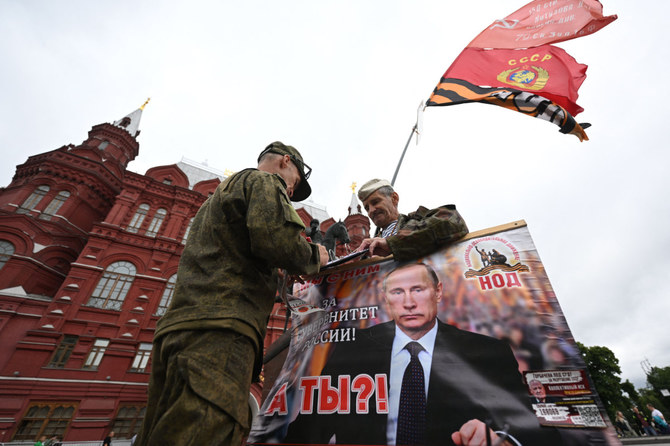
Activists hold a portrait of Russian President Vladimir Putin near Red Square in Moscow, on June 24, 2023, amid a rebellion by the Wagner mercenary group. (AFP)
2 / 3
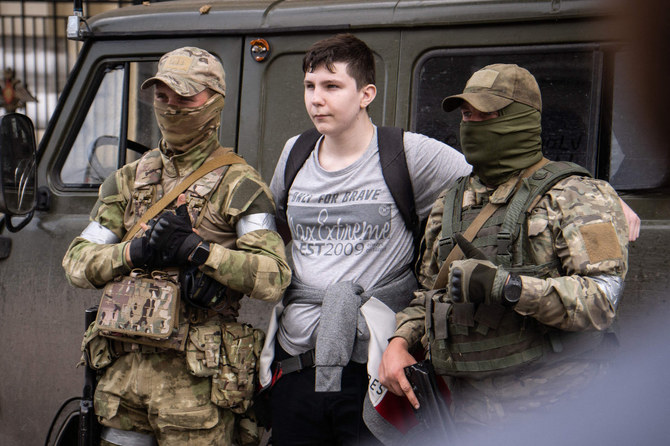
A man poses for a photo with members of Wagner group in a street in the city of Rostov-on-Don on June 24, 2023, as the mercenary allies of President Putin announced a rebellion. (AFP)
3 / 3
A man waves a Russian national flag near Moscow's Red Square on June 24, 2023, amid a rebellion by the Wagner mercenary group. (AFP)
Short Url
Updated 25 June 2023
Follow

Muscovites made uneasy by revolt, Ukrainians pleased at internal turmoil

  • Moscow's mayor declared that a “counter-terrorism regime” was in force before Wagner leader Yevgeny Prigozhin announced that his fighters would turn back to avoid bloodshed
  • In Kyiv’s Independence Square, residents enjoying a stroll acknowledged a certain pleasure in watching the Russian standoff

MOSCOW/KYIV: Muscovites on Saturday expressed unease or dismissed as political theater a standoff pitting the Kremlin against Wagner mercenaries who had vowed to descend on the capital in a “march of justice” denouncing the conduct of the war in Ukraine.

Ukrainians, on the other hand, were clearly satisfied, sometimes gleeful, at the prospect of a split in Russian ranks 16 months after the Kremlin’s troops invaded their country.
Moscow Mayor Sergei Sobyanin, an ally of President Vladimir Putin, had declared that a “counter-terrorism regime” was in force, before the leader of the Wagner private militia announced that his fighters would turn back to avoid bloodshed.
Yevgeny Prigozhin had said he wanted to oust the army’s top brass and “restore justice,” while Putin had promised to crush the mutiny.
One Moscow resident who gave his name as Nikolai — declining like others to give his surname — watched the military take up positions to protect the city.
“It’s frightening of course — you sit at home thinking about what might happen,” he told Reuters. “It’s disturbing, both for you and your loved ones.”
Some residents found it hard to grasp the scale of events.
“It’s really tough news, really unexpected. I’ve just come back from university. I’ve just done my last exam — and the news was really unexpected as I was prepping (for the exam) last night,” said Vladimir, a student. “I don’t really know how to react. I haven’t really got my head around it yet.”
In Kyiv’s Independence Square, packed with residents enjoying a stroll, Natalia Tanich, 48, acknowledged a certain pleasure in watching the Russian standoff.
“I enjoy what is happening in Russia. The inevitable conflict between Prigozhin and Putin was expected,” she said. “I don’t know what may come out of it. But I wish for them to shoot each other and die.”
In Kkarkiv, Ukraine’s second city subjected to frequent shelling since the invasion, Ivan said the confrontation was a consequence of volatile politics and the protracted conflict.
“They started the war and now they are getting it back. The harder you compress a spring, the harder it comes back,” he said. “The situation was compressed to such an extent in Russia that it became hopeless. I consider what happened a natural event. It will influence the war but I think it will not be over in a day. We will have to endure a bit.”

POST-SOVIET SHOWCASE
In Moscow, under Mayor Sobyanin, the state has spent vast amounts to transform the city into an urban showcase with relatively low crime. That is a far cry from the drab Soviet era, and the 1990s when it was plagued by contract killings or, later, suffered attacks by Chechen separatists.
A woman called Galina said she thought what was happening was some kind of “provocation.”
“It doesn’t frighten me at all,” she said. “I have confidence in our president and our people.”
One man who declined to be named at all said he thought it was just politics playing out.
“They might cancel a few events, and I make my living from events. I have an event going on now, so I could lose out because of this,” he said.
“But otherwise, it’s their business, it’s politics — let them get on with it.”


Afghan mothers seek hospital help for malnourished children

Updated 5 sec ago
Follow

Afghan mothers seek hospital help for malnourished children

  • Since the Taliban regained power in 2021, low-income families have been hit hard by cuts to international aid
  • Drought and the fallout of Afghans forced across the border from Iran and Pakistan add to the economic woes

HERAT: Najiba, 24, keeps a constant watch over her baby, Artiya, one of around four million children at risk of dying from malnutrition this year in Afghanistan.

After suffering a bout of pneumonia at three months old, Artiya’s condition deteriorated and his parents went from hospital to hospital trying to find help.

“I did not get proper rest or good food,” affecting her ability to produce breast milk, Najiba said at Herat Regional Hospital in western Afghanistan.

“These days, I do not have enough milk for my baby.”

The distressed mother, who chose not to give her surname for privacy reasons, said the family earns a living from an electric supplies store run by her husband.

Najiba and her husband spent their meagre savings trying to get care for Artiya, before learning that he has a congenital heart defect.

To her, “no one can understand what I’m going through. No one knows how I feel every day, here with my child in this condition.”

“The only thing I have left is to pray that my child gets better,” she said.

John Aylieff, Afghanistan director at the World Food Programme (WFP), said women are “sacrificing their own health and their own nutrition to feed their children.”

Artiya has gained weight after several weeks at the therapeutic nutrition center in the Herat hospital, where colorful drawings of balloons and flowers adorn the walls.

Mothers such as Najiba, who are grappling with the reality of not being able to feed their children, receive psychological support.

Meanwhile, Artiya’s father is “knocking on every door just to borrow money” which could fund an expensive heart operation on another ward, Najiba said.

‘STAGGERING’ SCALE

On average, 315 to 320 malnourished children are admitted each month to the center, which is supported by medical charity Doctors Without Borders (MSF).

The number of cases has steadily increased over the past five years, according to Hamayoun Hemat, MSF’s deputy coordinator in Herat.

Since the Taliban regained power in 2021, low-income families have been hit hard by cuts to international aid, as well as drought and the economic fallout of five million Afghans forced across the border from Iran and Pakistan.

“In 2025, we’d already seen the highest surge in child malnutrition recorded in Afghanistan since the beginning of the 21st century,” Aylieff said in Kabul.

The crisis is only set to worsen this year, he told AFP: “A staggering four million children in this country will be malnourished and will require treatment.”

“These children will die if they’re not treated.”

WFP is seeking $390 million to feed six million Afghans over the next six months, but Aylieff said the chance of getting such funds is “so bleak.”

Pledges of solidarity from around the globe, made after the Taliban government imposed its strict interpretation of Islamic law, have done little to help Afghan women, the WFP director said.

They are now “watching their children succumb to hunger in their arms,” he said.

‘NO HOPE’

In the country of more than 40 million people, there are relatively few medical centers that can help treat malnutrition.

Some families travel hundreds of kilometers (miles) to reach Herat hospital as they lack health care facilities in their home provinces.

Wranga Niamaty, a nurse team supervisor, said they often receive patients in the “last stage” where there is “no hope” for their survival.

Still, she feels “proud” for those she can rescue from starvation.

In addition to treating the children, the nursing team advises women on breastfeeding, which is a key factor in combating malnutrition.

Single mothers who have to work as cleaners or in agriculture are sometimes unable to produce enough milk, often due to dehydration, nurse Fawzia Azizi said.

The clinic has been a lifesaver for Jamila, a 25-year-old mother who requested her surname not be used out of privacy concerns.

Jamila’s eight-month-old daughter has Down’s syndrome and is also suffering from malnutrition, despite her husband sending money back from Iran where he works.

Wrapped in a floral veil, Jamila said she fears for the future: “If my husband is expelled from Iran, we will die of hunger.”