

102 suspects in army's custody over violent riots in Pakistan after ex-PM Khan arrest in May — official

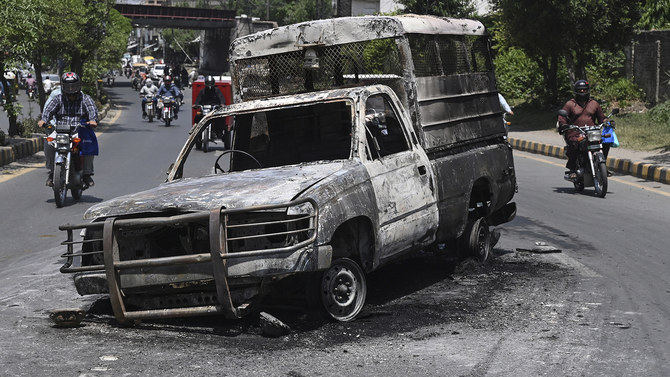
Commuters ride past a burnt vehicle set on fire during a protest by supporters of former Pakistan's Prime Minister Imran Khan over the arrest of their leader, in Lahore on May 11, 2023. (AFP/File)
Short Url
Updated 23 June 2023
Follow

102 suspects in army's custody over violent riots in Pakistan after ex-PM Khan arrest in May — official

  • Supreme Court is currently hearing petitions filed against the trial of civilians in military courts
  • Attorney General Mansoor Usman Awan says 'no journalists or lawyers are in the army’s custody'

ISLAMABAD: Mansoor Usman Awan, the attorney general for Pakistan (AGP), on Friday informed the Supreme Court that the army had 102 people in its custody who had been involved in violence that broke out in the South Asian country after former prime minister Imran Khan's arrest on May 9, Pakistani media reported. 

Pakistan’s government and army have said they will try in military courts suspects accused of attacking army installations in countrywide protests in the wake of Khan's arrest. Military courts operate under a separate system from the civilian legal system. Trials are closed to outsiders, and no media is allowed. Rights groups have criticized the secretive nature of the process. 

Four petitions have been filed against the use of military courts to try civilians by, namely, former Chief Justice Jawwad S. Khawaja, prominent lawyer and politician Aitzaz Ahsan, Pakistan Institute of Labour Education and Research Chief Executive Karamat Ali, and former PM Khan. 

A seven-member bench, led by Chief Justice of Pakistan (CJP) Umar Ata Bandial, on Friday resumed hearing pleas challenging the trials of civilians in military courts, Pakistan's Dawn newspaper reported. 

"The AGP took the rostrum at the tail-end of today’s hearing, telling the seven-member bench that 102 people were in the army’s custody, adding that none of these were women or minors," the report read. 

“No journalists or lawyers are in the army’s custody.” 

AGP Awan said the authorities had doubts about one of the suspects in custody being below 18 years of age. “His tests are being conducted. If he is less than 18 years of age he will be released,” he said. 

A day earlier, the chief justice had ignored a request to issue an interim order to stop the trials of civilians in the military courts, saying it was not possible without hearing AGP Awan first. 

While issuing notice to the respondents, the court had asked the AGP to furnish the total number of detained suspects in civil and military custody on account of offences allegedly committed by them on May 9. 

A bruising year-long standoff between Khan, arguably Pakistan’s most popular leader, and the army came to a head when military buildings and property were ransacked last month, allegedly by Khan supporters, following his arrest in a graft case. Khan was later released on bail but hundreds of his followers were arrested in the aftermath and the military said it would punish all those who had damaged military properties or instigated people to do so. 

Many of the top members of Khan’s party have since jumped ship and the government of PM Shehbaz Sharif has threatened to ban Khan's Pakistan Tehreek-e-Insaf party.  

Meanwhile, authorities have begun the process of trying dozens of people, including members of Khan’s party, suspected of involvement in the protests in military courts, usually reserved for service members or those categorized as enemies of the state. Khan says the purpose of military courts, in this case, is to put him in prison and dismantle his party. 

Pakistan’s Army Act of 1952 established military courts primarily to try members of the military or enemies of the state. Civilians can only be tried there under a federal government order. 

Civilians accused of offenses such as waging war against the armed forces or law enforcement agencies, attacking military installations, or inciting mutiny, can be tried at military courts. 


Pakistan puts border districts on high alert amid Iran protests — official

Updated 6 sec ago
Follow

Pakistan puts border districts on high alert amid Iran protests — official

  • The development comes as Iranian authorities try to suppress protests over faltering economy, with over 2,600 killed
  • Militancy in Balochistan has declined following the return of nearly 1 million Afghans, the additional chief secretary says

QUETTA: Pakistan has heightened security along districts bordering Iran as violent protests continue to engulf several Iranian cities, a top official in Pakistan’s southwestern Balochistan province said on Thursday, with authorities stepping up vigilance to guard against potential spillover.

The development comes as Iranian authorities try to suppress protests, which began late last month over the country’s faltering economy and the collapse of its currency, with more than 2,600 killed in weeks of violence in the Islamic republic.

The clampdown on demonstrations, the worst since the country’s 1979 Islamic revolution, has drawn threats from the United States (US) of a military intervention on behalf of the protesters, raising fears of further tensions in an already volatile region.

Pakistan, which shares a 909-kilometer-long border with Iran in its southwest, has said that it is closely monitoring the situation in the neighboring country and advised its citizens to keep essential travel documents with them amid the unrest.

“The federal government is monitoring the situation regarding what is happening in Iran and the provincial government is in touch with the federal government,” Hamza Shafqaat, an additional chief secretary at the Balochistan Home Department, told

Arab News in an exclusive interview on Thursday.

“As far as the law and order is concerned in all bordering districts with Iran, we are on high alert and as of now, the situation is very normal and peaceful at the border.”

Asked whether Islamabad had suspended cross-border movement and trade with Iran, Shafqaat said trade was ongoing, but movement of tourists and pilgrims had been stopped.

“There were few students stuck in Iran, they were evacuated, and they reached Gwadar,” he said. “Around 200 students are being shifted to their home districts.”

SITUATION ON PAKISTAN-AFGHANISTAN BORDER

Pakistan’s Balochistan province has long been the site of an insurgency by ethnic Baloch separatists and religiously motivated groups like the Tehreek e Taliban Pakistan (TTP). Besides Iran, the province shares more around 1,000-kilometer porous border with Afghanistan.

Islamabad has frequently accused Afghanistan of allowing its soil for attacks against Pakistan, an allegation denied by Kabul. In Oct., Pakistan and Afghanistan engaged in worst border clashes in decades over a surge in militancy in Pakistan. While the neighbors agreed to a ceasefire in Doha that month, relations between them remain tensed.

Asked about the government’s measures to secure the border with Afghanistan, Shafqaat said militancy in the region had declined following the return of nearly 1 million Afghan nationals as part of a repatriation drive Islamabad announced in late 2023.

“There is news that some of them keep on coming back from one border post or some other areas because we share a porous border and it is very difficult to man every inch of this border,” he said.

“On any intervention from the Afghanistan side, our security agencies which are deputed at the border are taking daily actions.”

LAW AND ORDER CHALLENGE

Balochistan witnessed 167 bomb blasts among over 900 militant attacks in 2025, which killed more than 400 people, according to the provincial government’s annual law and order report. But officials say the law-and-order situation had improved as compared to the previous year.

“More than 720 terrorists were killed in 2025 which is a higher number of operations against terrorists in many decades, while over a hundred terrorists were detained by law enforcement agencies in 90,000-plus security operations in Balochistan,” Shafqaat said.

The provincial government often suspended mobile Internet service in the southwestern province on various occasions last year, aimed at ensuring security in Balochistan.

“With that step, I am sure we were able to secure hundreds of lives,” Shafqaat said, adding it was only suspended in certain areas for less than 25 days last year.

“The Internet service through wireless routers remained open for the people in the entire year, we closed mobile Internet only for people on the roads because the government understands the difficulties of students and business community hence we are trying to reduce the closure of mobile Internet.”