

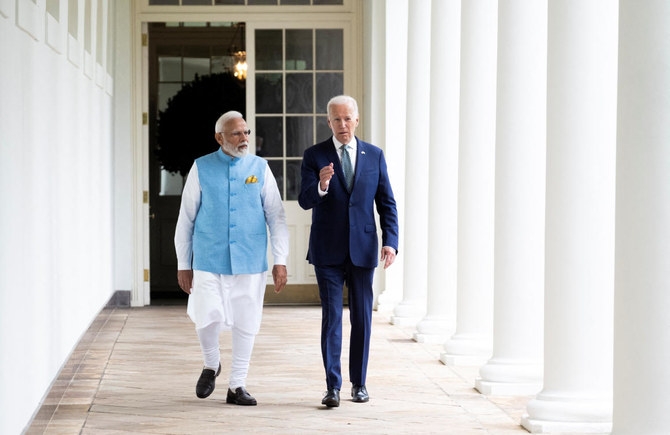

WASHINGTON: US President Joe Biden on Thursday hailed a “defining partnership” with India as he rolled out the red carpet for Prime Minister Narendra Modi, sealing major defense and technology deals as Washington bets big on New Delhi as a counterweight to China.
Modi is being feted with the pomp of a state visit, only the third of Biden’s presidency, in a calculated show of full-throated US support — despite quiet unease over India’s refusal to break with Russia and what rights groups see as growing authoritarianism by the Hindu nationalist leader.
With around 7,000 Indian-Americans gathered on the White House’s South Lawn to cheer him on, Modi, sporting a flowing white kurta with a sky-blue jacket, walked a red carpet to a military salute as Biden welcomed him.
“I have long believed that the relationship between the US and India will be one of the most defining relationships of the 21st century,” Biden said.
“The challenges and opportunities facing the world in this century require that India and the United States work and lead together,” he said.
Modi, India’s most powerful prime minister in decades, said that the two countries “are committed to work together for the global good and for global peace, stability and prosperity.”
“Our strong strategic partnership is a clear proof of the power of democracy,” said Modi, who unlike most of India’s post-independence leaders spoke Hindi rather than English on the global stage.
Modi will later address a joint session of Congress and return to the White House for a gala dinner, with First Lady Jill Biden tapping a star Californian plant-based chef, Nina Curtis, to cook for the strictly vegetarian prime minister.
The White House said the two leaders will take questions from the press, while stopping short of calling the event a press conference. Modi has nearly always avoided unscripted interactions with reporters during his nine years in office.
In one of the biggest agreements of the visit, described by a US official as “trailblazing,” the United States signed off on a technology transfer for engines as India begins producing homegrown fighter jets.
General Electric will have the green light to produce its F414 engines jointly with state-owned Hindustan Aeronautics.
A US official said India would also buy MQ-9B SeaGuardians, high-precision armed drones. India in 2019 broke precedent with an airstrike in Pakistani territory against an alleged extremist camp.
Washington hopes a tighter defense relationship will help wean India off Russia, New Delhi’s primary military supplier during the Cold War.
India has refused to join Western efforts to isolate Russia over its invasion of Ukraine and instead has seized on the crisis to buy discounted Russian oil.
In one long-running point of contention, India has been angered by US sales of F-16 fighter jets to its historic rival Pakistan.
In another agreement, US chip giant Micron will invest $800 million in a semiconductor assembly and testing plant in India, which is expected to reach $2.75 billion after contributions from New Delhi.
A US official said the plant would help diversify supply chains of advanced semiconductors, as Biden leads a concerted effort to deny exports of top-end chips to China.
Micron nonetheless also recently announced a $600 million investment in a factory in China.
India, a growing power in space, also agreed during Modi’s visit to join the Artemis Accords, a US-led multinational effort to put a human back on the Moon by 2025.
As part of the cooperation, India’s space program will work with NASA on a joint mission to the International Space Station next year, the White House said.
The United States has been seeking a closer relationship with India since the late 1990s, seeing the billion-plus democracy as like-minded on the challenges both of China and radical Islamism.
But Modi has also faced growing criticism for treatment of religious minorities, the opposition and independent media, with the State Department pointing to police and vigilante violence against Muslims and Christians.
Biden touched lightly on concerns, telling Modi that religious pluralism was among “core principles” for both the United States and India “even as they have faced challenges throughout each of our nations’ histories.”
Modi replied that both nations “take pride in their diversity.”
Three prominent left-wing Democrats including Representative Alexandria Ocasio-Cortez and two Muslims, Ilhan Omar and Rashida Tlaib, said they would boycott Modi’s speech to Congress.
Saying the US Congress should not invite leaders with “deeply troubling human rights records,” Ocasio-Cortez said she would stay away to show support for “pluralism, tolerance and freedom of the press.”
Dozens of other Democrats in a letter urged Biden to raise concerns “in an honest and forthright way,” although they stopped short of boycotting and backed closer ties with India.


