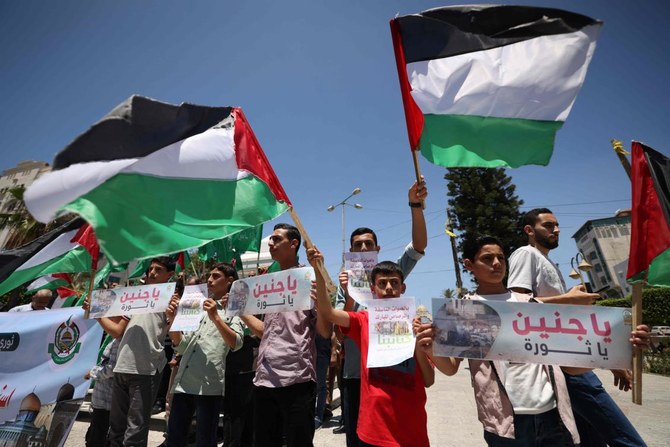

RAMALLAH: With the Israeli-occupied West Bank once again in turmoil after the latest bloodshed this week, uncertainty has deepened over the position of 87-year-old Palestinian President Mahmoud Abbas with a negotiated peace looking as unlikely as ever.
A gunbattle on Monday in which seven Palestinians were killed and over 90 wounded, followed a day later by the killing of four Israelis and a rampage by Israeli settlers through Palestinian towns, again underscored the West Bank’s volatility.
It also laid bare the weakness of the Palestinian Authority (PA) in the face of the hundreds of Palestinian militants in flashpoint cities like Jenin and Nablus, and the expansion of Israeli settlements that further dims Palestinian dreams of a state on land Israel captured in the 1967 Middle East war.
Set up 30 years ago as part of interim peace accords with Israel that Abbas helped craft, the PA has seen its popularity shrivel amid allegations of graft, incompetence and widely hated security cooperation arrangements with Israel.
A rambling speech at the United Nations last month spawned a wave of mocking TikTok memes after Abbas repeatedly appealed to the world to “Protect us!“
The theme was picked up on social media again this week as the PA, which exercises limited self-rule, stood by powerless while Jewish settlers attacked Palestinian towns.
Widely known as Abu Mazen, Abbas has defied repeated prophecies of an end to his two decades in power and refused mounting demands to go, even as prospects of a lasting peace look more distant than ever.
A chain smoker who has survived numerous health scares, he took over as Palestinian president almost two decades ago after the death of Yasser Arafat, the iconic founder of the Palestine Liberation Organization (PLO), and his departure could spark a shake-up of the entire Palestinian political system.
Abbas, who combines the positions of chairman of the PLO and head of its dominant political faction Fatah, has named no favored heir and has remained in power even though his term officially expired in 2009.
PRESSURE TO RESIGN
But almost 80 percent of Palestinians want him to resign, according to polling from the Palestinian Center for Policy and Survey Research, and with international powers including the United States calling for a resumption of peace negotiations with Israel frozen since 2014, the pressure has risen steadily.
In recent months, discussion over what will follow Abbas has been “greater than ever,” said one senior Fatah official who spoke on condition of anonymity because of the sensitivity of the issue inside the party.
An array of senior Fatah leaders have been jostling for position for months, in behind-the-scenes manoeuvring made more complicated by the fact that no elections have been held since 2006 and there is no clear mechanism to decide the succession.
Potential successors include Hussein Al-Sheikh, one of Abbas’ closest allies or Marwan Barghouti, a leader of the 2000-06 intifada (uprising) and hero to many Palestinians who has been imprisoned in Israel for the past two decades.
Much will depend on what Israel is willing to accept but publicly at least, it has avoided taking sides.
“Israel cannot choose the leadership of the Palestinians,” a senior Israeli government official said.
CHAOTIC SCENARIO
In public at least, Fatah leaders generally seek to play down speculation but they acknowledge that a leadership debate is going on within the party.
“There is a lot of exaggeration,” said Mahmoud Al-Aloul, the deputy chairman of Fatah and one of the potential successors.
“There are lots of issues being debated, including over leadership,” he said. “This is being debated but there are no concerns, unlike what some people are trying to imply,” he said, in comments made before the latest events in the West Bank.
However, many observers fear Abbas’ departure could trigger an anarchic period, possibly leading to some form of civil war or at least “cantonization” between leaders with different power centers in the West Bank.
An expansion of Israel’s arch-foe Hamas, which opposes any negotiated peace, outside its base in Gaza is also possible.
“There are two bad alternatives — one is chaos and one is Hamas taking power in the West Bank and both must be prevented,” Israeli military spokesman Daniel Hagari said.
For the Islamist Hamas itself, the departure of Abbas will present opportunities, which Israel and its international allies are determined to block, said Bassem Naim, a senior Hamas official in Gaza.
“I think he is the last one in Fatah who can still control (that) organization,” he said. “All the rest don’t have the power, the history, the charisma, the connections to control the organization and the West Bank.”
Hamas has run the Israeli-blockaded Gaza Strip since winning the 2006 Palestinian elections and defeating Fatah in a brief civil war in 2007.
Hamas is now extending its sway into the West Bank, increasingly challenging Abbas’ party on its home ground. It has long argued for elections to choose a new Palestinian leader, confident it would win, as in 2006.
“We believe the only way to unite the Palestinians politically is to go for elections,” Naim said. “Otherwise no one would have full legitimacy to represent the Palestinians.”