Pakistan says still can’t verify numbers, identities of nationals killed in Greece shipwreck

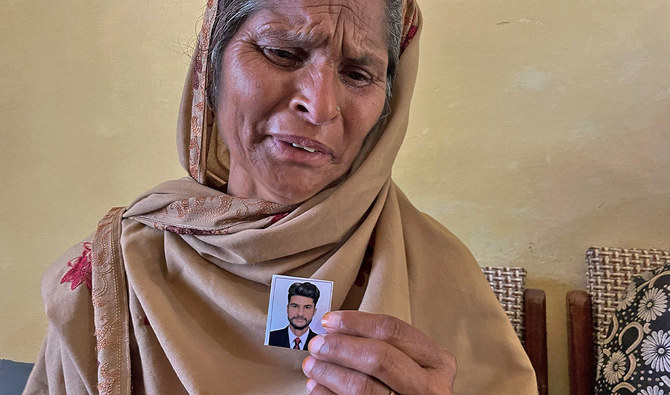
In this picture taken on June 20, 2023, Tazeem Pervaiz, mother of migrant Taquir Pervaiz who is missing after an overloaded trawler capsized and sank in the Ionian Sea, weeps while holding a picture of her son in Bandli village, in Pakistan-administered Kashmir. (AFP)
Short Url
Updated 22 June 2023
Follow

Pakistan says still can’t verify numbers, identities of nationals killed in Greece shipwreck

  • Federal Investigation Agency data shows there were at least 209 Pakistani “victims” on overloaded boat
  • On talks with TTP, Pakistan says does not negotiate with those who killed soldiers and civilians

ISLAMABAD: Pakistan’s foreign office said on Thursday the country was still unable to verify the number and identities of its nationals who had died or were missing after a fishing vessel sank in the Mediterranean Sea last week with around 750 illegal migrants onboard, many of them from Pakistan.

Data shared with Reuters by a Pakistani investigative agency meanwhile showed there were at least 209 Pakistani “victims” on an overloaded boat that capsized and sank in open seas off Greece.

But in a briefing on Thursday, foreign office spokesperson Mumtaz Zahra Baloch said the government still did not have exact figures.

“Unfortunately, we have been unable to verify the number and identity of Pakistani nationals among the deceased and missing,” she told reporters, adding that twelve Pakistanis among 104 survivors were in “good physical condition” and being provided relief.

She said 84 bodies recovered by Greek authorities would be identified through DNA matching.

“Relevant authorities have started collecting DNA samples from the families of those suspected to be on-board and will be sharing this with the Greek authorities,” Baloch said.

The Pakistani mission in Greece was working round the clock for the recovery and identification of Pakistani nationals who were missing or feared dead, she said, and Pakistan was in contact with Greek authorities regarding the circumstances under which the shipwreck took place.

Data shared by the Federal Investigation Agency with Reuters meanwhile said 28 victims were from Azad Kashmir, while 181 were from the rest of Pakistan, adding that DNA samples from 201 families had been gathered by officials to help Greece identify those missing.

It was not immediately clear on what basis the agency had identified them as victims, with the official toll from the accident still at 82 and survivors at 104, of which 12 are Pakistanis. Hundreds are believed to have been on board the vessel.

Speaking about another incident of a missing submersible that vanished on Sunday while carrying five people, including two Pakistanis, on a deep-sea tourist voyage to the wreckage of the Titanic, Baloch said Pakistan’s missions in the United States and Canada were in contact with the concerned authorities.

“We will not like to speculate on the circumstances of this incident and also like to respect the wishes of the Dawood family and their privacy,” she added, referring to British-Pakistani businessman Shahzada Dawood, 48, who is on board the missing Titanic sub with his son Suleman, 19.

Replying to a question regarding a recent offer by the Afghan Taliban that they would mediate talks between Pakistan and the banned Tehreek-e-Taliban Pakistan (TTP) militant group, the spokesperson said:

“We do not negotiate with individuals that are responsible for killing of Pakistani armed forces and Pakistani civilians.”

“We remained engaged with the interim Afghan government to counter the menace of terrorism and this is ongoing process. We hope that the commitments made including in the trilateral outcome declaration between Pakistan, Afghanistan and China and the steps will be taken to ensure that the Afghanistan is not the source of terrorism to its neighbors including Pakistan.”


Pakistan approves upgrades to national ID cards in push to strengthen digital ecosystem

Updated 6 sec ago
Follow

Pakistan approves upgrades to national ID cards in push to strengthen digital ecosystem

  • The amendments allow for QR-based verification, authentication controls, biometric expansion, and card format updates
  • The measures advance integrated digital governance through National Data Exchange Layer and broader digital ID ecosystem

ISLAMABAD: Pakistan has notified amendments to the National Identity Card and Pakistan Origin Card rules and introduced QR-based verification and stronger fraud controls, the National Database and Regulatory Authority (NADRA) said on Tuesday, amid efforts to strengthen the country’s digital ecosystem.

The amendments modernize Pakistan’s identity document framework by legally embedding QR-based verification, strengthening authentication controls across digital services, expanding biometric recognition and updating card formats for key citizen categories.

A core reform is the statutory introduction of the Quick Response (QR) code as a defined security and verification feature, authorizing the use of “QR code or any other technological feature” in lieu of current microchip enabling NADRA to adopt evolving verification technologies without repeated rule amendments.

This QR-enabled capability directly strengthens Pakistan’s Digital ID ecosystem and supports interoperability through the National Data Exchange Layer, according to the national database regulator.

“This establishes a robust legal basis for quick and secure verification of identity credentials in both offline and online environments,” NADRA said.

“This will also enable all citizens to carry similar card instead of currently prevalent two types of national identity cards one of which is with microchip and the other without.”

Pakistani state media reported in August that the country was developing digital identities of all its citizens to enable secure and efficient payments. The measures came as part of a broader effort to digitize the economy for greater transparency.

QR-based credentials allow rapid front-end validation of identity attributes in service delivery settings, while also enabling back-end systems to confirm authenticity and status through trusted exchanges. This is expected to improve speed, transparency and consistency of identity verification across government entities and regulated sectors, reduce manual handling, and lower the risk of fraud and impersonation, according to NADRA.

The amendments also strengthen the enforcement effect of card suspension. The Rules now clarify that where a card is suspended, all verification, authentication and related services linked to that card shall stand suspended forthwith. This closes a key risk area by ensuring that once a card is suspended, it cannot continue to be used through digital verification channels or institutional authentication processes.

“The amendments also introduce standardized identification for residents of Azad Jammu and Kashmir by requiring an inscription indicating ‘Resident of Azad Jammu and Kashmir’ in the manner specified by the Authority, thereby ensuring uniform geographic identification on the document,” NADRA said.

“Overall, these amendments strengthen the legal and technological foundations of Pakistan’s identity system by enabling secure QR-based verification, reinforcing the integrity of digital authentication services, improving biometric assurance,” it said. “They also advance readiness for integrated digital governance by supporting structured interoperability through the National Data Exchange Layer and a broader Digital ID ecosystem.”