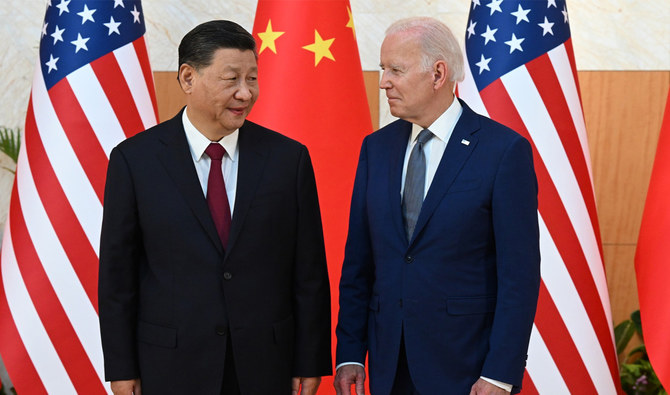

ISLAMABAD: Pakistan’s state minister for foreign affairs Hina Rabbani Khar said this week Islamabad had no appetite to pick a side in the growing global rivalry between Washington and Beijing.
Pakistan, historically a close ally of Washington, has become increasingly close to China, which has provided billions in loans and is Islamabad’s largest single creditor. Pakistan faces a crippling economic crisis, with record-high inflation and critically low foreign exchange reserves depleted by continued debt repayment obligations.
Washington is also still a significant military partner, with the State Department last year approving the potential sale of $450 million worth of equipment to maintain Pakistan’s F-16 fighter jets.
Speaking to Washington-based news outlet Politico this week, Khar said Islamabad was worried about the repercussions of an all-out rupture between the US and China.
“We are highly threatened by this notion of splitting the world into two blocs,” Khar said. “We are very concerned about this decoupling … Anything that splits the world further.”
“We have a history of being in a close, collaborative mode with the US. We have no intention of leaving that. Pakistan also has the reality of being in a close, collaborative mode with China, and until China suddenly came to everyone’s threat perception, that was always the case.”
Khar grabbed headlines in April when a leaked memo appeared in the Wall Street Journal in which she was cited as a warning that Pakistan’s instinct to preserve its partnership with the US would harm what she deemed the country’s “real strategic” partnership with China.
She declined to comment on that leak but said the US was unnecessarily fearful and defensive about being toppled from its plinth of global leadership, which she argued remained vital in areas such as health care, technology, trade and combating climate change.
“I don’t think the leadership role is being contested until they start making other people question it by being reactive,” she said. “I believe that the West underestimates the value of its ideals, soft power.”
On the other hand, she said, China’s biggest selling point for Pakistan was an economic model for lifting a huge population out of poverty.