

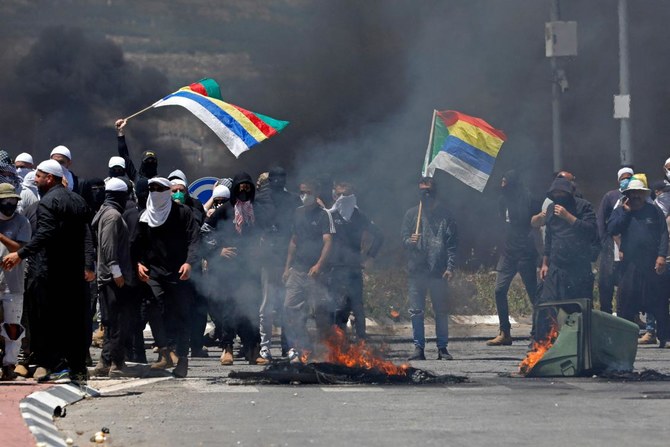

RAMALLAH: Dozens of residents in the occupied Syrian Golan Heights were injured in clashes with Israeli security forces attempting to suppress protests by the owners of land targeted for confiscation in a wind turbine project.
Clashes erupted after landowners protested against the plans, and representatives of the Israeli company responsible for the development stormed the land, backed by police, preventing locals from entering it.
Several protesters were injured after the Israeli security forces used tear gas canisters and rubber-coated metal bullets to disperse the demonstrators by force.
Eyewitnesses said eight people were arrested as Israeli police cordoned off the area, with help from aircraft and horses, and prevented ambulances from reaching the wounded.
Palestinians in the area announced a general strike on Wednesday in Majdal Shams, Buqata, Masada, and Ain Qinya in response to the actions of the Israeli authorities.
The installation of turbines in the villages of the Golan has already received the green light from the Israeli government and planning authorities.
Opponents say that the turbines will impede the cultivation of the land, as well as creating an environmental hazard.
The first attempt to start the installation work, in December 2020, was met with resistance from locals, who called it a “declaration of war” on their villages.
Ali Muaddi, head of the Druze Liaison Committee in Yarka, Galilee, denounced the Israeli action on Wednesday and called on those of the Druze faith in Israel to support moves against the turbines.
Mowafaq Tarif, the head of the Druze community in Israel, met Israeli Prime Minister Benjamin Netanyahu on Wednesday, and requested that work on the turbines in the Golan Heights be halted until the end of Eid Al-Adha. Tarif said that he had agreed to his request.
Ayman Abu Jabal, a prominent leader of the Golani community, told Arab News that the turbines were a direct threat to farmers’ lands.
He added: “No citizen of the Golan Heights is ready to give up his land.”
Areej Hakroush, a political analyst from Kafr Kanna in Galilee, told Arab News that people in the Golan Heights were dealt with in an oppressive way by the Israeli authorities.
However, Hakroush added: “After today’s strong protest of the Golani people, the Israeli authorities understand that all methods of repression are useless.
“I think the Israeli authorities are not interested in escalation in the Golan Heights, especially since the West Bank front is open.”
Dolan Abu Saleh, head of Majdal Shams Council in the Golan Heights, said that he had yet to receive any notification from the office of the Israeli prime minister regarding the cessation of work on constructing turbines on the lands.


