

Kabul says ready to mediate talks between Islamabad, Pakistani Taliban

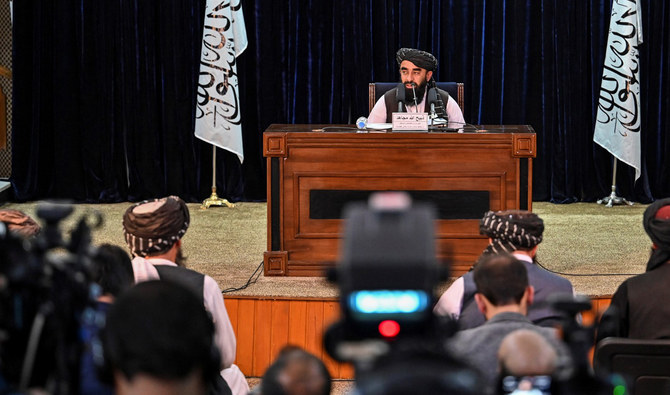
Taliban spokesman Zabiullah Mujahid addresses a press conference at government media and information center in Kabul city, on October 30, 2021. (AFP/File)
Short Url
Updated 21 June 2023
Follow

Kabul says ready to mediate talks between Islamabad, Pakistani Taliban

  • Afghan Taliban spokesperson denies TTP being provided safe haven by Kabul government
  • Pakistani officials have recently repeatedly said Kabul not doing enough to counter TTP

ISLAMABAD: The Afghan Taliban government has said Kabul is ready to negotiate talks between Pakistan and the banned Tehreek-e-Taliban Pakistan (TTP) militant group if Islamabad requested the mediation, Afghanistan’s ToloNews agency reported on Tuesday.

Relations between Pakistan and Afghanistan have been strained lately, mainly due to border skirmishes and a sharp rise in militant attacks by the TTP, which Islamabad says has been emboldened by the Afghan Taliban takeover of Kabul in August 2021. Attacks by the TTP, a separate group but allied with the Afghan Taliban, have risen since the militant group unilaterally called off a fragile truce with the Pakistani government last November. The cease-fire was brokered by the Afghan Taliban.

Officials in Islamabad have since repeatedly said Kabul was not doing enough to counter the activities of the TTP, many of whose commanders and soldiers fled to neighboring Afghanistan after the Pakistan military launched a series of operations against the group’s stronghold, North Waziristan, starting in 2014.

“If Pakistan wants us to mediate, and we know that it is beneficial, we will undoubtedly mediate as it benefits the region and we don’t want war in the region,” Afghanistan’s Tolonews quoted Afghan Taliban spokesperson, Zabiullah Mujahid, as saying.

However, he reiterated that the TTP was not using Afghan soil to launch attacks on Pakistan or any other country and the Taliban administration would not allow such a move.

“We don’t have any type of connection with the TTP in that we support them, or are with them, on the contrary, we do not allow them to be active in Afghanistan,” Mujahid said.

Last week, Pakistan’s state minister for foreign affairs, Hina Rabbani Khar, said Islamabad was taking a “highly diplomatic approach” to deal with the TTP by engaging in talks with the Afghan Taliban rather than resorting to “strong-arm tactics.”

“Threatening anyone normally gets you worse results than the ones you started with,” she told the US-based publication, POLITICO. 

“Even when it is exceptionally difficult to engage at a point when you think your red lines have not been taken seriously, we will still try the route of engagement.”


Pakistan joins 22 Muslim states, OIC to condemn Israeli FM’s visit to Somaliland

Updated 08 January 2026
Follow

Pakistan joins 22 Muslim states, OIC to condemn Israeli FM’s visit to Somaliland

  • Israeli Foreign Minister Gideon Saar visited breakaway African region of Somaliland on January 6
  • Muslim states urge Israel to withdraw Somaliland recognition, respect Somalia’s sovereignty

ISLAMABAD: A joint statement by Pakistan, 22 other Muslim states and the Organization of Islamic Cooperation (OIC) on Thursday condemned Israeli Foreign Minister Gideon Saar’s recent visit to Somaliland as a violation of the African nation’s territorial integrity and sovereignty.

Saar’s visit to Somaliland capital Hargeisa on Jan. 6 followed Israel’s move last month to recognize Somaliland, a breakaway region from Somalia, as an independent country. The move drew a sharp reaction from Muslim states, including Pakistan, who said it was in contravention of the UN Charter and international norms. 

Several international news outlets months earlier reported that Israel had contacted Somaliland over the potential resettlement of Palestinians forcibly removed from Gaza. Muslim countries fear Israel’s recognition of the breakaway region could be part of its plan to forcibly relocate Palestinians from Gaza to the region. 

“The said visit constitutes a clear violation of the sovereignty and territorial integrity of the Federal Republic of Somalia, and undermines established international norms and the United Nations Charter,” the joint statement shared by Pakistan’s foreign office, read. 

The joint statement was issued on behalf of 23 Muslim states, including Saudi Arabia, Bangladesh, Pakistan, Egypt, Iraq, Iran, Palestine, Jordan, Kuwait, Türkiye, Oman and others. 

It reaffirmed support for Somalia’s territorial integrity and sovereignty, pointing out that respect for international law and non-interference in the internal affairs of sovereign states was necessary for regional stability. 

“Encouraging secessionist agendas are unacceptable and risk exacerbating tensions in an already fragile region,” the statement said. 

The joint statement urged Israel to revoke its recognition of the breakaway region. 

“Israel should fully respect Somalia’s sovereignty, national unity and territorial integrity and honor its obligations in compliance with international law, and demand immediate revocation of the recognition issued by Israel,” the statement read.

Somaliland broke away from Somalia unilaterally in 1991 as a civil war raged in the country. Somaliland has its own constitution, parliament and currency, a move that has infuriated Somalia over the years as it insists the region is part of its territory.