

Saudi budget airline flynas signs $3.7bn deal with Airbus to buy 30 aircraft

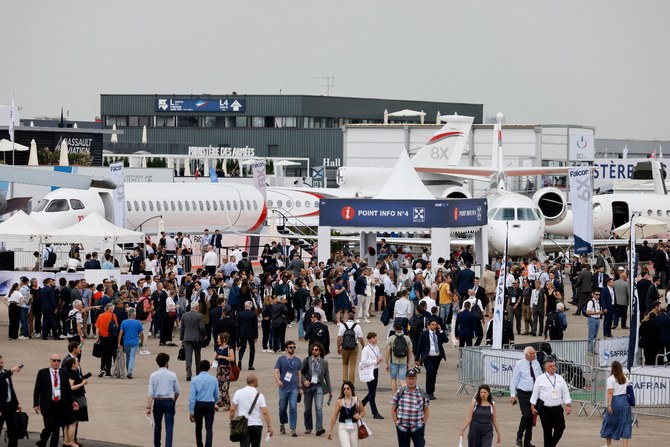
Visitors attend the International Paris Air Show at the Paris-Le Bourget Airport, France. Reuters
Short Url
Updated 20 June 2023
Follow

Saudi budget airline flynas signs $3.7bn deal with Airbus to buy 30 aircraft

  • Paris Air Show begins with a flurry of deals as aviation industry seeks to rebound

RIYADH: Saudi Arabia’s budget airline flynas has signed a $3.73 billion agreement with Airbus to buy 30 aircraft, Saudi state TV reported on Monday.

The deal was signed at the Paris Air Show by Bandar Al-Mohanna, flynas CEO and managing director, and Christian Scherer, Airbus chief commercial officer and head of Airbus international, in the presence of Saudi Minister of Transport and Logistics Saleh Al-Jasser, Abdulaziz Al-Duailej, president of the General Authority of Civil Aviation, and Ayed Aljeaid, chairman of the board of NAS Holding.

Looking to reach new long-haul destinations across its route map, flynas’ agreement includes 10 A321XLRs. These planes will join the airline’s existing fleet of 21 A320neos, 13 A320ceos, and four A330-300s. Between January and the end of this year, 19 A320neos would have been added to the operator’s fleet. Four have already been delivered in 2023 alone.

In a statement, Al-Mohanna said: “The A320neo Family brings unmatched benefits to our passengers, offering exceptional operational performance and environmental benefits while helping us provide unique travel experiences at low-cost.”

Commenting on the deal, Scherer said: “Unbeatable economics, longer range capability, and the most spacious single aisle cabin have made the A320neo Family the preferred choice of airlines worldwide.”

The planemaker also announced a record 500-plane deal with Indian airline IndiGo on the first day of the air show. The world’s largest air show, which alternates with Farnborough in Britain, is at Le Bourget for the first time in four years after the 2021 edition fell victim to the pandemic.

French President Emmanuel Macron flew in to the packed aerospace bazaar by helicopter and watched a flying demonstration including Airbus’ latest jet development, the A321XLR, and air power including the French Rafale fighter.

On the civilian side, plane makers arrived with growing demand expectations as airlines rush for capacity to meet demand and help reach industry goals of net zero emissions by 2050.

Industry executives say as many as 2,000 jet orders are up for grabs worldwide in a resurgent commercial jet market, on top of those provisionally announced already, as airlines try to fill a void left by sharp falls in activity in the COVID-19 crisis.

Only a portion of these potential fresh deals will be ready in time for this week’s air show, which could see a mixture of new and repeat announcements, they said.

IndiGo’s deal highlights the growing importance of India, the world’s fastest-growing aviation market, serving the largest population, to plane makers.

American Airlines ordered 460 single-aisle aircraft: 260 Airbus A320s and 200 Boeing 737, at a catalog price of $38 billion. Four Chinese airlines — Air China, China Eastern, China Southern, and Shenzhen Airlines — placed simultaneous orders for a total of 292 A320neo aircraft from Airbus worth $37 billion at list prices.

United Airlines ordered 270 medium-haul aircraft: 200 Boeing 737 MAX and 70 Airbus A321neo worth $35.4 billion at catalog prices.

Defense side

France’s Thales also announced a contract from Indonesia for 13 long-range air surveillance radars.

Looking ahead to the rest of the show, Airbus is expected to confirm that Qantas is exercising options for nine more A220s, as announced by the airline this year.

The plane maker is also close to a potentially large order for narrow-body jets from Mexican low-cost carrier Viva Aerobus, industry sources said on Sunday.

The number of planes being discussed was more than 100, they said, though by Monday some sources said the number in the final deal could settle closer to 60.

The Mexican carrier has long been a fierce battleground between Boeing and Airbus.


Saudi Arabia set to lead $500bn wave of GCC debt maturities: Kamco Invest 

Updated 6 sec ago
Follow

Saudi Arabia set to lead $500bn wave of GCC debt maturities: Kamco Invest 

RIYADH: The Gulf Cooperation Council region is expected to see elevated levels of fixed-income maturities over the next five years, driven primarily by Saudi Arabia and the UAE, a new analysis showed. 

In its latest report, Kamco Invest said fixed-income maturities in Saudi Arabia are projected to total $174.5 billion between 2026 and 2030, closely followed by the UAE at $171.8 billion.  

Saudi Arabia’s debt market has recorded robust growth in recent years, attracting strong investor interest in fixed-income instruments amid a global environment of elevated interest rates. 

In October, Kuwait Financial Center — also known as Markaz — said Saudi Arabia dominated the GCC’s primary debt market in the third quarter, raising $20.32 billion through 36 issuances, a 62.7 percent year-on-year increase in value. 

“The bulk of the maturities in Saudi Arabia are for bonds and sukuk issued by the government at $106.4 billion, while in the case of the UAE, the lion’s share of maturities are for instruments issued by corporates at $136.2 billion,” said Kamco Invest. 

Over the next five years, fixed-income maturities in Qatar are expected to reach $85.6 billion, while Kuwait, Bahrain and Oman are each projected to record maturities of around $25 billion. 

Citing Bloomberg data, the report showed that GCC sovereign maturities stand at $244.8 billion over the 2026–2030 period, while corporate maturities are higher at $263.3 billion. 
 
“Both bond and sukuk maturities are expected to remain elevated starting from 2026 until 2030 and then gradually taper for the rest of the tenor. The higher maturities during the next five years reflects deficit financing issuances from GCC governments as well as investment and refinancing related issuances from the corporates,” said Kamco Invest. 

The report added that the majority of maturities are denominated in US dollars, accounting for 64.7 percent, followed by local-currency issuances in Saudi riyals and Qatari riyals at 10.6 percent and 6.3 percent, respectively. 

Owing to the strong credit profiles of GCC governments, most maturities fall within the high investment-grade category. A-rated instruments account for $208.7 billion, while total investment-grade maturities stand at $239.1 billion. 

In terms of instruments, conventional bonds dominate, with maturities of $317.6 billion over the next five years, compared with $190.5 billion for sukuk. Corporate bond maturities, at $173.4 billion, exceed government bond maturities of $144.2 billion. 
 
By sector, banks and other financial services firms account for $210.4 billion in maturities through 2030, representing 79.9 percent of total corporate maturities and 41.4 percent of overall GCC maturities. The energy sector follows with $21.8 billion, or 8.3 percent, of corporate maturities, while utilities and industrials account for $13.6 billion and $5.4 billion, respectively. 

Real estate maturities are concentrated mainly in the UAE and Saudi Arabia, at $11.2 billion and $4.3 billion, respectively, through 2030. 
 
Issuances in 2025 

Aggregate bond and sukuk issuances in the GCC reached $206.6 billion through the third week of December 2025, broadly unchanged from $206.8 billion in the same period a year earlier.

However, issuance patterns shifted markedly. Government issuances declined sharply to $77.9 billion in 2025, from $98.6 billion in 2024, while corporate issuances rose to a record $128.6 billion, up from $108.2 billion. 

In terms of type of issuances, sukuk issuances witnessed a sharp decline during 2025, whereas bond issuances showed a healthy growth. 

“Aggregate GCC bond issuances stood at $125.2 billion in 2025, the highest on record, compared to $106.2 billion during 2024, whereas sukuk issuances declined by 19.1 percent to reach $81.4 billion this year as compared to issuances of $100.6 Bn during 2024,” said Kamco Invest. 

Despite an 18.3 percent decline, Saudi Arabia remained the region’s largest fixed-income issuer, with total issuance of $82.0 billion in 2025, down from $100.3 billion the previous year. 

Issuances from Qatar fell 21.7 percent to $22.1 billion, while the UAE recorded modest growth, with total issuance rising to $64.9 billion from $63.4 billion. Kuwait posted the sharpest increase, with issuance surging to $20.5 billion from $2.6 billion in 2024 following the approval of its debt law. 
 
Green issuances 

Green-instrument issuance in the GCC rose sharply in 2025, though it remained below the record levels seen in 2023. Total green issuance reached $12.5 billion, up from $4.6 billion in 2024 but below $17.3 billion recorded in 2023. 

The UAE led the region with $5.6 billion in green issuance, compared with $3.8 billion a year earlier. Saudi Arabia followed with $5.1 billion, after recording no green issuances in 2024. 

Green sukuk are Shariah-compliant instruments designed to finance environmentally sustainable projects, including renewable energy, clean transportation and climate-resilient infrastructure. 
 
Outlook 

Kamco Invest expects higher issuance levels in 2026, particularly among GCC countries facing fiscal deficits. The UAE and Qatar are also projected to see elevated corporate issuance. 

A potential decline in interest rates could further support issuance activity, especially early in the year, as borrowers seek to lock in lower funding costs. 

“Maturity refinancing is expected to result in approximately $85.4 billion in issuances during the year, while government deficit financing led by lower average oil prices would also contribute to the overall trend during the rest of the year,” the report said.  

Based on IMF forecasts, deficit financing could result in issuance of close to $60 billion in 2026, it added.