

Teenager among five Palestinians killed as Israelis use helicopter gunships in West Bank

1 / 2
Smoke is seen rising into the air during an Israeli raid in Jenin, in the Israeli-occupied West Bank June 19, 2023. (Reuters)
2 / 2
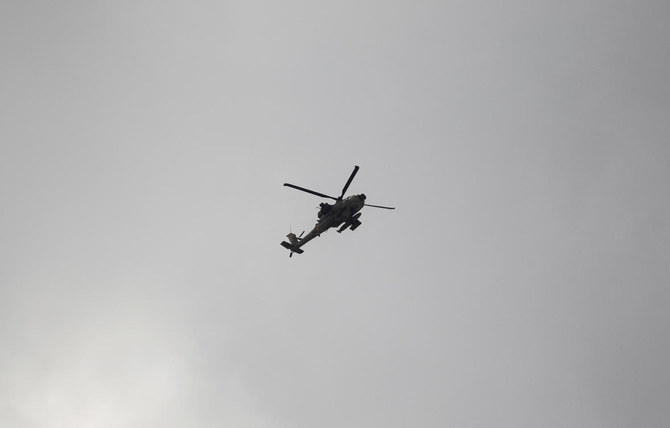
A helicopter flies during an Israeli raid in Jenin, in the Israeli-occupied West Bank June 19, 2023. (Reuters)
Short Url
Updated 19 June 2023
Follow

Teenager among five Palestinians killed as Israelis use helicopter gunships in West Bank

  • Military fires on Jenin refugee camp during dawn incursion

RAMALLAH: Five Palestinians, including a 15-year-old, were killed as Israeli forces used helicopter gunships in a raid in the occupied West Bank on Monday.

The Palestinian Health Ministry identified those killed in Jenin as Khaled Asasa, 21, Qassam Abu Sariya, 29, Qais Jabarin, 21, Ahmed Daraghmeh,19, and 15-year-old Ahmed Yousef Saqer.

The assault also wounded 66 Palestinians, 10 of them seriously, during the incursion into the outskirts of the Jenin camp at dawn, according to the Health Ministry.

Media reported that five Apache helicopters were used in the attack, the first such use of gunships in the occupied West Bank since the second Palestinian uprising two decades ago.

Reports said that 250 Israeli military vehicles took part in the incursion, as well as transport helicopters used to ferry soldiers and drones for surveillance and reconnaissance.

Jordan condemned the Israeli escalation and called for an immediate halt of the continuous assault on Palestinian cities.

A general strike spread throughout the city of Jenin and its camp to protest at Israeli aggression.

High school students could not reach their final exams due to the heavy presence of the army forces on the outskirts of Jenin camp and on the streets of the city.

The Fatah movement also announced a comprehensive strike in Ramallah to mourn those killed, and called on citizens to protest at Israeli military checkpoints.

The Palestinian Red Crescent said the Israeli army prevented Palestinian ambulances from rescuing the wounded and opened fire at them.

The Israeli military claimed that seven soldiers were injured when a 40kg bomb exploded under one of its armored vehicles. Reports in Israel said that gunships were called in when military transport helicopters came under fire.

The Izz al-Din al-Qassam Brigades, the military wing of Hamas operatives in the Jenin refugee camp, claimed it carried out the bombing.

Israeli security sources claim that 20 armed cells operate in the northern West Bank, Jenin, Nablus and Tulkarem.

Israeli officials have also spoken of a plan to invade the cities of Nablus and Jenin for several days to eliminate the suspected armed groups.

Walid Masharqa, a resident of the Jenin camp, told Arab News that he had witnessed “a very bloody day”.

Israeli forces used a bulldozer to destroy an electricity transformer and cut power to the Jenin camp. The blackout prevented Palestinian fighters from communicating and coordinating movements against Israeli forces.

Life was “paralyzed and disrupted,” he said, adding that students could not get to school and adults got not get to work, leading to an atmosphere of “sadness, anger, and frustration.”

“This invasion, destruction, and use of excessive force without justification reminded us of the Jenin camp invasion in 2002,” he said.

Mansour Al-Saadi, deputy governor of Jenin, told Arab News that life had stopped in Jenin.

“Only the sound of Israeli drones hovering in the air and the sound of ambulances transporting the wounded to the city's three hospitals are heard,” he told Arab News.

“The people fear that the Israeli army forces will shoot them as they leave the city and the camp,” he added.

Mohammed Kamil, general manager of the Jenin Chamber of Commerce, told Arab News that the city's economy had been stunted by repeated military incursions, as Palestinians living in Israel stopped visiting to take advantage of cheaper goods.

“When it comes to their lives and their safety, Palestinians from the Galilee and the Triangle inside Israel prefer to preserve their lives by not coming to Jenin to shop for clothes or have a meal in a restaurant,” Kamil told Arab News.

There are around 18,000 people in the camp. The city has a population of 50,000.


UK foreign minister urges UN Security Council to confront ‘bitter truth’ of ‘catastrophically failing Sudan’

Updated 5 sec ago
Follow

UK foreign minister urges UN Security Council to confront ‘bitter truth’ of ‘catastrophically failing Sudan’

  • Yvette Cooper recounts harrowing stories of atrocities during the country’s civil war, including ‘point-blank executions of civilians’ and sexual violence against women and girls
  • The diplomatic momentum that secured the Gaza ceasefire must now be harnessed to secure peace in Sudan and ensure those guilty of atrocities are held to account, she says

NEW YORK CITY: Britain’s foreign secretary, Yvette Cooper, on Thursday called on the UN Security Council to confront “the bitter truth” that the world has been “catastrophically failing the people of Sudan.”
The UK is chairing the Security Council this month, and Cooper is serving as its president. Setting out the scale of the crisis in Sudan, which has been locked in civil war since April 2023, she cited a report by a fact-finding mission on atrocities in El-Fasher, commissioned by the UK, that was published on Thursday.
She highlighted its accounts of “indiscriminate shootings, point-blank executions of civilians in homes, streets, open areas or while attempting to flee the city.”
In one incident, Cooper said: “A pregnant woman was asked how far she was in her pregnancy. When she responded ‘seven months,’ he fired seven bullets into her abdomen, killing her.”
Hospitals, medical personnel and the wounded “were not spared,” she added, and survivors reported being raped in front of relatives, including children.
The report concluded that the atrocities “bear the hallmarks of genocide,” Cooper said. “El-Fasher should have been a turning point. Instead, the violence now is continuing.”
More than three months after the fall of the city, she said, reports of violations of international humanitarian law and human rights abuses persist. Aid agencies face barriers to access, while schools, hospitals, markets and humanitarian convoys, including those belonging to the World Food Programme, have come under attack.
Since the start of the month alone, she said, there have been reports of strikes on aid operations by both of the warring military factions, the Sudanese Armed Forces and the Rapid Support Forces.
Cooper described what she had witnessed firsthand during a recent visit to the border between Chad and Sudan, and warned that behind the statistics lie shattered lives.
“At the Chad-Sudan border, in a camp of over 140,000 people who have fled Sudan’s conflict, 85 percent of them are women and children,” she said.
A Sudanese community worker told her she believed “half, more than half, the women in the camp had been subjected to sexual violence,” Cooper revealed.
She recounted the case of “three sisters arriving at one of the Sudanese emergency response rooms, who had all been raped. The oldest sister was 13. The youngest was eight.
“There is a war being waged on the bodies of women and girls. The world must hear the voices of the women of Sudan and not the military men who are perpetuating this conflict; voices that ensure that this council confronts the bitter truth, because the world has been catastrophically failing the people of Sudan.”
She described the conflict as “the worst humanitarian crisis of the 21st Century,” with 33 million people in need of assistance, 14 million forced from their homes, and famine “stalking millions of malnourished children.”
It is also a regional security crisis and a migration crisis, Cooper added, as she warned of destabilization across the Horn of Africa and the Sahel, opportunities for extremist groups to exploit the instability, and the risk of increased migration affecting Europe.
Cooper commended US-led efforts to convene regional powers, including Egypt, the UAE and Saudi Arabia, to discuss peace plans, as well as support from the African Union and the EU.
“We will need pressure from every UN member state,” she said. “I urge all of those with influence on both the RSF and the SAF not to fuel further conflict, but instead to exert maximum pressure on them to halt the bloodshed.”
She warned that “the reason that the military men still convince themselves there is a military solution is because they can still obtain ever-more lethal weapons.”
Arms restrictions “need to be enforced and extended,” Cooper said, adding: “Now is the time to choke off the arms flows and exert tangible pressure for peace.”
She also called for greater accountability, saying it was time for more sanctions against the perpetrators. The UK has already sanctioned senior RSF commanders linked to atrocities in El-Fasher, she said, and joined the US and France in proposing that they be designated by the Security Council.
Recalling the diplomatic momentum behind efforts to secure a ceasefire in Gaza last year, Cooper said: “We need that same energy and determination to bring peace for Sudan so we can
secure an immediate ceasefire, humanitarian truce, and so that those responsible for atrocities are held to account.
“Let this be the time that the world comes together to end the cycle of bloodshed and to pursue a path to peace.”