

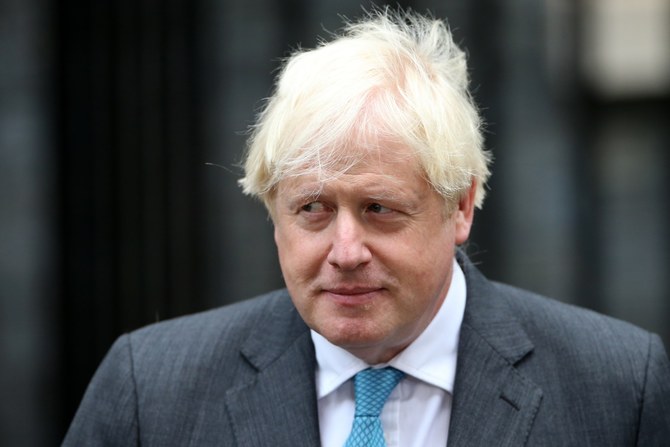
Former UK PM announces new weekly newspaper column

Johnson's column runs every Saturday, says Mail. (AFP/File)
Short Url
Updated 17 June 2023
Follow

Former UK PM announces new weekly newspaper column

  • Boris Johnson’s Daily Mail announcement comes a week following his resignation from Parliament

LONDON: Boris Johnson, the former UK prime minister, will pen a weekly column for the Daily Mail, the London-based newspaper revealed on Friday.

In a Twitter video shared by the Mail, Johnson promised readers “completely unexpurgated stuff.”

He also said: “I will write whatever I want.”

The announcement came almost a week after Johnson stepped down as an MP, an event the Mail described as the loss of “a transformative political genius,” who “was brought down by the envy of Westminster and the spite of Whitehall.”

Johnson’s revelation also came a day after a 30,000-word report by MPs on the House of Commons’ Privileges Committee found that he repeatedly and deliberately misled Parliament with denials over pandemic gatherings at No. 10 Downing Street.

The Mail said in its announcement that it was “delighted to announce Boris Johnson” as its new columnist, describing him as “one of the wittiest and most original writers in the business.”

However, Johnson is accused of having failed to correctly seek approval from the parliamentary watchdog, the Advisory Committee on Business Appointments, prior to assuming his new role with the Daily Mail.

A spokeswoman for ACOBA said in a statement on Friday: “The Ministerial Code states that Ministers must ensure that no new appointments are announced, or taken up, before the Committee has been able to provide its advice.

“An application received 30 mins before an appointment is announced is a clear breach.

“We have written to Mr Johnson for an explanation and will publish correspondence in due course, in line with our policy of transparency.”

According to the Mail, the former prime minister’s column will run every Saturday, with “a preview on MailOnline and The Mail+ on Fridays.”


UAE outlines approach to AI governance amid regulation debate at World Economic Forum

Updated 22 January 2026
Follow

UAE outlines approach to AI governance amid regulation debate at World Economic Forum

  • Minister of State Maryam Al-Hammadi highlights importance of a robust regulatory framework to complement implementation of AI technology
  • Other experts in panel discussion say regulators should address problems as they arise, rather than trying to solve problems that do not yet exist

DUBAI: The UAE has made changes to 90 percent of its laws in the past four years, Maryam Al-Hammadi, minister of state and the secretary-general of the Emirati Cabinet, told the World Economic Forum in Davos on Wednesday.

Speaking during a panel discussion titled “Regulating at the Speed of Code,” she highlighted the importance of having a robust regulatory framework in place to complement the implementation of artificial intelligence technology in the public and private sectors.

The process of this updating and repealing of laws has driven the UAE’s efforts to develop an AI model that can assist in the drafting of legislation, along with collecting feedback from stakeholders on proposed laws and suggesting improvements, she said.

Although AI might be more agile at shaping regulation, “there are some principles that we put in the model that we are developing that we cannot compromise,” Al-Hammadi added. These include rules for human accountability, transparency, privacy and data protection, along with constitutional safeguards and a thorough understanding of the law.

At this stage, “we believe AI can advise but still (the) human is in command,” she said.

Authorities in the UAE are aiming to develop, within a two-year timeline, a shareable model to help other nations learn and benefit from its experiences, Al-Hammadi added.

Argentina’s minister of deregulation and state transformation, Federico Sturzenegger, warned against overregulation at the cost of innovation.

Politicians often react to a “salient event” by overreacting, he said, describing most regulators as “very imaginative of all the terrible things that will happen to people if they’re free.”

He said that “we have to take more risk,” and regulators should wait to address problems as they arise rather than trying to create solutions for problems that do not yet exist.

This sentiment was echoed by Joel Kaplan, Meta’s chief global affairs officer, who said “imaginative policymakers” often focus more on risks and potential harms than on the economic and growth benefits of innovation.

He pointed to Europe as an example of this, arguing that an excessive focus on “all the possible harms” of new technologies has, over time, reduced competitiveness and risks leaving the region behind in what he described as a “new technological revolution.”