

British tabloid Daily Mail’s apology proof of PM’s innocence — Nawaz Sharif

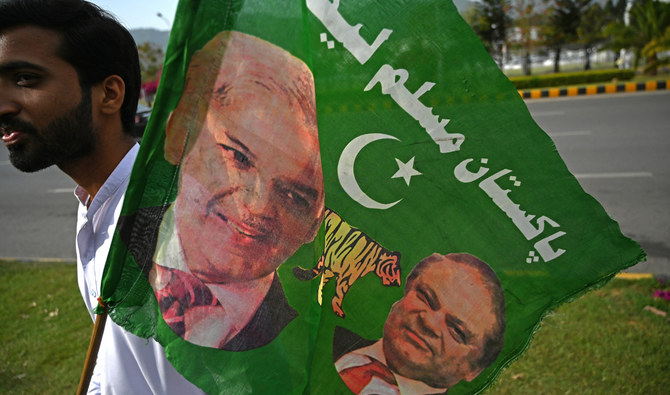
A supporter of Pakistan Muslim League-N (PML-N) holds a party flag with images of Shehbaz Sharif and his elder brother and former prime minister Nawaz Sharif outside the parliament house building in Islamabad on April 11, 2022. (Photo courtesy: AFP/File)
Short Url
Updated 10 December 2022
Follow

British tabloid Daily Mail’s apology proof of PM’s innocence — Nawaz Sharif

  • Nawaz Sharif says fake cases were registered against him over the past couple of years
  • Sharif says PM given clean chit by UK government’s crime agency, British tabloid

ISLAMABAD: Former three-time prime minister Nawaz Sharif on Saturday said British tabloid Daily Mail’s apology to his younger brother, Prime Minister Shehbaz Sharif, was proof that he and other leaders of the Pakistan Muslim League-Nawaz (PML-N) party were innocent of corruption charges.

British newspaper ‘The Mail on Sunday’ and online news website ‘Mail Online’ on Thursday apologized to the Pakistani prime minister for publishing a 2019 report that said he was being investigated by Pakistani authorities for embezzling funds meant for earthquake victims.

Shehbaz Sharif sued the newspaper in 2020, claiming the story was “politically motivated” at the behest of then prime minister Imran Khan and his accountability czar, Mirza Shahzad Akbar. Both denied the allegations.

In its apology, Daily Mail made it clear Shehbaz Sharif was never accused by Pakistan’s National Accountability Bureau (NAB) of any wrongdoing in relation to British money or any grant by the UK’s Department of International Development (DfID).

In a video message, the elder Sharif said the apology by the British newspaper carried weight as no political party was in government in the UK and hence, couldn’t influence its decision.

“There is democracy here [in the UK], this country’s newspaper has tendered an apology here,” he said. “What bigger proof can there be of someone’s innocence?”

Sharif said ex-PM Khan “is involved in corruption himself from head to feet”, adding that on the contrary, his younger brother had been given a clean chit by the UK government and a British newspaper.

Sharif was restricted for life from holding any political office by Pakistan’s top court in April 2018, followed by his conviction in a corruption case the same year. He says the cases against him were politically motivated.

He has been living in self-imposed exile in London since 2019, after he was granted bail by a Pakistani court to seek treatment abroad.

“[Politically motivated] cases were registered against us, we had to unnecessarily face exile and face jail time,” he said, adding that charges against him were never proven.

Though Sharif did not speak on the matter, his party has repeatedly said he would return to Pakistan ahead of next year’s general elections to lead the party in the polls.


Rating firm S&P says it won’t rush Iran war downgrades, sees risks for countries like Pakistan

Updated 4 sec ago
Follow

Rating firm S&P says it won’t rush Iran war downgrades, sees risks for countries like Pakistan

  • Agency says it is monitoring indebted energy importers as higher oil prices strain finances
  • Gulf economies seen better placed to weather shock, though Bahrain flagged as vulnerable

LONDON: S&P Global ‌said it would not make any knee-jerk sovereign rating cuts following the outbreak of war in the ​Middle East, but warned on Thursday that soaring oil and gas prices were putting a number of already cash-strapped countries at risk.

The firm’s top analysts said in a webinar that the conflict, which has involved US and Israeli strikes ‌against Iran and Iranian ‌strikes against Israel, ​US ‌bases ⁠and Gulf ​states, ⁠was now moving from a low- to moderate-risk scenario.

Most Gulf countries had enough fiscal buffers, however, to weather the crisis for a while, with more lowly rated Bahrain the only clear exception.

Qatar’s banking sector could ⁠also struggle if there were significant ‌deposit outflows in ‌reaction to the conflict, although there ​was no evidence ‌of such strains at the moment, they ‌said.

“We don’t want to jump the gun and just say things are bad,” S&P’s head global sovereign analyst, Roberto Sifon-Arevalo, said.

The longer the crisis ‌was prolonged, though, “the more difficult it is going to be,” he ⁠added.

Sifon-Arevalo ⁠said Asia was the second-most exposed region, due to many of its countries being significant Gulf oil and gas importers.

India, Thailand and Indonesia have relatively lower reserves of oil, while the region also had already heavily indebted countries such as Pakistan, Bangladesh and Sri Lanka whose finances would be further hurt by rising energy prices.

“We ​are closely monitoring ​these (countries) to see how the credit stories evolve,” Sifon-Arevalo said.