

Cyclone Biparjoy leaves destructive trail on Indian coast 

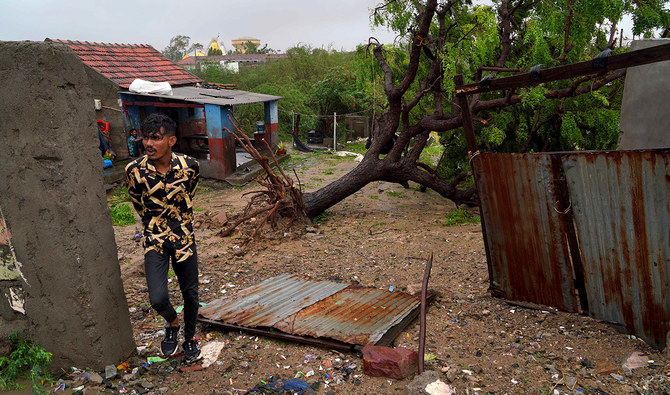
A man walks past a fallen tree at his house in the coastal town of Mandvi as cyclone Biparjoy makes landfall on June 16, 2023. (AFP)
Short Url
Updated 17 June 2023
Follow

Cyclone Biparjoy leaves destructive trail on Indian coast 

  • More than 180,000 people in the Indian state of Gujarat and Pakistan’s neighboring Sindh province fled the path of cyclone 
  • Two men in India’s Bhavnagar district drowned with over 1,000 villages around the coast left without electricity by the storm 

MANDVI: Cyclone Biparjoy tore down power poles and uprooted trees Friday after pummelling the Indian coastline, but the storm was weaker than feared and there were only two confirmed deaths. 

More than 180,000 people in the Indian state of Gujarat and Pakistan’s neighboring Sindh province fled the path of Biparjoy — which means “disaster” in Bengali — before it made landfall on Thursday evening. 

The storm packed sustained winds of up to 125 kilometers (78 miles) per hour as it struck — but weakened overnight, with Indian forecasters expecting it to calm into a moderate low-pressure system by late Friday. 

Two men in Bhavnagar district died on Thursday evening after drowning in flood waters, the Gujarat state government said. 

Relief director C.C. Patel had earlier told AFP there had been no deaths reported in Gujarat but 23 people had been injured in the storm. 

Driving rain and howling winds continued to lash the state’s coast on Friday despite the worst of the danger receding. 

“I’ve never seen anything like this before,” Mukesh Pattni, 22, told AFP from the concrete shophouse where he and 10 other family members took shelter. 

“I haven’t eaten anything since yesterday. Trees are falling, everything is falling apart.” 

State relief commissioner Alok Pandey told reporters that nearly 500 homes had been partially damaged after Biparjoy made landfall. 

More than 1,000 villages around the coast were without electricity on Friday as the force of the storm knocked down power lines. 

Rescue crews were working to clear trees knocked onto roads and restore access to villages. 

In Gujarat, more than 100,000 people had been moved from the storm’s path before it struck, the state government said, as well as 82,000 others in Pakistan. 

Pakistan climate change minister Sherry Rehman said “no human lives were lost” on her side of the border. 

“Thank God it did not directly hit the coastal areas of Pakistan,” she told broadcaster Dunya. 

On Friday, shops and markets gradually reopened under drizzling skies and a cool ocean breeze in Thatta, a city around 50 kilometers inland. 

“So far, so good,” said 40-year-old government worker Hashim Shaikh. “We were pushed into a state of fear for the past several days, but now it seems to be over.” 

In the fishing port of Keti Bandar — forecast to be hardest hit by the storm — “there was zero damage,” according to engineer Rahimullah Qureshi from the provincial irrigation department. 

Cyclones are a regular and deadly menace on the coast of the northern Indian Ocean, where tens of millions of people live. 

In 2021, the coast of Gujarat was hit by the more powerful Cyclone Tauktae, which killed more than 150 people and caused large-scale destruction. 

More than 4,000 people died in India when another cyclone hit the same coastline in 1998. 

Scientists have warned that storms are becoming more powerful as the world gets warmer with climate change. 

Roxy Mathew Koll, a climate researcher at the Indian Institute of Tropical Meteorology, said cyclones derive their energy from warm waters, and that surface temperatures in the Arabian Sea were 1.2 to 1.4 degrees Celsius (34 to 35 degrees Fahrenheit) warmer than four decades ago. 


Saudi ambassador becomes first foreign envoy to meet Bangladesh’s new PM

Updated 4 sec ago
Follow

Saudi ambassador becomes first foreign envoy to meet Bangladesh’s new PM

  • Tarique Rahman took oath as PM last week after landslide election win
  • Ambassador Abdullah bin Abiyah also meets Bangladesh’s new FM

Dhaka: Saudi Arabia’s ambassador to Dhaka became on Sunday the first foreign envoy to meet Bangladesh’s new Prime Minister Tarique Rahman since he assumed the country’s top office.

Rahman’s Bangladesh Nationalist Party made a landslide win in the Feb. 12 election, securing an absolute majority with 209 seats in the 300-seat parliament.

The son of former Prime Minister Khaleda Zia and former President and BNP founder Ziaur Rahman, he was sworn in as the prime minister last week.

The Saudi government congratulated Rahman on the day he took the oath of office, and the Kingdom’s Ambassador Abdullah bin Abiyah was received by the premier in the Bangladesh Secretariat, where he also met Bangladesh’s new foreign minister.

“Among the ambassadors stationed in Dhaka, this is the first ambassadorial visit with Prime Minister Tarique Rahman since he assumed office,” Saleh Shibli, the prime minister’s press secretary, told Arab News.

“The ambassador conveyed greetings and best wishes to Bangladesh’s prime minister from the king and crown prince of Saudi Arabia … They discussed bilateral matters and ways to strengthen the ties among Muslim countries.”

Rahman’s administration succeeded an interim government that oversaw preparations for the next election following the 2024 student-led uprising, which toppled former leader Sheikh Hasina and ended her Awami League party’s 15-year rule.

New Cabinet members were sworn in during the same ceremony as the prime minister last week.

Foreign Minister Khalilur Rahman is a former UN official who served as Bangladesh’s national security adviser during the interim government’s term.

He received Saudi Arabia’s ambassador after the envoy’s meeting with the prime minister.

“The foreign minister expressed appreciation for the Saudi leadership’s role in promoting peace and stability in the Middle East and across the Muslim Ummah. He also conveyed gratitude for hosting a large number of Bangladeshi workers in the Kingdom and underscored the significant potential for expanding cooperation across trade, investment, energy, and other priority sectors, leveraging the geostrategic positions of both countries,” the ministry said in a statement.

“The Saudi ambassador expressed his support to the present government and his intention to work with the government to enhance the current bilateral relationship to a comprehensive relationship.”

Around 3.5 million Bangladeshis live and work in Saudi Arabia. They have been joining the Saudi labor market since 1976, when work migration to the Kingdom was established during the rule of the new prime minister’s father.

Bangladeshis are the largest expat group in the Kingdom and the largest Bangladeshi community outside Bangladesh and send home more than $5 billion in remittances every year.