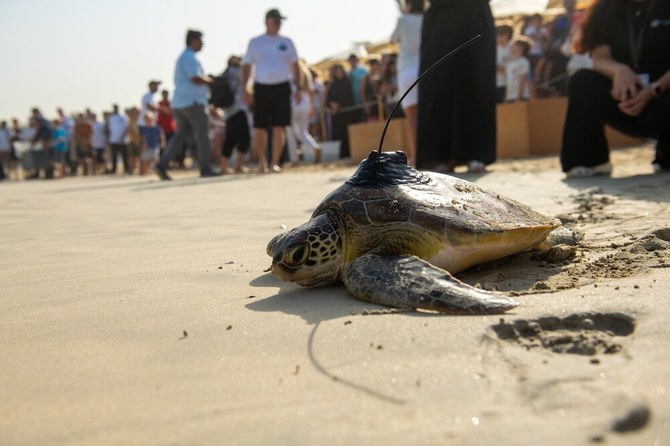
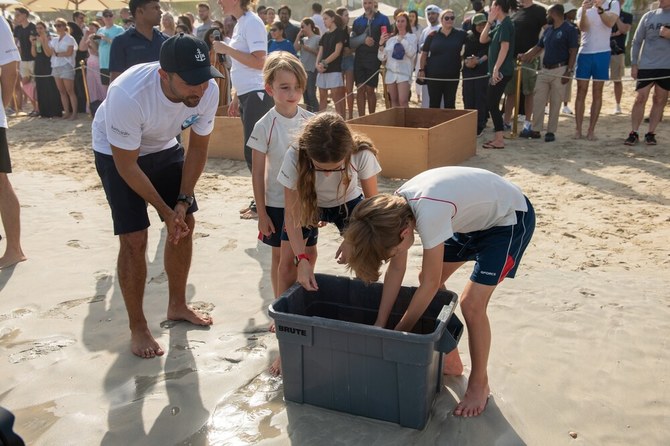
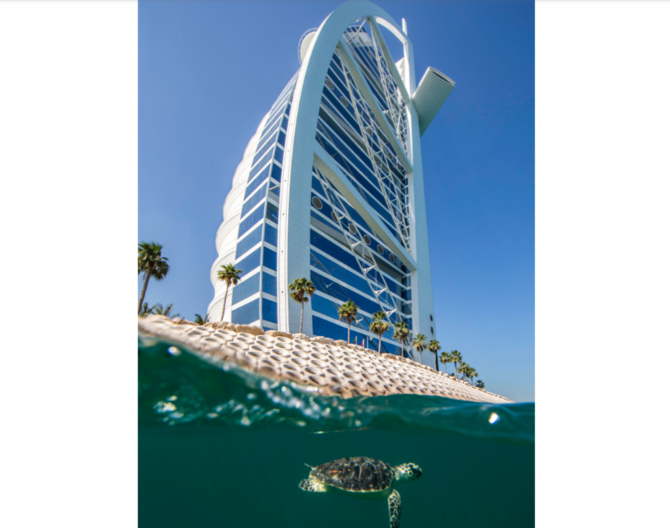
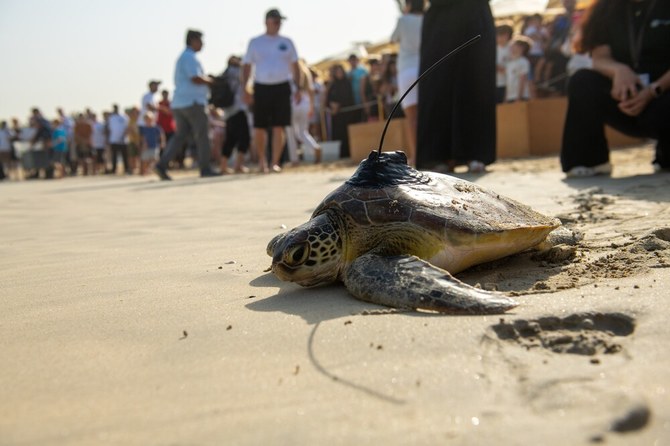
DUBAI: The Dubai Turtle Rehabilitation Project released on Friday 15 hawksbill and six green turtles into the Arabian Gulf in an event that coincided with World Sea Turtle Day 2023.
The project, launched by Jumeirah Group, comes as part of Dubai’s ongoing commitment to marine biodiversity and ecosystems, reported the Emirates News Agency.
The release of the two species, both of which are endangered, underscores the vital role turtles play in maintaining the balance of marine habitats.
The Dubai Turtle Rehabilitation Project mainly focuses on the conservation of the hawksbill turtle, a critically endangered species that annually nests along the Gulf coast.
Jumeirah Group’s CEO Katerina Giannouka said that, with many of Jumeirah’s resorts being coastal, “we witness first-hand the impact of climate change on precious marine species and these delicate ecosystems.
“Coastal resilience and biodiversity health are critical to Jumeirah as a business … We have an obligation to act now, to educate, to collaborate, and to champion progress toward a sustainable future for all.”
Among the successfully rehabilitated turtles were one large female green turtle, which had suffered carapace damage due to a boat strike, and a male hawksbill turtle named Zippy.
Zippy was rescued by DTRP in October 2022 after being found in bad shape floating near the Ras Al-Khaimah shoreline. He had suffered intestinal impaction from eating plastic debris and a severe lung infection and was completely covered in barnacles.
Government representatives, academia and non-governmental organizations attended Friday’s event. Representatives from Yas Sea World Research and Rescue, which performed a CT scan on Zippy at the start of his remarkable rehabilitation journey, were also present.
“With such a limited number of these turtles left, it is essential to ensure that every one of them can fulfill its role in maintaining population numbers. It was critical for us to release our adult sea turtles as soon as they fully recovered,” said Barbara Lang-Lenton Arrizabalaga, director of the aquarium at Burj Al-Arab.
She added that they have already released several turtles this season, and “we can see from our satellite tagging program that some of these animals have traveled to their nesting sites.
“As beach temperatures rise due to climate change, the sex ratio of sea turtles is shifting toward a higher number of females being born. The reintroduction of a fully grown male hawksbill turtle like Zippy marks a significant milestone for sea turtle conservation in the UAE and globally,” added Arrizabalaga.
The satellite tagging program has helped the team successfully trace the journey of a rescued olive ridley turtle, which are occasionally encountered in UAE waters, back to crucial nesting sites for the species in India.
Previous data has also shown a green turtle migrating as far as Thailand, demonstrating the importance of rehabilitation and release in maintaining sea turtle populations worldwide.
“The goal is to ensure that turtles receive the best care possible. Building inter-emirate cooperation across the UAE’s scientific communities, rescue centers and government entities enables us to undertake a mutually beneficial cooperation in sea turtle rehabilitation, research, and habitat restoration,” concluded Arrizabalaga.
The project also runs an educational program for school groups to learn more about the work undertaken by DTRP.


21 endangered turtles released into Arabian Gulf for World Sea Turtle Day
https://arab.news/67ehy
21 endangered turtles released into Arabian Gulf for World Sea Turtle Day
- Dubai Turtle Rehabilitation Project comes as part of Dubai’s ongoing commitment to marine biodiversity and ecosystems
- Jumeirah Group’s CEO: ‘We have an obligation to champion progress toward a sustainable future for all’


In southeast Pakistan, Ramadan brings Hindus and Muslims closer
MITHI: Partab Shivani, a Hindu in Muslim-majority Pakistan, has fasted on and off during Ramadan for years, but this time is different as he practices abstinence for the entire holy month.
Every year, he and his friends in the southeastern city of Mithi arrange iftar, when Muslims break their daily fast, to foster peace and solidarity between the two religions.
“I believe we need to promote interfaith harmony. First, we are humans — religions came later,” Shivani, a 48-year-old social activist, told AFP, adding that he also reads the teachings of the Buddha.
“His message is about peace and ending war. Peace can spread through solidarity and by standing with one another. Distance only widens the gap between people,” he added.
Ninety-six percent of Pakistan’s 240 million people are Muslim. Just two percent are Hindu, most of them living in rural areas of Sindh province where Mithi is located.
In Mithi itself, most of the 60,000 inhabitants are Hindu.
Many of the city’s Hindus also observe Ramadan and iftar has become a social gathering where people from both faiths happily participate.
“This has been a wonderful tradition of ours for a very long time,” said Mir Muhammad Buledi, a 51-year-old Muslim friend who attended Shivani’s iftar gathering.
“It is a beautiful example of harmony between the two communities.”
Like brothers
Discrimination against minorities runs deep in Pakistan.
Following the end of British rule in South Asia in 1947, the subcontinent was partitioned into mainly Hindu India and Muslim-majority Pakistan.
That triggered widespread religious bloodshed in which hundreds of thousands were killed and millions displaced.
According to the Human Rights Commission of Pakistan, freedom of religion or belief is under constant threat, with religiously motivated violence and discrimination increasing yearly.
State authorities, often using religious unrest for political gain, have failed to address the crisis, the independent non-profit says.
But such tensions are absent in Mithi.
“I am a Hindu but I keep all the fasts during this month,” said Sushil Malani, a local politician. “I feel happy standing with my Muslim brothers.
“We celebrate Eid together as well. This tradition in the region is very old.”
Restaurants and tea stalls are closed across Pakistan during Ramadan.
Ramesh Kumar, a 52-year-old Hindu man who sells sweets and savoury items outside a Muslim shrine, keeps his push cart covered and closed until iftar.
“There is no discrimination among us if someone is Muslim or Hindu. I have been seeing this since my childhood that we all live together like brothers,” he said.
Muslim shrine, Hindu caretaker
Locals say Mithi’s peaceful religious coexistence can be traced to its remote location, emerging from the sand dunes of the Tharparkar desert, which borders the modern Indian state of Rajasthan.
Cows — considered sacred in Hinduism — roam freely in Mithi city, as they do in neighboring India.
At two Sufi Muslim shrines in the middle of the city, Hindu families arrange meals, bringing fruit, meals and juices for their Muslim neighbors to break their fasts.
“We respect Muslims,” said Mohan Lal Malhi, a Hindu caretaker of one of the shrines.
Mohan said his parents and elders taught him to respect people regardless of religion or color, and the traditions pass from one generation to the next.
Local residents said both communities consider their social relationships more important than their religious identity.
“You will see a (Sikh) gurdwara, a mosque, and a shrine standing side by side here,” Mohan said. “The atmosphere of this area teaches humanity.”