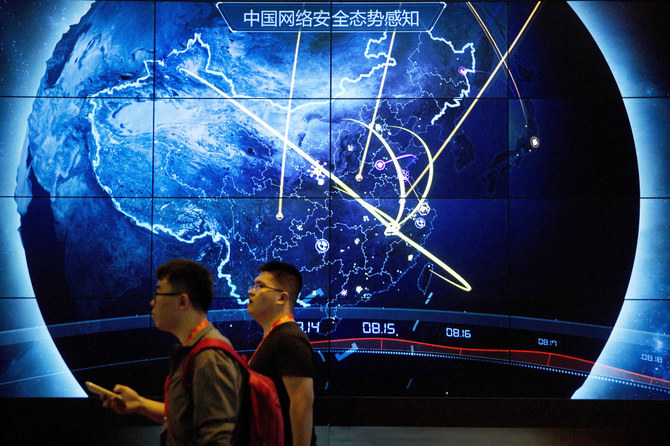
Washington: Online attackers with clear links to China are behind a vast cyber espionage campaign targeting government agencies of interest to Beijing, Google subsidiary Mandiant said on Thursday.
“This is the broadest cyber espionage campaign known to be conducted by a China-nexus threat actor since the mass exploitation of Microsoft Exchange in early 2021,” said Mandiant chief technology officer Charles Carmakal.
The cyberattackers compromised the computer defenses of hundreds of organizations, in some cases stealing “emails of prominent employees dealing in matters of interest to the Chinese government,” Carmakal added.
Mandiant reported having “high confidence” that a group referred to as UNC4841 was behind the wide-ranging espionage campaign “in support of the People’s Republic of China.”
The hackers targeted victims in at least 16 different countries, striking organizations in the public and private sectors worldwide, the report said.
The targeting focused on issues of high policy importance to the Chinese government, particularly in the Asia-Pacific region and Taiwan, according to the report.
Victims included foreign ministries, research organizations, and foreign trade missions based in Hong Kong and Taiwan, Mandiant said in its findings.
The attacks involved email messages booby-trapped with malicious code and exploited a vulnerability in Barracuda software for screening such missives to make sure they are safe, according to the report.
The cyber espionage activity was detected in May and is believed to have started as early as October of last year.
“We continue to see evidence of ongoing malware activity” on some systems that were compromised, Barracuda Networks told AFP.
The 2021 hack of Microsoft Exchange, which security researchers attributed to a Beijing-backed group, affected at least 30,000 organizations in the United States including businesses and local governments.
Washington has frequently accused Beijing of cyberattacks against US targets, with the issue contributing to a deterioration in relations between the two powers in recent years.
China has consistently denied the claims, and has railed against alleged US cyber espionage, last year accusing the US National Security Agency of carrying out “tens of thousands of malicious attacks on network targets in China.”
The latest hacking revelations come as Secretary of State Antony Blinken heads to China for talks on Sunday and Monday, the first visit by a top US diplomat in nearly five years.
A senior State Department official said the trip is aimed at helping the two countries manage their “competition” responsibly, and “at a minimum, reduce the risk of miscalculation so that we do not veer into potential conflict.”
Meanwhile, in an apparently unrelated cyberattack, CNN reported Thursday that several US federal agencies had been caught in a Russian group’s hack of the commonly used software MOVEit.
When asked for comment by AFP, the White House pointed to an advisory issued last week by the FBI and CISA, the federal government’s lead cybersecurity agency, warning of the software’s vulnerability and offering information on how to mitigate it.

Vast cyber espionage campaign linked to China: report
Short Url
https://arab.news/p7npz
Vast cyber espionage campaign linked to China: report
- Victims included foreign ministries, research organizations, and foreign trade missions based in Hong Kong and Taiwan
EU diplomats to meet Board of Peace director over Gaza’s future
- Former Bulgarian politician and UN diplomat Nikolay Mladenov has been chosen by Trump to manage the Board of Peace
- Mladenov will meet with the EU’s foreign policy chief Kaja Kallas and foreign ministers from across the 27-nation block
BRUSSELS: The European Union’s top diplomats are set to meet Monday with the director of the Board of Peace in Brussels after a shaky and controversial embrace of US President Donald Trump’s efforts to secure and rebuild the war-ravaged Gaza Strip.
Nikolay Mladenov, a former Bulgarian politician and UN diplomat chosen by Trump to manage the Board of Peace, will meet the EU’s foreign policy chief Kaja Kallas and foreign ministers from across the 27-nation bloc. The EU diplomats are also expected to discuss the war in Ukraine and fresh sanctions on Russia.
Just across the Mediterranean Sea from the Middle East, the EU has deep links to Israel and the Palestinians. It now plays a crucial oversight role at the Rafah border crossing, and is the top donor to the Palestinian Authority.
The question of whether to work with the Trump-led board has split national capitals from Nicosia to Copenhagen. The EU is supportive of the United Nations’ mandate in Gaza.
EU members Hungary and Bulgaria are full members of the board, as are EU candidate countries Turkiye, Kosovo and Albania.
Twelve other EU nations sent observers to the inaugural meeting in Washington on Thursday: Austria, Croatia, Cyprus, Czech Republic, Finland, Germany, Greece, Italy, Netherlands, Poland, Romania and Slovakia. The EU flag was displayed at the event alongside EU observer and member nations.
European leaders like French President Emmanuel Macron and European Commission President Ursula von der Leyen turned down invitation to join, as did Pope Leo XIV. But von der Leyen did send European Commissioner for the Mediterranean Dubravka Šuica to the meeting in Washington as an observer.
French Foreign Minister Jean-Noël Barrot said sending Šuica without consulting the European Council, the group of the bloc’s leaders, broke EU regulations.
“The European Commission should never have attended the Board of Peace meeting in Washington,” Barrot said in a post on X. “Beyond the legitimate political questions raised by the ‘Board of Peace,’ the Commission must scrupulously respect European law and institutional balance in all circumstances.”
“It is in the remit of the Commission to accept invitations,” von der Leyen spokesperson Paula Pinho said Friday.
While the executive is not joining the board, it is seeking to influence reconstruction and peacekeeping in Gaza beyond being the top donor to the Palestinian Authority, she said.
Trump’s ballooning ambitions for the board extend from governing and rebuilding Gaza as a futuristic metropolis to challenging the UN Security Council’s role in solving conflicts. But they could be tempered by the realities of dealing with Gaza, where there has so far been limited progress in achieving the narrower aims of the ceasefire.
Nikolay Mladenov, a former Bulgarian politician and UN diplomat chosen by Trump to manage the Board of Peace, will meet the EU’s foreign policy chief Kaja Kallas and foreign ministers from across the 27-nation bloc. The EU diplomats are also expected to discuss the war in Ukraine and fresh sanctions on Russia.
Just across the Mediterranean Sea from the Middle East, the EU has deep links to Israel and the Palestinians. It now plays a crucial oversight role at the Rafah border crossing, and is the top donor to the Palestinian Authority.
The question of whether to work with the Trump-led board has split national capitals from Nicosia to Copenhagen. The EU is supportive of the United Nations’ mandate in Gaza.
EU members Hungary and Bulgaria are full members of the board, as are EU candidate countries Turkiye, Kosovo and Albania.
Twelve other EU nations sent observers to the inaugural meeting in Washington on Thursday: Austria, Croatia, Cyprus, Czech Republic, Finland, Germany, Greece, Italy, Netherlands, Poland, Romania and Slovakia. The EU flag was displayed at the event alongside EU observer and member nations.
European leaders like French President Emmanuel Macron and European Commission President Ursula von der Leyen turned down invitation to join, as did Pope Leo XIV. But von der Leyen did send European Commissioner for the Mediterranean Dubravka Šuica to the meeting in Washington as an observer.
French Foreign Minister Jean-Noël Barrot said sending Šuica without consulting the European Council, the group of the bloc’s leaders, broke EU regulations.
“The European Commission should never have attended the Board of Peace meeting in Washington,” Barrot said in a post on X. “Beyond the legitimate political questions raised by the ‘Board of Peace,’ the Commission must scrupulously respect European law and institutional balance in all circumstances.”
“It is in the remit of the Commission to accept invitations,” von der Leyen spokesperson Paula Pinho said Friday.
While the executive is not joining the board, it is seeking to influence reconstruction and peacekeeping in Gaza beyond being the top donor to the Palestinian Authority, she said.
Trump’s ballooning ambitions for the board extend from governing and rebuilding Gaza as a futuristic metropolis to challenging the UN Security Council’s role in solving conflicts. But they could be tempered by the realities of dealing with Gaza, where there has so far been limited progress in achieving the narrower aims of the ceasefire.
© 2026 SAUDI RESEARCH & PUBLISHING COMPANY, All Rights Reserved And subject to Terms of Use Agreement.