

Trials under army laws meet international fair trial requirements — Pakistan law minister

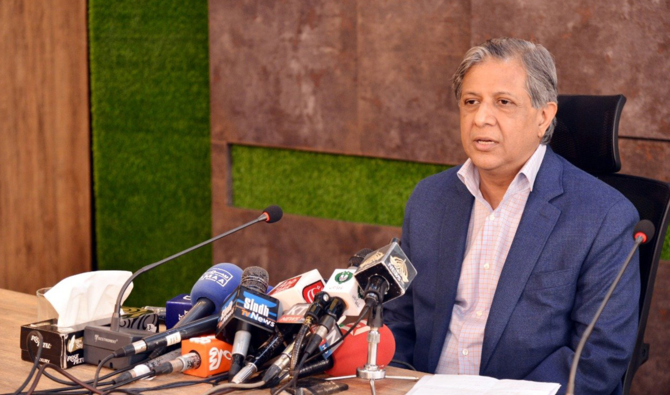
In this file photo Pakistan's Federal Minister for Law and Justice Senator Azam Nazeer Tarar addressing a Press Conference in Islamabad on September 29, 2022. (Photo courtesy: @MoLawJusticeof1/Twitter)
Short Url
Updated 14 June 2023
Follow

Trials under army laws meet international fair trial requirements — Pakistan law minister

  • Tarar cites Article 14 of International Covenant on Civil and Political Rights 1966 on fair trial
  • Government and military have come under criticism for pushing for military court trials of rioters

ISLAMABAD: Law Minister Azam Nazeer Tarar said on Wednesday trials under army laws met “internationally acknowledged minimum requirements” of a fair trial, as the Pakistani government and military face widespread criticism for pushing for military court trials of suspects who participated in riots last month. 

In recent weeks, local and international human rights bodies have expressed alarm over the government and army’s plan to bring former Prime Minister Imran Khan's supporters, who clashed with police and attacked military properties last month, to trial under military rules. Military trials in Pakistan are usually held behind closed doors, depriving civilians of some of their basic rights, including contracting a lawyer of their choice.

A wave of violence engulfed Pakistan’s capital and other cities following the dramatic arrest of Khan from a courtroom in Islamabad on May 9. Angry Khan supporters torched buildings and vehicles and attacked police and military personnel and facilities.

Speaking to the media on Wednesday, Tarar cited Article 14 of the International Covenant on Civil and Political Rights 1966 on fair trials, which he said gave the right to appoint a counsel of choice, reduce defence evidence, have access to the relevant record and seek a judicial review.

The law minister said army laws in Pakistan “covered all these [aspects] and that is why it is said that they meet the internationally acknowledged minimum requirements pertaining to the procedure and law.”

Khan’s Pakistan Tehreek-e-Insaf party has approached the Supreme Court against the state’s decision to prosecute civilians under the Army Act. 

So far, a Lahore anti-terrorism court has sanctioned the handing over of 16 May 9 suspects to the military and a Rawalpindi court has approved the handing over of another eight suspects. Interior Minister Rana Sanaullah has separately said 33 suspects — 19 in Punjab and 14 in Khyber Pakhtunkhwa provinces — had been handed over to the military following the May 9 attacks on army installations.

Military courts operate under a separate system from the civilian legal system and are run by military officers. The judges are also military personnel and cases are tried at military installations. Trials are closed to outsiders, and no media presence is allowed.


IMF board to approve Pakistan reviews today ‘if all goes well,’ say officials

Updated 4 sec ago
Follow

IMF board to approve Pakistan reviews today ‘if all goes well,’ say officials

  • IMF’s executive board is scheduled to meet today to discuss the disbursement of $1.2 billion
  • Economists say the money will boost Pakistan’s forex reserves, send positive signals to investors

KARACHI: The International Monetary Fund’s (IMF) executive board is scheduled to meet today, Monday, to approve the release of about $1.2 billion for Pakistan under the lender’s two loan facilities, said IMF officials who requested not to be named.

The IMF officials confirmed the executive board was going to decide on the Fund’s second review under the $7 billion Extended Fund Facility (EFF) and first review under the $1.4 billion Resilience and Sustainability Facility (RSF), a financing tool that provides long-term, low-cost loans to help countries address climate risks.

“The board meeting will be taking place as planned,” an IMF official told Arab News.

“The board is on today yes as per the calendar,” said another.

A well-placed official at Pakistan’s finance ministry also confirmed the board meeting was scheduled today to discuss the next tranche for Pakistan.

The IMF executive board’s meeting comes nearly two months after a staff-level agreement (SLA) was signed between the two sides in October.

Procedurally, the SLAs are subject to approval by the executive board, though it is largely viewed as a formality.

“If all goes well, the reviews should pass,” said the second IMF official.

On approval, Pakistan will have access to about $1 billion under the EFF and about $200 million under the RSF, the IMF said in a statement in October after the SLA.

The fresh transfer will bring total disbursements under the two arrangements to about $3.3 billion, it added.

Experts see smooth sailing for Pakistan in terms of the passing of the two reviews, saying the IMF disbursements will help the cash-strapped nation to strengthen its balance of payments position.

Samiullah Tariq, group head of research at Pakistan Kuwait Investment Company Limited, said the IMF board’s approval will show that Pakistan’s economy is on the right path.

“It obviously will help strengthen [the country’s] external sector, the balance of payments,” he told Arab News.

Until recently, Pakistan grappled with a macroeconomic crisis that drained its financial resources and triggered a balance of payments crisis.

Pakistan has reported financial gains since 2022, recording current account surpluses and taming inflation that touched unprecedented levels in mid-2023.

Economists also viewed the IMF’s bailout packages as crucial for cash-strapped Pakistan, which has relied heavily on financing from bilateral partners such as Saudi Arabia, China and the United Arab Emirates, as well as multilateral lenders.

Saudi Arabia, through the Saudi Fund for Development, last week extended the term of its $3 billion deposit for another year to help Pakistan boost its foreign exchange reserves, which stood at $14.5 billion as of November 28, according to State Bank of Pakistan statements.

“In our view this [IMF tranche] will be approved,” said Shankar Talreja, head of research at Karachi-based brokerage Topline Securities Limited.

“This will help strengthen reserves and will eventually help a rating upgrade going forward,” he said.

The IMF board’s nod, Talreja said, would also send a signal to the international and local investors regarding the continuation of the reform agenda by Pakistan’s government.