

Trials under army laws meet international fair trial requirements — Pakistan law minister

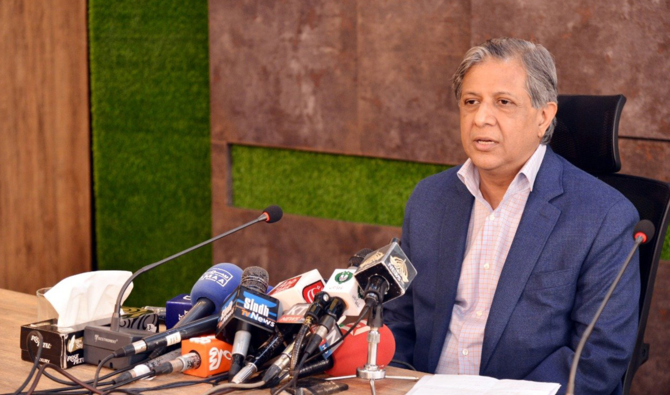
In this file photo Pakistan's Federal Minister for Law and Justice Senator Azam Nazeer Tarar addressing a Press Conference in Islamabad on September 29, 2022. (Photo courtesy: @MoLawJusticeof1/Twitter)
Short Url
Updated 14 June 2023
Follow

Trials under army laws meet international fair trial requirements — Pakistan law minister

  • Tarar cites Article 14 of International Covenant on Civil and Political Rights 1966 on fair trial
  • Government and military have come under criticism for pushing for military court trials of rioters

ISLAMABAD: Law Minister Azam Nazeer Tarar said on Wednesday trials under army laws met “internationally acknowledged minimum requirements” of a fair trial, as the Pakistani government and military face widespread criticism for pushing for military court trials of suspects who participated in riots last month. 

In recent weeks, local and international human rights bodies have expressed alarm over the government and army’s plan to bring former Prime Minister Imran Khan's supporters, who clashed with police and attacked military properties last month, to trial under military rules. Military trials in Pakistan are usually held behind closed doors, depriving civilians of some of their basic rights, including contracting a lawyer of their choice.

A wave of violence engulfed Pakistan’s capital and other cities following the dramatic arrest of Khan from a courtroom in Islamabad on May 9. Angry Khan supporters torched buildings and vehicles and attacked police and military personnel and facilities.

Speaking to the media on Wednesday, Tarar cited Article 14 of the International Covenant on Civil and Political Rights 1966 on fair trials, which he said gave the right to appoint a counsel of choice, reduce defence evidence, have access to the relevant record and seek a judicial review.

The law minister said army laws in Pakistan “covered all these [aspects] and that is why it is said that they meet the internationally acknowledged minimum requirements pertaining to the procedure and law.”

Khan’s Pakistan Tehreek-e-Insaf party has approached the Supreme Court against the state’s decision to prosecute civilians under the Army Act. 

So far, a Lahore anti-terrorism court has sanctioned the handing over of 16 May 9 suspects to the military and a Rawalpindi court has approved the handing over of another eight suspects. Interior Minister Rana Sanaullah has separately said 33 suspects — 19 in Punjab and 14 in Khyber Pakhtunkhwa provinces — had been handed over to the military following the May 9 attacks on army installations.

Military courts operate under a separate system from the civilian legal system and are run by military officers. The judges are also military personnel and cases are tried at military installations. Trials are closed to outsiders, and no media presence is allowed.


Imran Khan not a ‘national security threat,’ ex-PM’s party responds to Pakistan military

Updated 06 December 2025
Follow

Imran Khan not a ‘national security threat,’ ex-PM’s party responds to Pakistan military

  • Pakistan’s military spokesperson on Friday described Khan’s anti-army narrative as a “national security threat”
  • PTI Chairman Gohar Ali Khan says words used by military spokesperson for Khan were “not appropriate”

ISLAMABAD: Former prime minister Imran Khan’s Pakistan Tehreek-e-Insaf (PTI) party on Saturday responded to allegations by Pakistan military spokesperson Lt. Gen. Ahmed Sharif Chaudhry from a day earlier, saying that he was not a “national security threat.”

Chaudhry, who heads the military’s media wing as director general of the Inter-Services Public Relations (ISPR), spoke to journalists on Friday, in which he referred to Khan as a “mentally ill” person several times during the press interaction. Chaudhry described Khan’s anti-army narrative as a “national security threat.”

The military spokesperson was responding to Khan’s social media post this week in which he accused Chief of Defense Forces Field Marshal Asim Munir of being responsible for “the complete collapse of the constitution and rule of law in Pakistan.” 

“The people of Pakistan stand with Imran Khan, they stand with PTI,” the party’s secretary-general, Salman Akram Raja, told reporters during a news conference. 

“Imran Khan is not a national security threat. Imran Khan has kept the people of this country united.”

Raja said there were several narratives in the country, including those that created tensions along ethnic and sectarian lines, but Khan had rejected all of them and stood with one that the people of Pakistan supported. 

PTI Chairman Gohar Ali Khan, flanked by Raja, criticized the military spokesperson as well, saying his press talk on Thursday had “severely disappointed” him. 

“The words that were used [by the military spokesperson] were not appropriate,” Gohar said. “Those words were wrong.”

NATURAL OUTCOME’

Speaking to reporters earlier on Saturday, Pakistan’s Defense Minister Khawaja Asif defended the military spokesperson’s remarks against Khan.

“When this kind of language is used for individuals as well as for institutions, then a reaction is a natural outcome,” he said. 

“The same thing is happening on the Twitter accounts being run in his [Khan’s] name. If the DG ISPR has given any reaction to it, then I believe it was a very measured reaction.”

Khan, who was ousted after a parliamentary vote of confidence in April 2022, blames the country’s powerful military for removing him from power by colluding with his political opponents. Both deny the allegations. 

The former prime minister, who has been in prison since August 2023 on a slew of charges he says are politically motivated, also alleges his party was denied victory by the army and his political rivals in the 2024 general election through rigging. 

The army and the government both deny his allegations.